Anthropic's Head of Growth: "70% of what I spend my time on is what we internally refer to as 'success disasters.' Where things have gone so well that other things are breaking.
Anthropic's Head of Growth: "70% of what I spend my time on is what we internally refer to as 'success disasters.' Where things have gone so well that other things are breaking. It's funny, because all the charts are green and fully up and to the right, but it can be quite tough
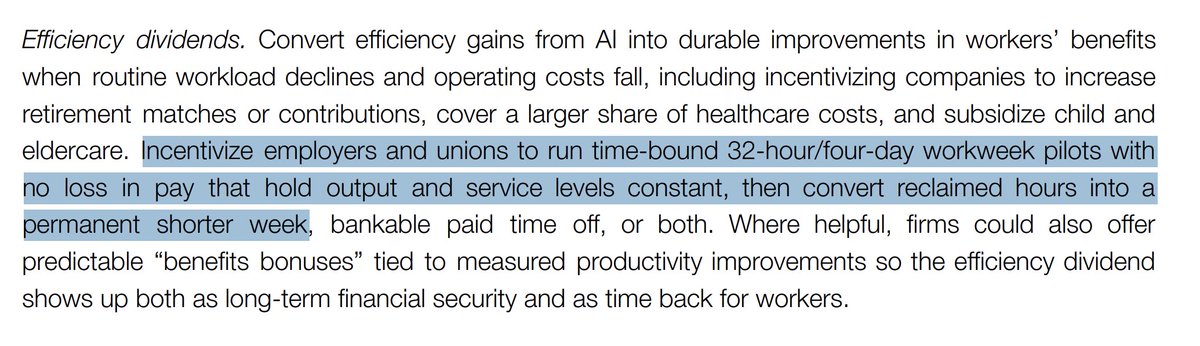
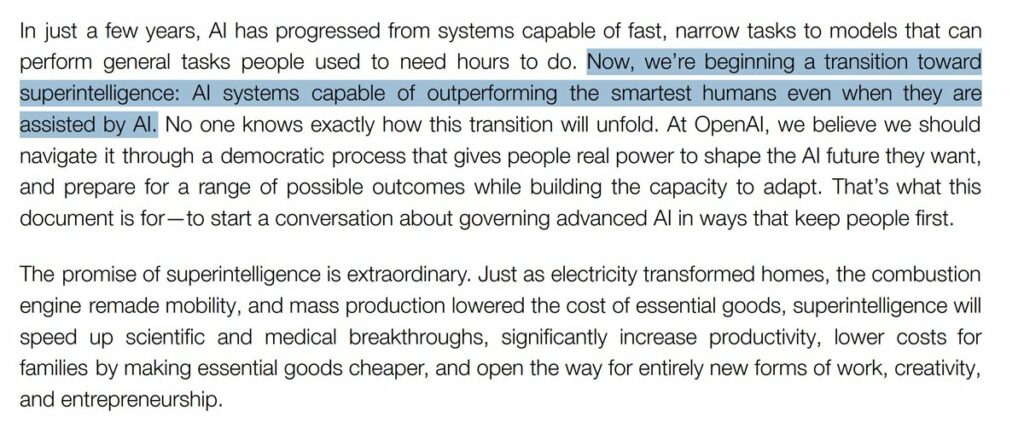
So maybe OpenAI *really* figured out superintelligence. In a way, Anthropic did, right? nitter.net/kimmonismus/status/204… Chubby♨️ (@kimmonismus) Looks like OpenAI reached Superintelligence. OpenAI: "Now, we’re beginning a transition toward superintelligence: AI systems capable of outperforming the smartest humans even when they are assisted by AI." OpenAI just published a 13-page policy blueprint for the "Intelligence Age"- proposing a Public Wealth Fund, 32-hour workweek pilots, portable benefits, a formal "Right to AI," and tax reforms to offset shrinking payroll revenue as automation scales. The document frames superintelligence not as a distant scenario *but an active transition requiring New Deal-level ambition*: new safety nets, containment playbooks for dangerous models, and international coordination modeled on aviation safety institutions. Here are OpenAI's suggestions (tl;dr): Open Economy: -Give workers a formal voice in AI deployment decisions -Microgrants and "startup-in-a-box" for AI-native entrepreneurs -Treat AI access as basic infrastructure (like electricity) -Shift tax base from payroll toward capital gains and corporate income -Public Wealth Fund — every citizen gets a stake in AI growth -Fast-track energy grid expansion via public-private partnerships -32-hour workweek pilots, better benefits from productivity gains -Auto-scaling safety nets triggered by displacement metrics -Portable benefits untied from employers -Invest in care economy as a transition path for displaced workers -Distributed AI-enabled labs to accelerate scientific discovery Resilient Society: -Safety tools for cyber, bio, and large-scale risks -AI trust stack — provenance, verification, audit logs -Competitive auditing market for frontier models -Containment playbooks for dangerous released models -Frontier AI companies adopt Public Benefit Corporation structures -Codified rules and auditing for government AI use -Democratic public input on AI alignment standards -Mandatory incident and near-miss reporting -International AI safety network for joint evaluations and crisis coordination Notably, OpenAI calls for stricter controls only on a narrow set of frontier models while keeping the broader ecosystem open, a clear attempt to position regulation as targeted, not industry-wide. They're backing it with up to $100K in fellowships and $1M in API credits for policy research, plus a new DC workshop opening in May. — https://nitter.net/kimmonismus/status/2041130939175284910#m
Compute Wars chart updated with the latest Anthropic/Google deal – it gets Anthropic much closer to the publicly known OpenAI capacity 2027 onwards – previously there was a big gap with OpenAI being significantly ahead, now OpenAI is only slightly ahead.
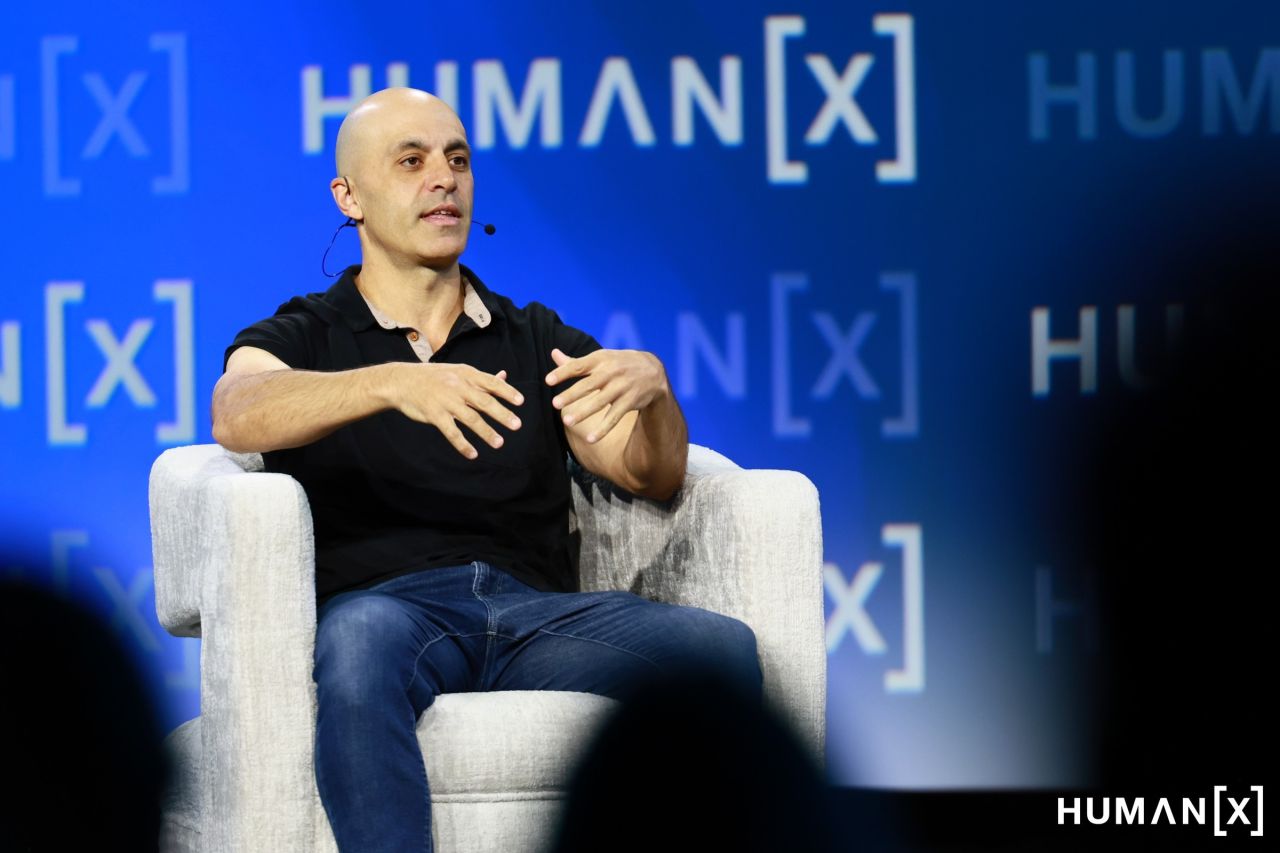
Databricks co-founder and CEO @alighodsi joined CNBC anchor @dee_bosa on stage at HumanX today to talk about the race toward super intelligence, where enterprises should be focused instead, and what AI needs to be reliable at scale. "There is a lot of talk about super
AI-RAN is a shift in where AI happens. Instead of sending data back to distant data centers, intelligence runs closer to where data is created, inside the network itself. That changes speed, efficiency, and what’s possible. ➡️ linkedin.com/pulse/how-netwo… #MWC26 @SoftBank @SoftBank_RandD @ericsson
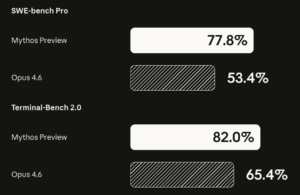
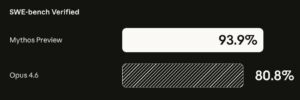
Y FUAH! Independientemente de lo costoso del modelo y tal, esta es una evidencia clara de que esto no para, y sobre todo en programación. Habiendo asumido un ritmo rápido pero progresivo con cada nuevo modelo, sorprende ver un salto tan bestia de golpe. Curvas vienen
This is beyond insanity. That jump is nuts. Opus 4.6 was released a few months ago. Look at that jump!! I am shocked Alex Albert (@alexalbert__) We released Claude Opus 4.6 just two months ago. Today we're sharing some info on our new model, Claude Mythos Preview. — https://nitter.net/alexalbert__/status/2041579938537775160#m
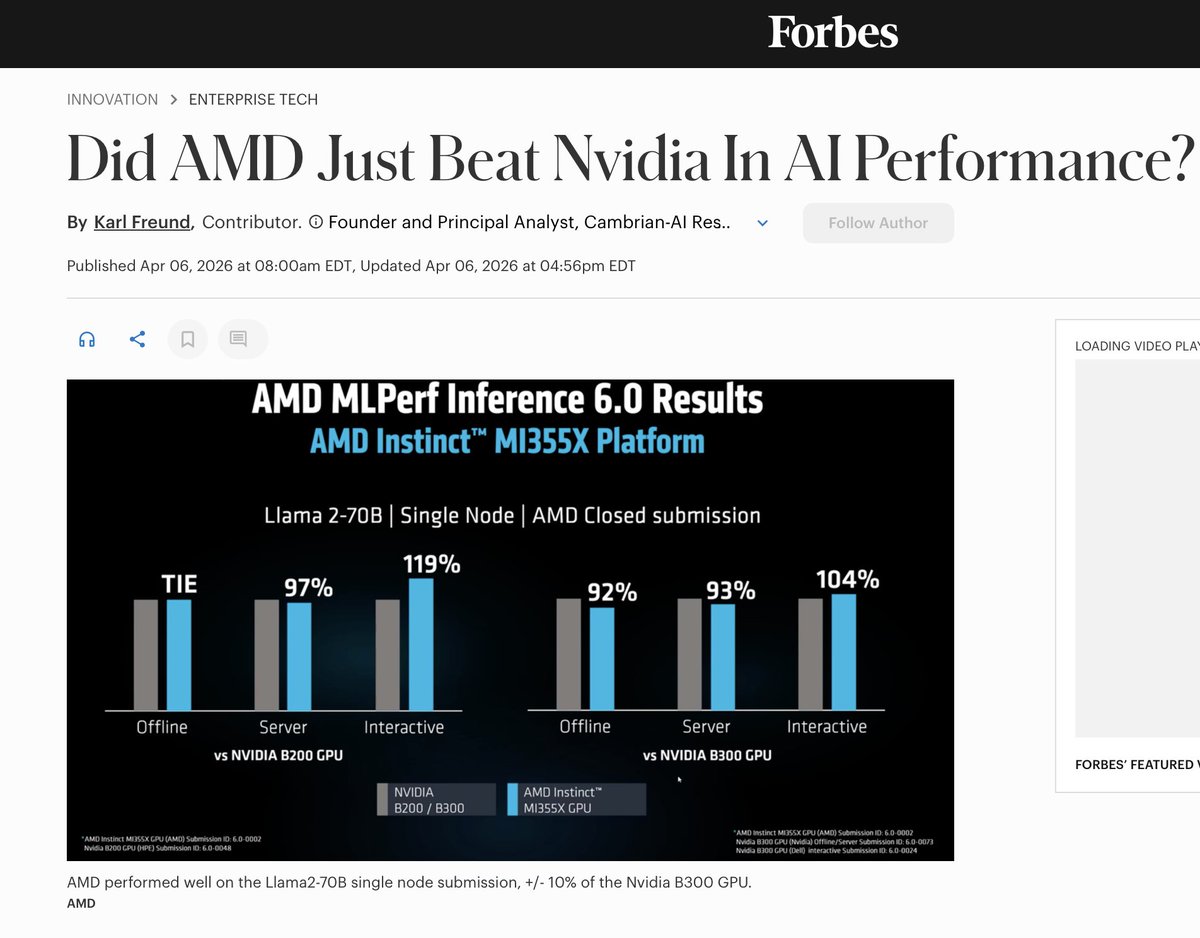
Did AMD Just Beat NVIDIA In AI Performance? No. And the article itself says so. I really don't like clickbaity headlines. They even state it at the very end, though the title suggest a bit otherwise: "NVIDIA ran every newly added benchmark and won every one of them. Only two of these were attempted by AMD, and for which Nvidia out-performed them by ~30 and ~50%. So, no, AMD did not beat Nvidia." MLPerf 6.0 results are out and the actual data tells a clear story: -NVIDIA won every new benchmark it entered -GB300 NVL72 delivered nearly 3x more throughput than 6 months ago, same hardware, better software -2.5M tokens/sec on DeepSeek R1 with 288 B300s AMD made real progress with the MI355X; getting within 10-30% on select single-node tests is no joke. And they deserve credits for that. But they skipped most new benchmarks and didn't compete on the hardest models. Imho / take: The real story isn't GPU vs GPU anymore. It's full-stack AI infrastructure: networking, software optimization, disaggregated serving. And tbh that's where NVIDIA keeps pulling ahead.