Ah yes 226 on 16.4 million tourists, what a tragedy We really have to get down to the bottom of this digital nomad crime problem! /s
MACHINE LEARNING
-
Auto-Research for Data: The Underrated ML Game Changer
By
–
Auto-research for ML training models is all the rage now, but underrated is: auto-research for data! Sure, you can squeeze out a bit of model performance by optimizing hyperparameters, but code agents can do data work that has been very labour intensive and required a lot of attention to a lot details effortlessly: > download data from many different data sources > bring all the data sources into uniform format > do detailed EDA: find patterns and outliers > look at 100s of samples and take detailed notes > make beautiful infographics rather than mpl plots > iterate on data filtering by looking at more samples > make a simple pipelines robust and scalable It's now possible to write data pipelines for dozens of data sources in hours that would have taken weeks of reading many docs, debugging APIs and data formats, wrangling outliers and missing data. A few weeks ago we gave Claude access to the CPU partition of our cluster and it iteratively refined filters to retrieve a domain subset of FineWeb. This would have taken me 2-3 days to work through while it took Claude just a few hours with almost no babysitting and with a nice logbook. Thus the long tail of small, niche data sources becomes more accessible and can be aggregated to even larger high quality datasets for cool applications. Data has been fuelling LLM progress more than model architecture innovations, so I am very excited about this!
→ View original post on X — @thom_wolf, 2026-03-24 17:04 UTC
-
Why There Is No AlphaFold for Materials Science
By
–
Why There Is No "AlphaFold for Materials" https://
latent.space/p/materials Materials Science is a force for good everywhere in our lives, from your clothes to the computers you use. We catch up on AI for Materials Discovery with Prof. Heather Kulik of @KulikGroup
, one of the first -
SIMA 2: Next-Generation AI Agent for Virtual 3D Worlds
By
–
SIMA 2: Next-Gen #AIAgent Built to Navigate Virtual #3D Worlds
— Ronald van Loon (@Ronald_vanLoon) 24 mars 2026
by @GoogleDeepMind#ArtificialIntelligence #MachineLearning #ML #Technology pic.twitter.com/1A6bMutPbWSIMA 2: Next-Gen #AIAgent Built to Navigate Virtual #3D Worlds
by @GoogleDeepMind #ArtificialIntelligence #MachineLearning #ML #Technology -
Optimal Intellect Introduces Moreau GPU-Native Solver
By
–
We're Optimal Intellect, a research lab from the team behind CVXPY. Today we're introducing Moreau: a GPU-native solver that's orders of magnitude faster than the best existing tools.
→ View original post on X — @soumithchintala, 2026-03-24 16:48 UTC
-

Thought Communication in Multiagent AI Collaboration Systems
By
–
Thought Communication in Multiagent Collaboration https://
buff.ly/VTgDmxo
#AI #MachineLearning #DeepLearning #LLMs #DataScience -
Shenzhen Confirmed as Global Robotics and AI Innovation Center
By
–
This Video Proves It: Shenzhen Is the World’s Robotics Hub
— Ronald van Loon (@Ronald_vanLoon) 24 mars 2026
by @Robo_Tuo
#Robotics #MachineLearning #ArtificialIntelligence #Innovation #Technology pic.twitter.com/eVaMjLTHMVThis Proves It: Shenzhen Is the World’s Robotics Hub
by @Robo_Tuo #Robotics #MachineLearning #ArtificialIntelligence #Innovation #Technology -
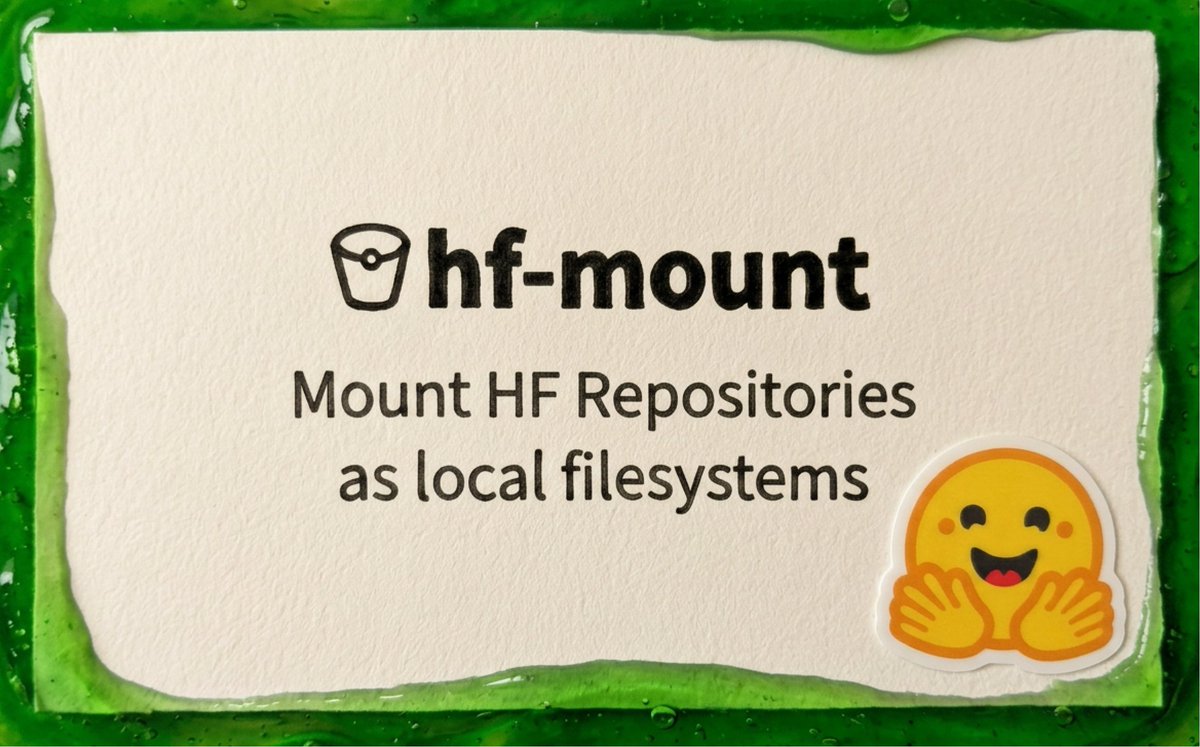
hf-mount: Mount Hugging Face datasets and models as local filesystems
By
–
Now available on Hugging Face: hf-mount 🧑🚀 The team really cooked, still wrapping my head everything possible but you can do things like: – mount a 5TB dataset as a local folder and query only the parts you need with DuckDB (✅ works) – browse any model repo with ls/cat like it's a USB drive – use a shared read-write bucket as a team drive for ML artifacts – drop the init container that downloads models in your k8s pods – point llama.cpp at a mounted GGUF and run inference (infinite storage??)
→ View original post on X — @thom_wolf, 2026-03-24 16:13 UTC
-
Causality Framework for Interpretability Methods in Foundation Models
By
–
We have a position paper led by the awesome @_shruti_joshi_ and @rpatrik96 that shows how causality can provide a unifying framework to formalize, estimate and evaluate interpretability methods for foundation models. Have a look! https://t.co/pcnI4XzHUk
— Dhanya Sridhar (@dhanya_sridhar) 24 mars 2026We have a position paper led by the awesome @_shruti_joshi_ and @rpatrik96 that shows how causality can provide a unifying framework to formalize, estimate and evaluate interpretability methods for foundation models. Have a look! Shruti Joshi (@_shruti_joshi_) Mechanistic interpretability aims to understand models — and the more superhuman or incoherent they become, the more we need that understanding to be reliable. We propose a framework for this, drawing on established tools from causal reasoning and statistical identifiability: 🧵 — https://nitter.net/_shruti_joshi_/status/2035025756632302039#m
→ View original post on X — @hugo_larochelle, 2026-03-24 16:12 UTC
-
Interactive Tool Visualizes Arena Physica Generator and Evaluator Loop
By
–
We made some fun interactive things to help grok what @arenaphysica is doing, like this one that shows how their generator and evaluator models loop to alien designs that work. https://t.co/OcfICGDSQ4 pic.twitter.com/sy8obQ6f4U
— Packy McCormick (@packyM) 24 mars 2026We made some fun interactive things to help grok what @arenaphysica is doing, like this one that shows how their generator and evaluator models loop to alien designs that work.