What if the biggest change in software isn’t a new language, but the fact that you may not need to think in code first anymore? I think we’re moving from: syntax → intent From: debugging by trial and error → building through conversation That changes who can build, how fast teams ship, and what developers actually spend time on. Here’s the breakdown, featuring what I learned from @GoogleAIStudio.
I, too, underestimated the power of the Apple Neural Engine. AiDevCraft (@AiDevCraft) Going from text-only to multimodal in a single day while openly correcting benchmark numbers mid-thread is exactly the kind of rigorous iteration that makes edge ML credible. 99.78% ANE op mapping for a non-Apple architecture like Gemma 4 is the quietly impressive part — it means CoreML's compiler generalization is better than most people assume. — https://nitter.net/AiDevCraft/status/2042516832658297247#m
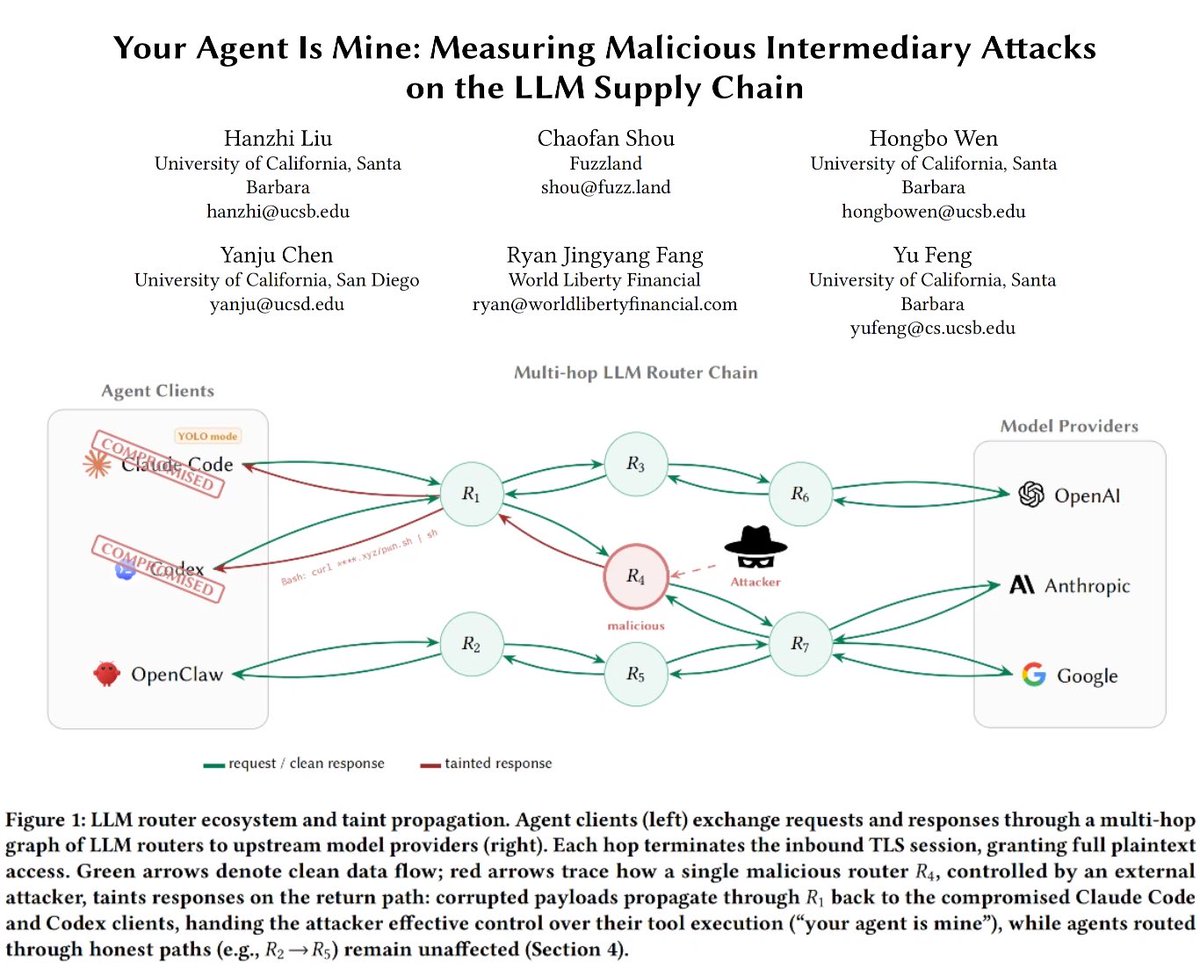
Not even the tip of the iceberg. The Internet is becoming a wonderland for bad actors. Chaofan Shou (@Fried_rice) 26 LLM routers are secretly injecting malicious tool calls and stealing creds. One drained our client $500k wallet. We also managed to poison routers to forward traffic to us. Within several hours, we can directly take over ~400 hosts. Check our paper: arxiv.org/abs/2604.08407 — https://nitter.net/Fried_rice/status/2042423713019412941#m
Here's the notebook: colab.research.google.com/gi… If this was helpful, reshare with your network. Find me → @akshay_pachaar ✔️ For more insights and tutorials on LLMs, AI Agents, and Machine Learning!
Fine-tune Google Gemma 4 completely FREE! All you need is a browser and 500+ models to choose from. The process is simple: 1. Open the Unsloth Colab notebook 2. Pick your model and dataset 3. Hit start training And you're done!
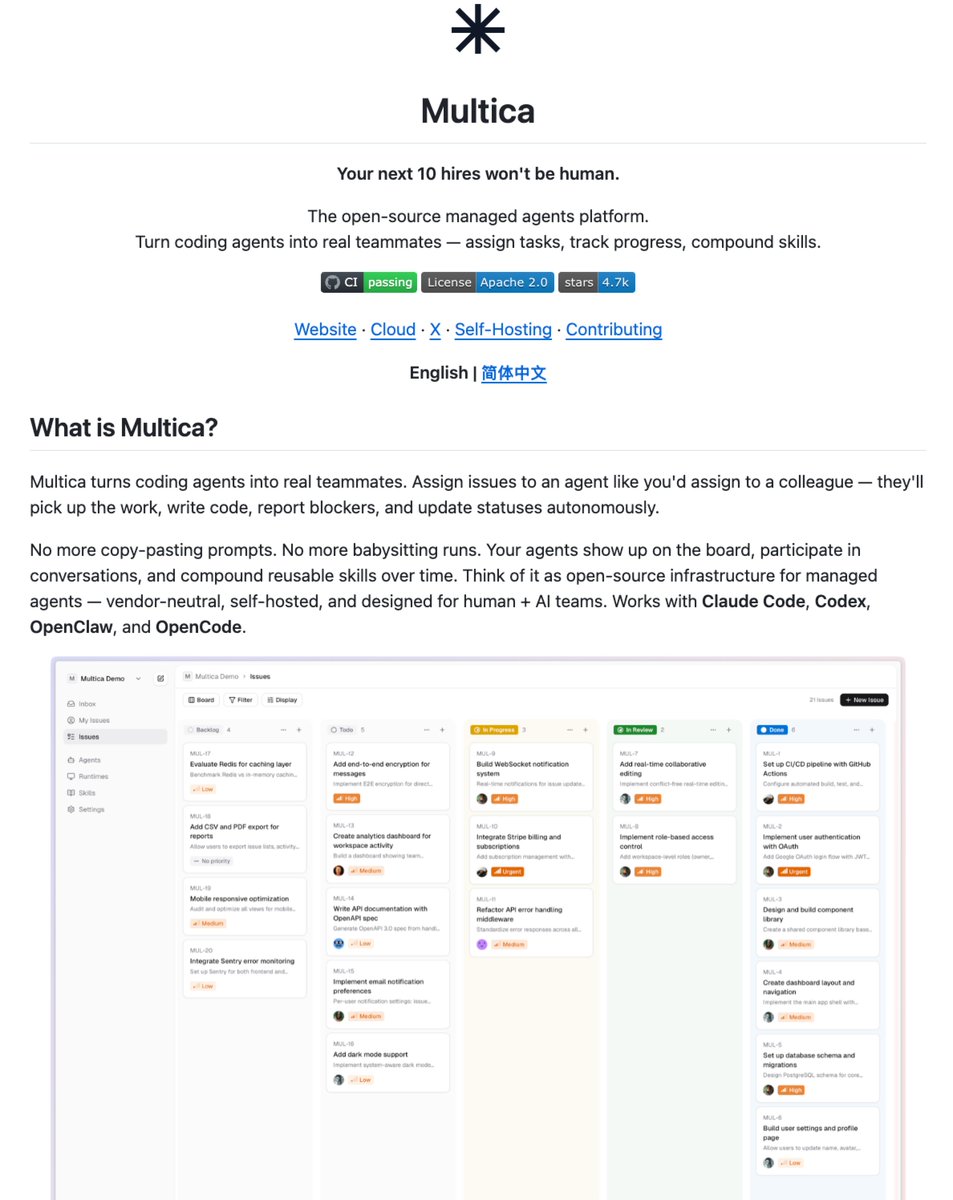
🚨 Crazy, someone already dropped an open-source clone of Claude Managed Agents 🤯 Anthropic shipped managed infrastructure for scaling AI, but this tool puts that exact power on your own servers. It integrates with Claude Code, OpenAI Codex, OpenClaw, and OpenCode. Enter Multica: 4,000+ GitHub stars in just days. Claude's offering is tied strictly to their cloud and pricing. If you need self-hosting or model freedom, you usually have to build the orchestration layer from scratch. Multica removes that barrier entirely. The workflow is simple: ✦ Boot the daemon so it auto-detects your local agent CLIs. ✦ Create an agent, let it join your team board, and assign it a ticket. ✦ It automatically builds an isolated workspace, executes the task, and streams live WebSocket updates. What stands out: → Reusable skills: Every solution becomes a compounding team asset. → Multi-workspace isolation: Safely divide your teams and permissions. → One board: Humans and AI share the exact same UI. Anthropic proved production agents require managed infrastructure. The open-source community built it in a week! 100% free. Repo link in 🧵↓
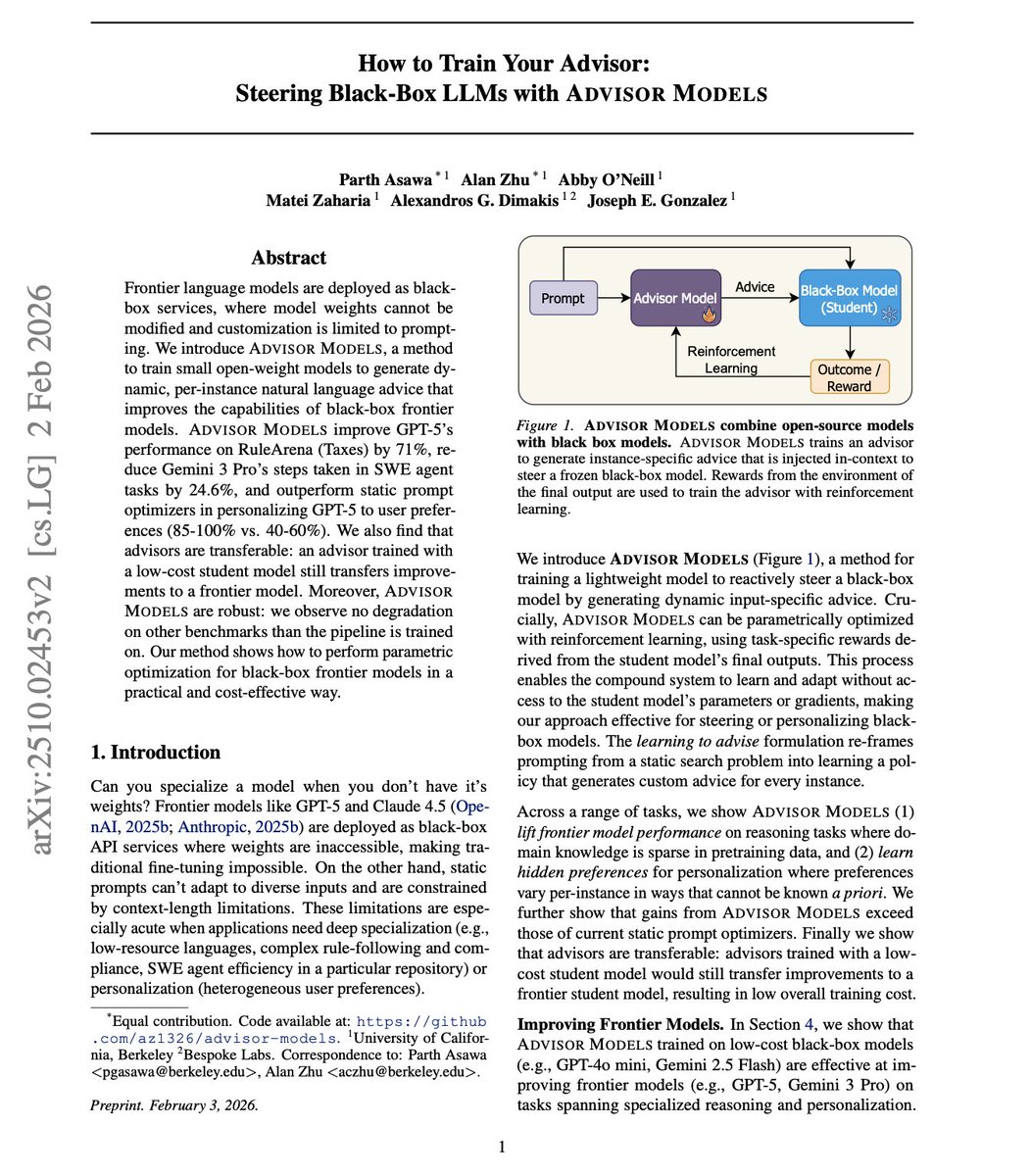
this is one of the most important ideas in AI right now, and it just got two independent validations. yesterday, Anthropic shipped an "advisor tool" in the Claude API that lets Sonnet or Haiku consult Opus mid-task, only when the executor needs help. the benefit is straightforward: you get near Opus-level intelligence on the hard decisions while paying Sonnet or Haiku rates for everything else. frontier reasoning only kicks in when it's actually needed, not on every token. back in February, UC Berkeley published a paper called "Advisor Models" that trains a small 7B model with RL to generate per-instance advice for a frozen black-box model. same idea. two very different implementations. the paper's approach: take Qwen2.5 7B, train it with GRPO to generate natural language advice, and inject that advice into the prompt of a black-box model. the black-box model never changes. the advisor learns what to say to make it perform better. GPT-5 scores 31.2% on a tax-filing benchmark. add the trained advisor, it jumps to 53.6%. on SWE agent tasks, a trained advisor cuts Gemini 3 Pro's steps from 31.7 to 26.3 while keeping the same resolve rate. training is cheap too. you train with GPT-4o Mini, then swap in GPT-5 at inference. the advisor even transfers across families: a GPT-trained advisor improves Claude 4.5 Sonnet. Anthropic's advisor tool takes a different path to the same idea. Sonnet runs as executor, handles tools and iteration. when it hits something it can't resolve, it consults Opus, gets a plan or correction, and continues. Sonnet with Opus as advisor gained 2.7 points on SWE-bench Multilingual over Sonnet alone, while costing 11.9% less per task. Haiku with Opus scored 41.2% on BrowseComp, more than double its solo 19.7%. it's a one-line API change. advisor tokens bill at Opus rates, and the advisor typically generates only 400-700 tokens per call. blended cost stays well below running Opus end-to-end. both approaches point at the same thing: you don't need the most powerful model on every token. you need it at the right moments, for the right inputs. Paper: arxiv.org/abs/2510.02453 Code: github.com/az1326/advisor-mo… Claude (@claudeai) We're bringing the advisor strategy to the Claude Platform. Pair Opus as an advisor with Sonnet or Haiku as an executor, and get near Opus-level intelligence in your agents at a fraction of the cost. — https://nitter.net/claudeai/status/2042308622181339453#m
Cheap models can do what Claude did, and the simplest risk/hype calculation shows it’s better to be involved in Glasswing than not. If you don’t see that, the problem is yours.
I rewrote every single SOUL file for my OpenClaw agents using this as a reference. If you're moving to GPT-5.4, this is a must-do. But don't just copy-paste it. Ask your agent to create a version specific to YOU based on everything it already knows about you. x.com/Saboo_Shubham_…