AI Dynamics

Global AI News Aggregator

About

JOBS

  • AGI Alpha Launch: Intelligence Automation Machine Coming Online
    AGI Alpha Launch: Intelligence Automation Machine Coming Online

    🚀 [ 🎖️ “We Choose to Ascend with AGI” 🌌✨ ] 🌕 At the substrate, an invention-automation machine is coming online—where intelligence compounds. Powered by $AGIALPHA CA: tWKHzXd5PRmxTF5cMfJkm2Ua3TcjwNNoSRUqx6Apump 🌐 github.com/MontrealAI/ #AGIALPHA #AGIJobs #ASIFirst

    → View original post on X — @montreal_ai, 2026-04-06 16:50 UTC

  • Autonomy and Scale: Vincent Boucher on AGI Alpha and AI Agents
    Autonomy and Scale: Vincent Boucher on AGI Alpha and AI Agents

    "Autonomy & Scale" Vincent Boucher, President of @Montreal_AI and @Quebec_AI: linkedin.com/pulse/autonomy-… #AGIALPHA #AIAgents #Jobs

    → View original post on X — @montreal_ai, 2026-04-06 16:07 UTC

  • Autonomy and Scale: Vincent Boucher on AI Agents and Future Jobs
    Autonomy and Scale: Vincent Boucher on AI Agents and Future Jobs

    "Autonomy & Scale" Vincent Boucher, President of @Montreal_AI and @Quebec_AI : linkedin.com/pulse/autonomy-… #AGIALPHA #AIAgents #Jobs

    → View original post on X — @ceobillionaire, 2026-04-06 16:03 UTC

  • Sam Altman Proposes Six-Point AI Policy Blueprint for Superintelligence Era
    Sam Altman Proposes Six-Point AI Policy Blueprint for Superintelligence Era

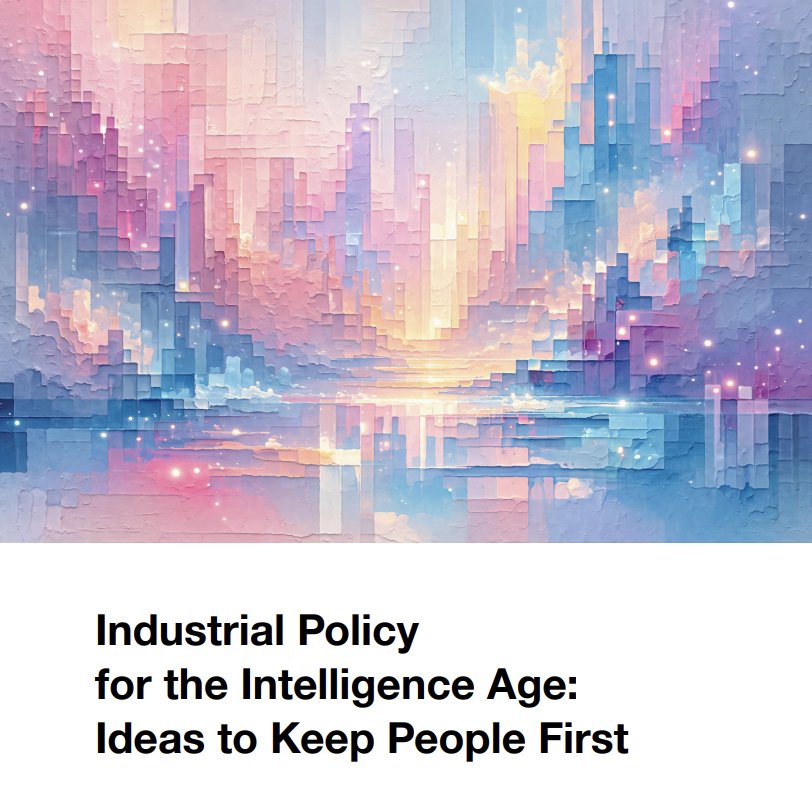
    Sam Altman just published a 13-page policy blueprint called "Industrial Policy for the Intelligence Age: Ideas to keep people first." The premise: AI superintelligence is so close that America needs a new social contract. The six proposals: > A Public Wealth Fund where every

    → View original post on X — @therundownai

  • SMBs Using AI to Fill Expertise Gaps – Forbes
    SMBs Using AI to Fill Expertise Gaps – Forbes

    How SMBs can use AI to fill gaps in expertise… By Brian Chess via @ForbesTechCncl & Oracle NetSuite… forbes.com/councils/forbeste… @BetaMoroney @Nicochan33 @enilev @mvollmer1 @mikeflache @antgrasso @FrRonconi @ramonvidall @baski_LA @AkwyZ @Khulood_Almani @sijlalhussain @PawlowskiMario @pierrepinna @sonu_monika @efipm @mvollmer1 @sallyeaves @NevilleGaunt @Corix_JC @enricomolinari @Shi4Tech @wcrpaul @RagusoSergio @RLDI_Lamy @NigelTozer @EstelaMandela @JagersbergKnut @DrFerdowsi @PerBBerggreen @sir4K_zen @AmitChampaneri1 @FmFrancoise @MasterofIoT @dcallahan2 @globaliqx @HLStockenstrom @TheAdityaPatro @ILoveBooks786 @Hana_ElSayyed @CurieuxExplorer @HaroldSinnott @MikeNashTech @SegundoConnect @pchamard @trudydarwin

    → View original post on X — @nicochan33, 2026-04-06 15:51 UTC

  • Stop the AI hype: Just give us models, not societal surgery

    Please please please. I'm on my knees begging every AI exec on the planet. Just stop with this stuff. Stop. Just give us models. Let the collective distributed intelligence of people figure things out in real time like we always do. Let people adapt. It's what we do. It's all just so tiresome. We just want models. We'll figure it out. We promise. We don't need societal level surgery and UBI and robot taxes and ham-fisted legislation and populists politicians passing dumb law after dumb law and lobbying groups and all this craziness. We are not giving birth to magic super miracle machines that suddenly invalidate every single pattern of the entirety of human history and technological development. We're not. Really. AI is amazing. It's wonderful. But it's not magic. Can we please just let AI be cool and useful and problematic in realistic ways instead of all this crazy talk? We are hallucinating at a collective scale. It's a madness really. A societal meme level madness. Just give us a products please and leave all the politics in the garage. Stop proposing societal level surgery with drastic measures for things that have not happened and may not happen and probably won't happen. Just stop. Mike Allen (@mikeallen) 🚨🚨@sama tells me he feels such URGENCY about the power of coming AI models that @OpenAI is unveiling a New Deal for superintelligence – ideas to wake up DC He says AI will soon be so mindbending that we need a new social contract 👇Altman's top 6 ideas axios.com/2026/04/06/behind-… — https://nitter.net/mikeallen/status/2041099089031356468#m

    → View original post on X — @ylecun, 2026-04-06 15:07 UTC

  • OpenAI Superintelligence: New Policy Blueprint for Intelligence Age
    OpenAI Superintelligence: New Policy Blueprint for Intelligence Age

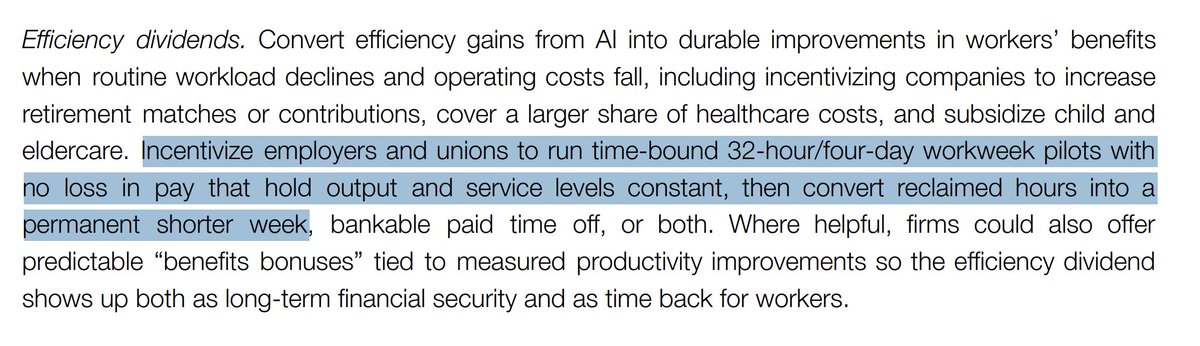
    OpenAI is preparing ready to launch their new and next generation of models. They are about to revolutionizing science & economy. "A very significant step forward" compared to their current models. Imho this is preparing people for the launch, very very soon, maybe even this week. Chubby♨️ (@kimmonismus) Looks like OpenAI reached Superintelligence. OpenAI: "Now, we’re beginning a transition toward superintelligence: AI systems capable of outperforming the smartest humans even when they are assisted by AI." OpenAI just published a 13-page policy blueprint for the "Intelligence Age"- proposing a Public Wealth Fund, 32-hour workweek pilots, portable benefits, a formal "Right to AI," and tax reforms to offset shrinking payroll revenue as automation scales. The document frames superintelligence not as a distant scenario *but an active transition requiring New Deal-level ambition*: new safety nets, containment playbooks for dangerous models, and international coordination modeled on aviation safety institutions. Here are OpenAI's suggestions (tl;dr): Open Economy: -Give workers a formal voice in AI deployment decisions -Microgrants and "startup-in-a-box" for AI-native entrepreneurs -Treat AI access as basic infrastructure (like electricity) -Shift tax base from payroll toward capital gains and corporate income -Public Wealth Fund — every citizen gets a stake in AI growth -Fast-track energy grid expansion via public-private partnerships -32-hour workweek pilots, better benefits from productivity gains -Auto-scaling safety nets triggered by displacement metrics -Portable benefits untied from employers -Invest in care economy as a transition path for displaced workers -Distributed AI-enabled labs to accelerate scientific discovery Resilient Society: -Safety tools for cyber, bio, and large-scale risks -AI trust stack — provenance, verification, audit logs -Competitive auditing market for frontier models -Containment playbooks for dangerous released models -Frontier AI companies adopt Public Benefit Corporation structures -Codified rules and auditing for government AI use -Democratic public input on AI alignment standards -Mandatory incident and near-miss reporting -International AI safety network for joint evaluations and crisis coordination Notably, OpenAI calls for stricter controls only on a narrow set of frontier models while keeping the broader ecosystem open, a clear attempt to position regulation as targeted, not industry-wide. They're backing it with up to $100K in fellowships and $1M in API credits for policy research, plus a new DC workshop opening in May. — https://nitter.net/kimmonismus/status/2041130939175284910#m

    → View original post on X — @kimmonismus, 2026-04-06 15:03 UTC

  • Gary Marcus Criticizes Altman’s Finances and Confirms Cyberattack Risk
    Gary Marcus Criticizes Altman’s Finances and Confirms Cyberattack Risk

    1. The more Sam's finances don't add up, the hype he generates gets bigger. 2. But he's right that a massive cyberattack is likely imminent. (See my January 2025 @politico essay for why.) Chubby♨️ (@kimmonismus)
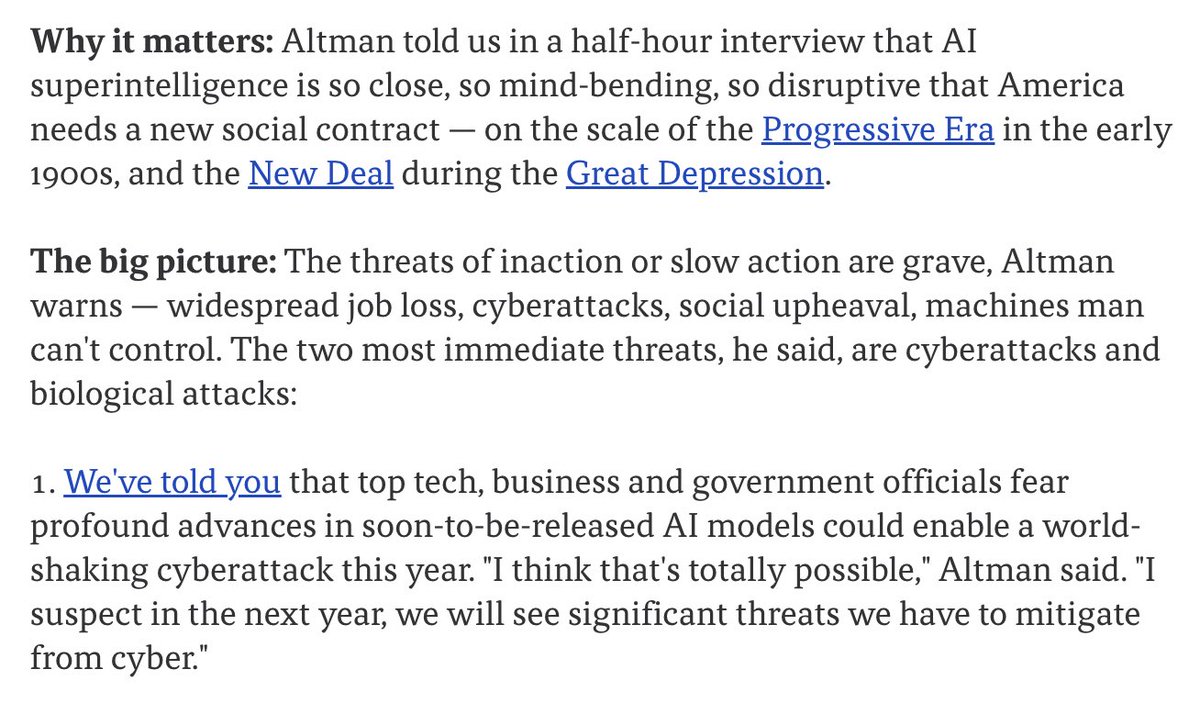
    Holy moly: Sam Altman told Axios in a half-hour interview that AI superintelligence is so close, so mind-bending, so disruptive that America needs a new social contract. – It's on the scale of the Progressive Era in the early 1900s, and the New Deal during the Great Depression. – Altman warns: widespread job loss, cyberattacks, social upheaval, machines man can't control – "Soon-to-be-released AI models could enable a world-shaking cyberattack this year. I think that's totally possible," Altman said. "I suspect in the next year, we will see significant threats we have to mitigate from cyber." [Translated from EN to English]

    → View original post on X — @garymarcus, 2026-04-06 14:57 UTC

  • Goldman Sachs: AI Impact on U.S. Employment Shows Net Negative Effect
    Goldman Sachs: AI Impact on U.S. Employment Shows Net Negative Effect

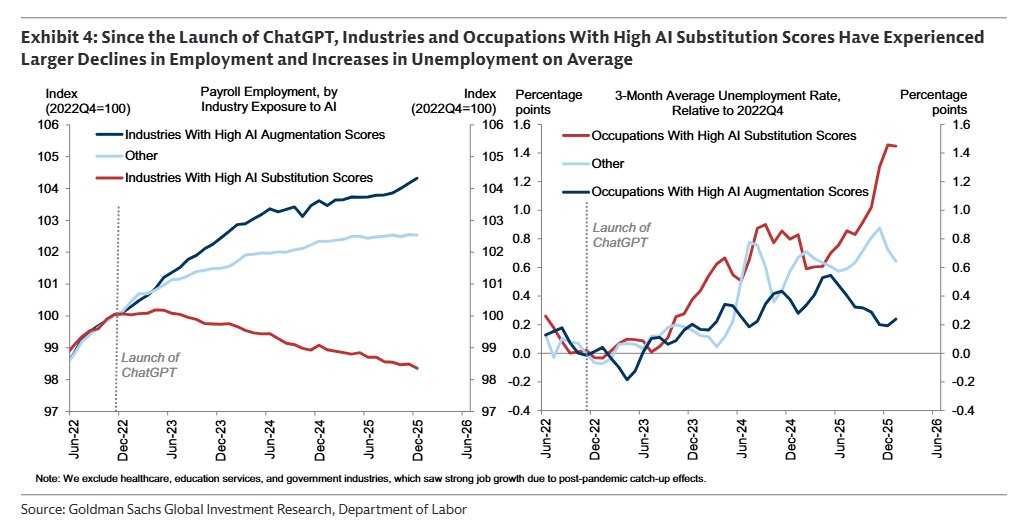
    Goldman tries to quantify the net effect of AI both substituting for and augmenting U.S. employment. Their conclusion: AI substitution in occupations like phone operations and insurance claims administration have reduced monthly payroll gains by around -25K and raised the unemployment rate by 0.16 pp over the past year. AI augmentation in occupations including medicine and education have added +9K to monthly payrolls and lowered the unemployment rate by 0.06 pp. This nets out to a slight -16K drag on payrolls and an increase in the unemployment rate by 0.1 pp. Caveat: This exercise doesn't account for the possible benefit from either construction hiring due to data-center buildout or AI-driven productivity/income gains.

    → View original post on X — @mfordfuture, 2026-04-06 14:57 UTC

  • How Anthropic’s Growth Team Leverages AI and Automation

    My biggest takeaways from @AnthropicAI's Head of Growth Amol Avasare: 1. Engineering is getting the most AI leverage—and it’s squeezing PMs and designers. With Claude Code, a five-engineer team now produces the output of 15 to 20 engineers. But PM and design productivity haven’t scaled proportionally. The result is a compressed ratio where one PM is effectively managing the output of a much larger engineering team. Anthropic's growth team is responding in two ways: hiring even more PMs (!), and formally deputizing product-minded engineers to act as mini-PMs for any project with less than two weeks of engineering time. 2. Anthropic is using Claude to automate its own growth. The internal initiative is called CASH (Claude Accelerates Sustainable Hypergrowth). It works across four stages: identifying opportunities, building features, testing quality, and analyzing results. Right now it handles copy changes and minor UI tweaks. The win rate is comparable to a junior PM with two to three years of experience, and improving rapidly. 3. The one part of PM work that AI can’t automate yet: getting six people in a room to agree. Amol and his head of design joke that even with AGI, it’ll still be impossible to align six stakeholders. Cross-functional coordination—managing opinions, navigating politics, mediating tradeoffs—remains the bottleneck that AI doesn’t touch for larger projects. This is why Amol believes PM roles aren’t going away, and may actually grow. 4. 60-80% of Anthropic’s growth team's projects have no PRD. For smaller work, kickoffs happen on Slack—messages back and forth with product-minded engineers who can push back and ask the right questions. For larger projects, Amol believes in a proper 30-minute cross-functional kickoff (legal, safeguards, stakeholders) to surface concerns early. 5. Adding friction to onboarding drives growth—if the friction helps users understand why the product is for them. His work Mercury, MasterClass, Calm, and now Anthropic, adding steps to onboarding flows consistently improved conversion. The key: cut annoying friction that doesn’t add value, but add friction that helps users understand why the product is for them. 6. AI companies need to focus on bigger bets, not better A/B tests. Amol’s argument: if your core product value is driven by AI, then the future value is orders of magnitude higher than today’s value, because model capabilities grow exponentially. In that world, micro-optimizations capture a shrinking share of a growing pie. Traditional growth teams do 60% to 70% small optimizations and 20% to 30% big swings. At Anthropic, they flip this ratio. 7. Amol built a weekly AI agent that scans Slack for cross-functional misalignment. Using Cowork with the Slack MCP, he has a scheduled task that looks across his projects and conversations and surfaces areas where teams are about to do overlapping work or pull in different directions. A colleague on the enterprise team already caught major misalignment that would have caused weeks of wasted effort. 8. A traumatic brain injury taught Amol the principle that now drives his work: freedom through constraints. In early 2022, a kick to the head during a Muay Thai sparring session caused a traumatic brain injury. Amol spent nine months off work and months relearning to walk, unable to look at screens or listen to music for more than 20 seconds. He was re-injured a month after joining Mercury and had to take two more months off. He’s still not fully healed. But the constraints—no alcohol, no caffeine, mandatory breaks, daily meditation—have become the habits that let him operate at the intensity Anthropic demands. “The true freedom in life is learning how to be content when you don’t get what you want.” Lenny Rachitsky (@lennysan) Anthropic is on an unprecedented growth run. Just in the past year they grew from $1B to $19B ARR. They added $6B in ARR just in *February*. Companies like Palantir and Atlassian took 15-20 years to reach ~$5B ARR. Anthropic is adding that every month. Amol Avasare is head of growth at Anthropic, and one of the most impressive people I've had on the podcast. In his first ever public interview, Amol shares: 🔸 How Anthropic is automating growth experiments with Claude (their internal tool called “CASH”) 🔸 Why activation is the single highest-leverage growth problem in AI 🔸 Why Amol is hiring more PMs, not less 🔸 How he uses Cowork to automatically detect team misalignment in Slack 🔸 How the company’s focus on AI coding created a research flywheel that accelerated their models 🔸 How Amol landed his role by cold emailing Anthropic’s CPO @mikeyk 🔸 The brain injury that nearly ended Amol's career Listen now 👇 piped.video/k-H4nsOTuxU — https://nitter.net/lennysan/status/2040827067126907113#m

    → View original post on X — @paulroetzer, 2026-04-06 14:48 UTC