Join the ARC Prize team — help us build ARC-AGI-4 and ARC-AGI-5 ARC Prize (@arcprize) Platform Engineer – Benchmark Lead ARC Prize Foundation is hiring a senior engineer to build our benchmark platform * Expand ARC-AGI-3 * Own ARC-AGI-4 * Lay the foundations for ARC-AGI-5 Come build the benchmark that defines progress toward AGI $7.5K referral bonus — https://nitter.net/arcprize/status/2041626929380626530#m
If building humanist AI with unlimited tokens sounds up your alley, we're hiring at MAI. All the benefits of startup speed + agility w/the resources of one of the world's leading tech companies. If you want to work with a small, brilliant, low-ego team – get in touch.
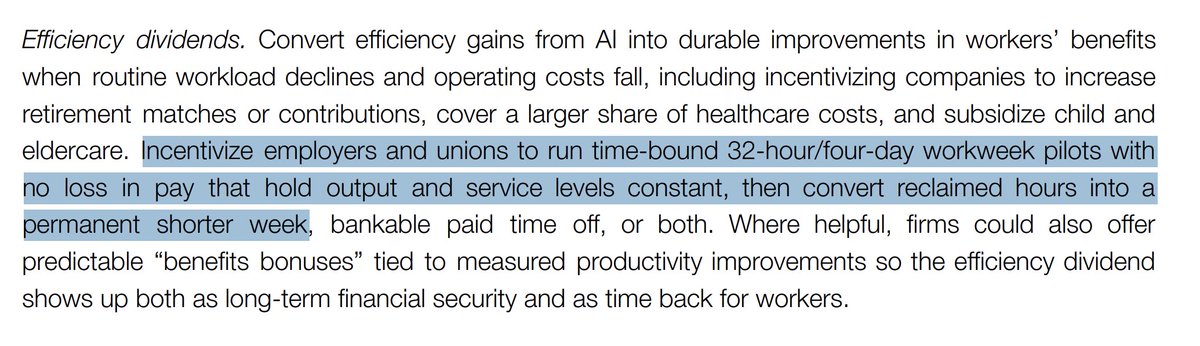
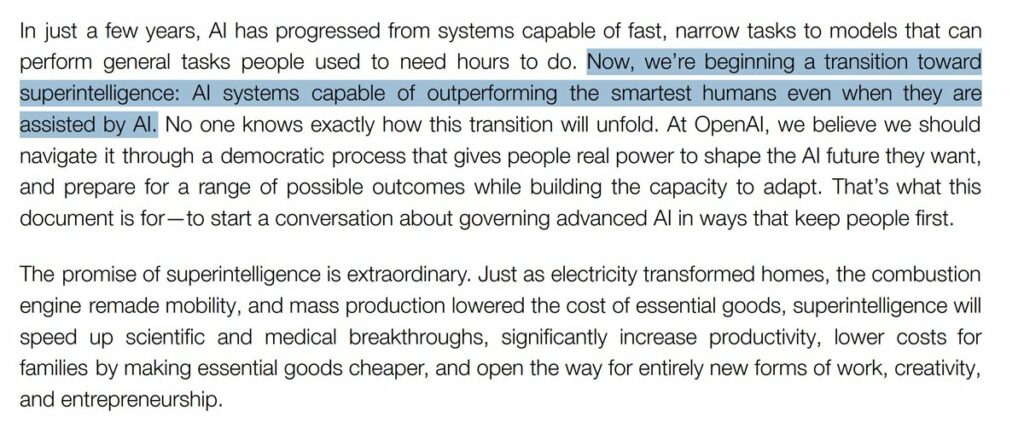
So maybe OpenAI *really* figured out superintelligence. In a way, Anthropic did, right? nitter.net/kimmonismus/status/204… Chubby♨️ (@kimmonismus) Looks like OpenAI reached Superintelligence. OpenAI: "Now, we’re beginning a transition toward superintelligence: AI systems capable of outperforming the smartest humans even when they are assisted by AI." OpenAI just published a 13-page policy blueprint for the "Intelligence Age"- proposing a Public Wealth Fund, 32-hour workweek pilots, portable benefits, a formal "Right to AI," and tax reforms to offset shrinking payroll revenue as automation scales. The document frames superintelligence not as a distant scenario *but an active transition requiring New Deal-level ambition*: new safety nets, containment playbooks for dangerous models, and international coordination modeled on aviation safety institutions. Here are OpenAI's suggestions (tl;dr): Open Economy: -Give workers a formal voice in AI deployment decisions -Microgrants and "startup-in-a-box" for AI-native entrepreneurs -Treat AI access as basic infrastructure (like electricity) -Shift tax base from payroll toward capital gains and corporate income -Public Wealth Fund — every citizen gets a stake in AI growth -Fast-track energy grid expansion via public-private partnerships -32-hour workweek pilots, better benefits from productivity gains -Auto-scaling safety nets triggered by displacement metrics -Portable benefits untied from employers -Invest in care economy as a transition path for displaced workers -Distributed AI-enabled labs to accelerate scientific discovery Resilient Society: -Safety tools for cyber, bio, and large-scale risks -AI trust stack — provenance, verification, audit logs -Competitive auditing market for frontier models -Containment playbooks for dangerous released models -Frontier AI companies adopt Public Benefit Corporation structures -Codified rules and auditing for government AI use -Democratic public input on AI alignment standards -Mandatory incident and near-miss reporting -International AI safety network for joint evaluations and crisis coordination Notably, OpenAI calls for stricter controls only on a narrow set of frontier models while keeping the broader ecosystem open, a clear attempt to position regulation as targeted, not industry-wide. They're backing it with up to $100K in fellowships and $1M in API credits for policy research, plus a new DC workshop opening in May. — https://nitter.net/kimmonismus/status/2041130939175284910#m
I stole this framework, and it has genuinely been one of the most helpful hiring and onboarding guides my team uses. Being AI-first means nothing without solving real business problems. It's not enough to just use AI. I know plenty of folks using AI dozens of times a day, 7 days a week, who are still working at a Level 2. Even worse, they have no idea they're stuck as a surface user. You have to use AI for faster experimentation. To shorten the iteration cycle. To improve the actual outcome. Without those three, you're just wasting tokens. Most people I interview are at a 3 (solution-oriented, but not action-oriented). I want everyone to start at a 4 (action-oriented with a sense of technical, user, and business tradeoffs). And when they earn trust, we move up to a level 5 (full ownership of the problem, solution, and continued management of the work). Using AI doesn't replace your critical thinking. It means the work you can pull off now wasn't on the table a year ago, and your job is getting bigger. Save this for your next new hire. Source: this was a framework first introduced to me by Alex (@businessbarista) who was introduced to it by Steph (@stephsmithio). I added the AI parts.
Don't Be the Best Interviewee. Be the Best Marketer.
Most people prep for AI job interviews by practicing answers. That's sales — and by then, there's very little leverage left. The real game is marketing: your GitHub repos, your README files, your project results. If your… pic.twitter.com/gUxRRExpXd
Don't Be the Best Interviewee. Be the Best Marketer. Most people prep for AI job interviews by practicing answers. That's sales — and by then, there's very little leverage left. The real game is marketing: your GitHub repos, your README files, your project results. If your marketing is strong, you can do a mediocre interview and still come out ahead. Here's how to flip the script before you even walk in. #AIJobs #MachineLearning #CareerAdvice #JobInterview #GitHub #ComputerVision #DeepLearning #TechCareers
Its an important time for the AI labs to build interfaces around the goal of "job augmentation through AI" rather than building "job replacement through AI." Chatbots were mostly augments, requiring a human to work. Agentic work patterns are still in flux & could center humans.
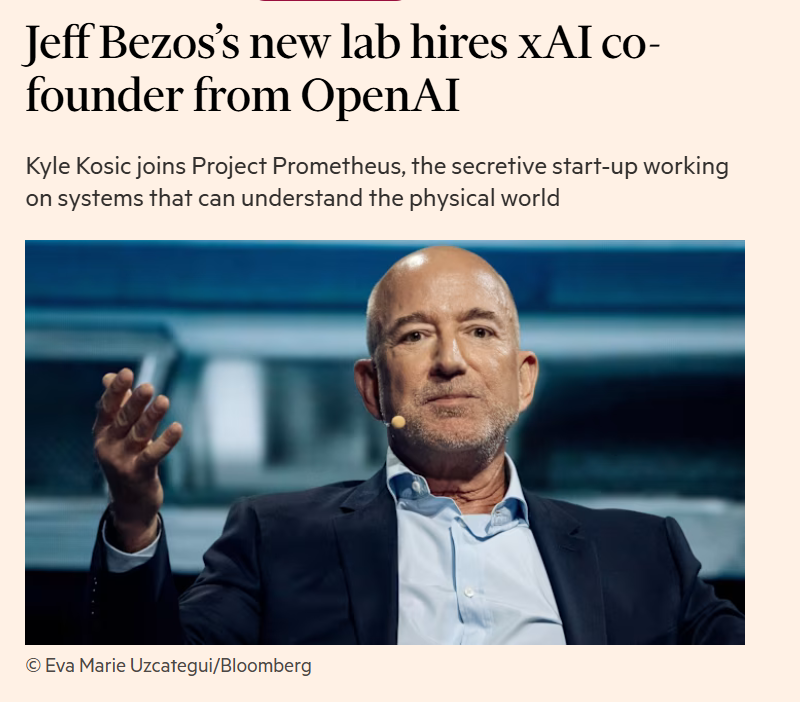
Amazon wants to be back in the game: Jeff Bezos is rapidly scaling his stealth AI venture “Project Prometheus,” hiring Kyle Kosic, a former OpenAI and xAI leader, to build next-gen infrastructure. The company is aggressively recruiting top talent and aiming to develop AI that understands the physical world, targeting industries like aviation and engineering with massive proprietary datasets. With plans to raise tens of billions and build a Berkshire-style AI investment powerhouse, Prometheus shows his shift from chatbots to real-world industrial transformation in finance. Via FT