
How can enterprises accelerate decision-making and improve efficiency? We're joining @Microsoft's Model Mondays on April 6th to discuss how AI can help you: 🌎 Drive real-world enterprise value 💡 Surface precise, verifiable insights 📌 Use Microsoft Azure and Cohere enterprise models to accelerate your AI journey
GENERATIVE AI
-
LLM Knowledge Bases: Building Personal Research Wiki Systems
By
–
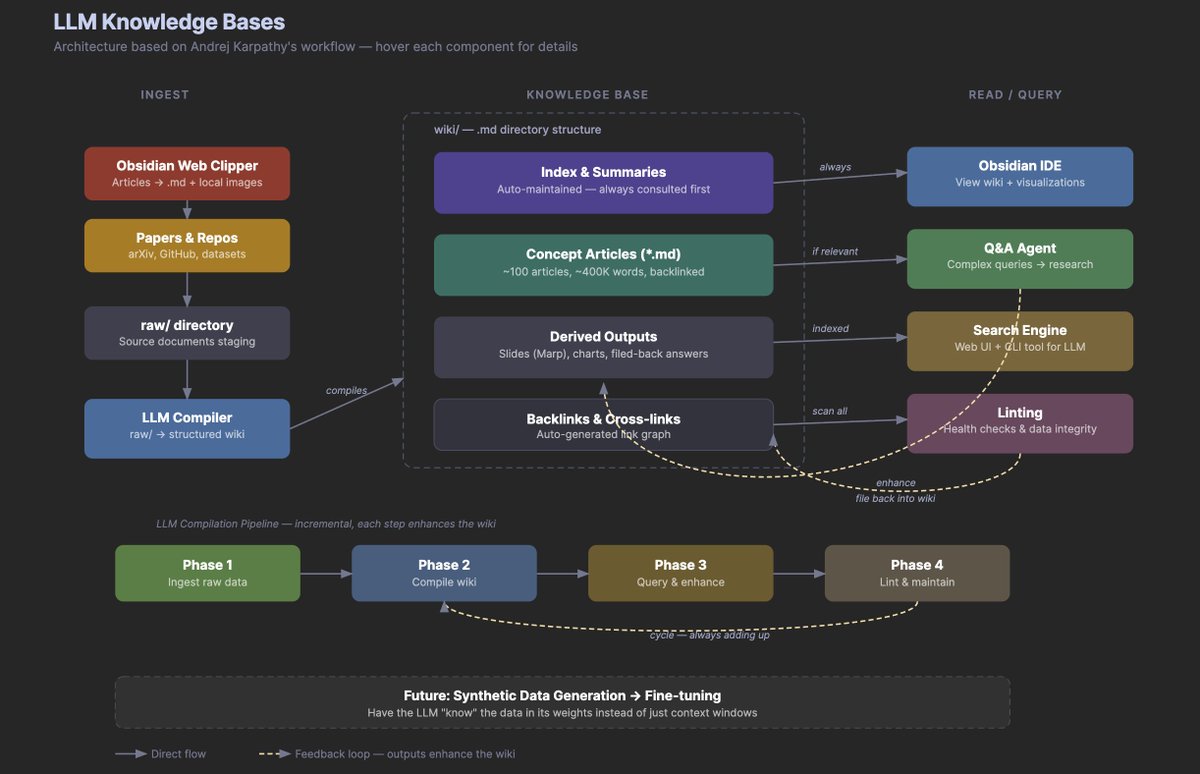
Diagram of the LLM Knowledge Base system. Feed this to your favorite agent and get your own LLM knowledge base going. Andrej Karpathy (@karpathy) LLM Knowledge Bases Something I'm finding very useful recently: using LLMs to build personal knowledge bases for various topics of research interest. In this way, a large fraction of my recent token throughput is going less into manipulating code, and more into manipulating knowledge (stored as markdown and images). The latest LLMs are quite good at it. So: Data ingest: I index source documents (articles, papers, repos, datasets, images, etc.) into a raw/ directory, then I use an LLM to incrementally "compile" a wiki, which is just a collection of .md files in a directory structure. The wiki includes summaries of all the data in raw/, backlinks, and then it categorizes data into concepts, writes articles for them, and links them all. To convert web articles into .md files I like to use the Obsidian Web Clipper extension, and then I also use a hotkey to download all the related images to local so that my LLM can easily reference them. IDE: I use Obsidian as the IDE "frontend" where I can view the raw data, the the compiled wiki, and the derived visualizations. Important to note that the LLM writes and maintains all of the data of the wiki, I rarely touch it directly. I've played with a few Obsidian plugins to render and view data in other ways (e.g. Marp for slides). Q&A: Where things get interesting is that once your wiki is big enough (e.g. mine on some recent research is ~100 articles and ~400K words), you can ask your LLM agent all kinds of complex questions against the wiki, and it will go off, research the answers, etc. I thought I had to reach for fancy RAG, but the LLM has been pretty good about auto-maintaining index files and brief summaries of all the documents and it reads all the important related data fairly easily at this ~small scale. Output: Instead of getting answers in text/terminal, I like to have it render markdown files for me, or slide shows (Marp format), or matplotlib images, all of which I then view again in Obsidian. You can imagine many other visual output formats depending on the query. Often, I end up "filing" the outputs back into the wiki to enhance it for further queries. So my own explorations and queries always "add up" in the knowledge base. Linting: I've run some LLM "health checks" over the wiki to e.g. find inconsistent data, impute missing data (with web searchers), find interesting connections for new article candidates, etc., to incrementally clean up the wiki and enhance its overall data integrity. The LLMs are quite good at suggesting further questions to ask and look into. Extra tools: I find myself developing additional tools to process the data, e.g. I vibe coded a small and naive search engine over the wiki, which I both use directly (in a web ui), but more often I want to hand it off to an LLM via CLI as a tool for larger queries. Further explorations: As the repo grows, the natural desire is to also think about synthetic data generation + finetuning to have your LLM "know" the data in its weights instead of just context windows. TLDR: raw data from a given number of sources is collected, then compiled by an LLM into a .md wiki, then operated on by various CLIs by the LLM to do Q&A and to incrementally enhance the wiki, and all of it viewable in Obsidian. You rarely ever write or edit the wiki manually, it's the domain of the LLM. I think there is room here for an incredible new product instead of a hacky collection of scripts. — https://nitter.net/karpathy/status/2039805659525644595#m
-
Visual Guide to Gemma 4: Exploring Google DeepMind’s New Models
By
–
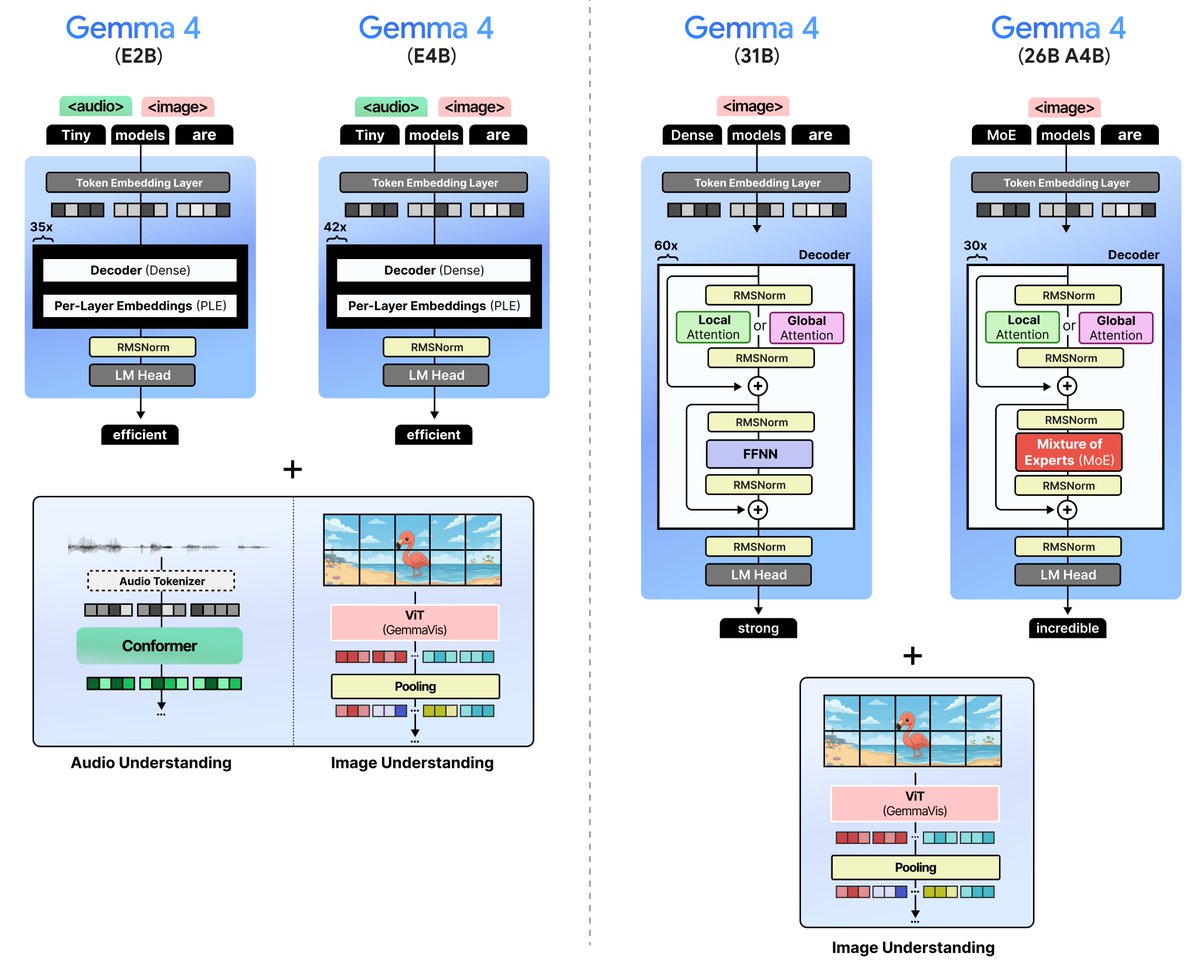
A Visual Guide to Gemma 4 With almost 40 (!) custom visuals, explore the new models from Google DeepMind. We explore various techniques, ranging from Mixture of Experts and the Vision Encoder all the way up to Per-Layer Embeddings and the Audio Encoder. Link below 👇
→ View original post on X — @jeremyphoward, 2026-04-03 16:10 UTC
-
Economists Finally Acknowledge AI Threat to Employment
By
–
nytimes.com/2026/04/03/busin… [Translated from EN to English]
→ View original post on X — @mfordfuture, 2026-04-03 16:10 UTC
-
Try Lyria 3 Pro on Replicate
By
–
Try Lyria 3 Pro: replicate.com/google/lyria-3… [Translated from EN to English]
→ View original post on X — @replicate, 2026-04-03 15:59 UTC
-
Discover Lyria 3: Google’s New Audio Tool
By
–
Try Lyria 3:
replicate.com/google/lyria-3 [Translated from EN to English]→ View original post on X — @replicate, 2026-04-03 15:59 UTC
-
Google DeepMind’s Lyria 3 Now Available on Replicate for Music Creation
By
–
Lyria 3 (and 3 Pro) from @GoogleDeepMind are now on Replicate!
— Replicate (@replicate) 3 avril 2026
Produce studio-quality tracks with the ability to prompt intros, verses, choruses, and bridges.
With Lyria 3 Pro, you can create songs up to 3 minutes long. pic.twitter.com/5Y6DDUxKoaLyria 3 (and 3 Pro) from @GoogleDeepMind are now on Replicate! Produce studio-quality tracks with the ability to prompt intros, verses, choruses, and bridges. With Lyria 3 Pro, you can create songs up to 3 minutes long. [Translated from EN to English]
→ View original post on X — @replicate, 2026-04-03 15:59 UTC
-
Seedance 2.0 Generates Stunning Kung Fu Video from Photos
By
–
Been messing with the new Seedance 2.0 on Higgs and it’s legitimately ace!
— Charly Wargnier (@DataChaz) 3 avril 2026
You feed it 2 photos and a prompt, and it outputs THIS 🤯
Nailing flawless kung fu physics + native audio from a couple of jpegs is just absurd https://t.co/9sod5mbZmh pic.twitter.com/CO0pQJ30BCBeen messing with the new Seedance 2.0 on Higgs and it’s legitimately ace! You feed it 2 photos and a prompt, and it outputs THIS Nailing flawless kung fu physics + native audio from a couple of jpegs is just absurd
-
Seedance 2.0 AI Tool Enhances Creative Control for Video and Audio Generation
By
–
Seedance 2.0 est officiellement dispo sur Pollo AI.
— Jouhatsu | AI Influence Operator (@Jouhatsu_ai) 3 avril 2026
Et honnêtement, on commence à toucher un autre niveau.
Les mouvements sont plus propres, les scènes plus cohérentes, et surtout t’as un vrai contrôle créatif.
Vidéo + audio générés ensemble = rendu beaucoup plus naturel
-60%… https://t.co/2EgjkTGa2J pic.twitter.com/S8BvwPGYOsSeedance 2.0 est officiellement dispo sur Pollo AI. Et honnêtement, on commence à toucher un autre niveau. Les mouvements sont plus propres, les scènes plus cohérentes, et surtout t’as un vrai contrôle créatif. Vidéo + audio générés ensemble = rendu beaucoup plus naturel -60%
-
AI Hallucinations: Addressing Model Reliability Concerns
By
–
and yes it is a hallucination, despite what you say