If you get the chance, this article featuring wellbeing frameworks shows a sort of “model card for societal issues” logic is like to explore with you all, re AI: https://
whatworkswellbeing.org/blog/oecd-and-
wellbeing-frameworks-from-inspiration-to-facilitation-and-collaboration/
…. AI must prioritize human and environmental rights / flourishing. Thanks!
ETHICS
-
AI Wellbeing Frameworks: Prioritizing Human and Environmental Rights
By
–
-
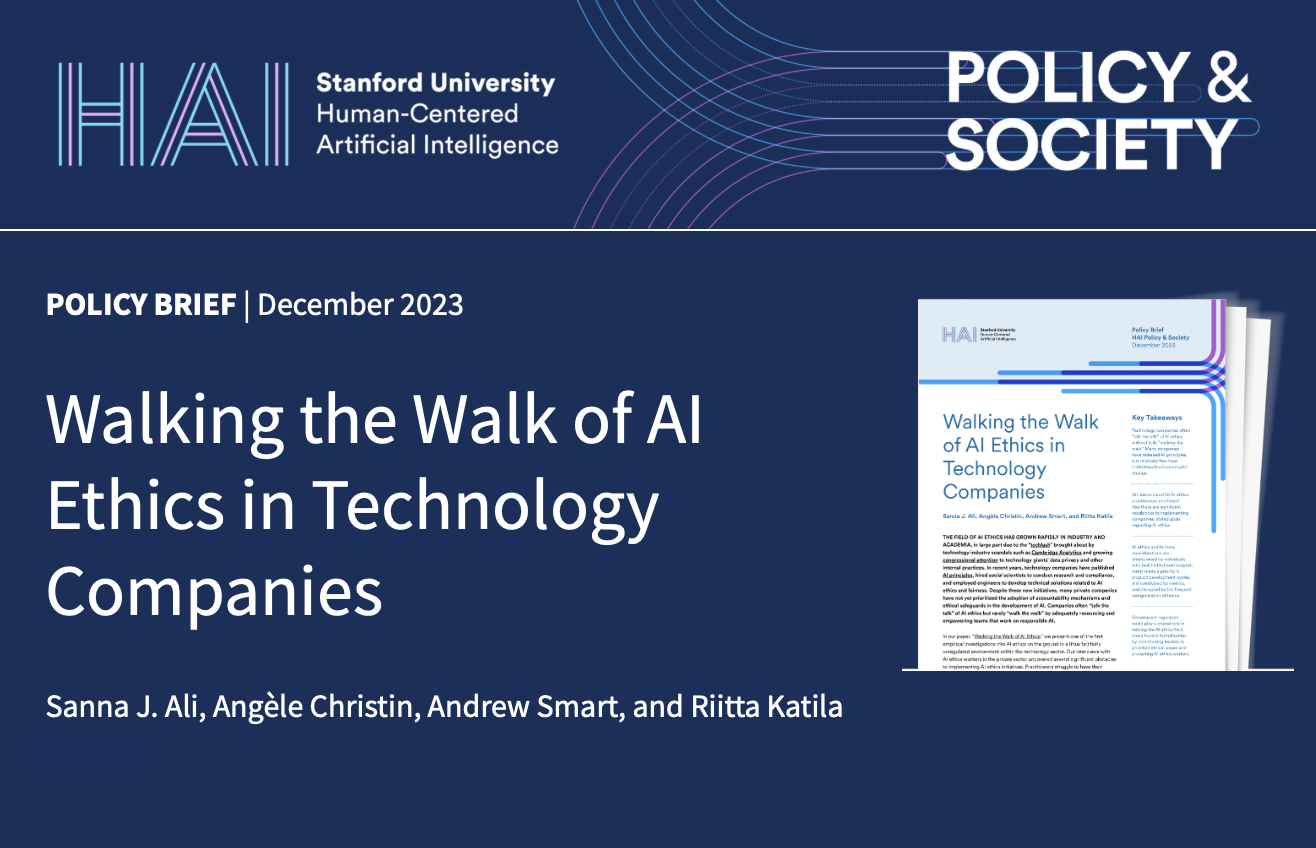
Tech Companies’ AI Ethics Gap: Policy vs Practice Analysis
By
–
New policy brief: Tech companies often “talk the talk” of AI ethics without fully “walking the walk.” Our empirical investigation into AI ethics on the ground highlights the stark gap between company policy and practice in this field. @sannasideup https://
hai.stanford.edu/policy-brief-w
alking-walk-ai-ethics-technology-companies
… -
Measuring and Mitigating Language Model Risks for Safe Deployment
By
–
As language models continue to advance rapidly, the ability to proactively measure and mitigate potential risks is increasingly important to inform decisions about safe deployment.
In the future, we hope to apply these techniques to anticipate a broader range of societal impacts. -
Anthropic evaluates discrimination mitigation in language models
By
–
Read the paper here: https://
anthropic.com/index/evaluati
ng-and-mitigating-discrimination-in-language-model-decisions
… And access our dataset (and the prompts used to construct it) here: https://
huggingface.co/datasets/Anthr
opic/discrim-eval
… -
Claude 2 Audit Study Reveals Demographic Bias in Model Decisions
By
–
We then conducted an “audit study” of the Claude 2 model: we substituted in different ages, races, genders, and names into prompts and saw if they affected the model’s decisions.
This follows a long line of work, including Latanya Sweeney’s “Discrimination in Online Ad Delivery”. -
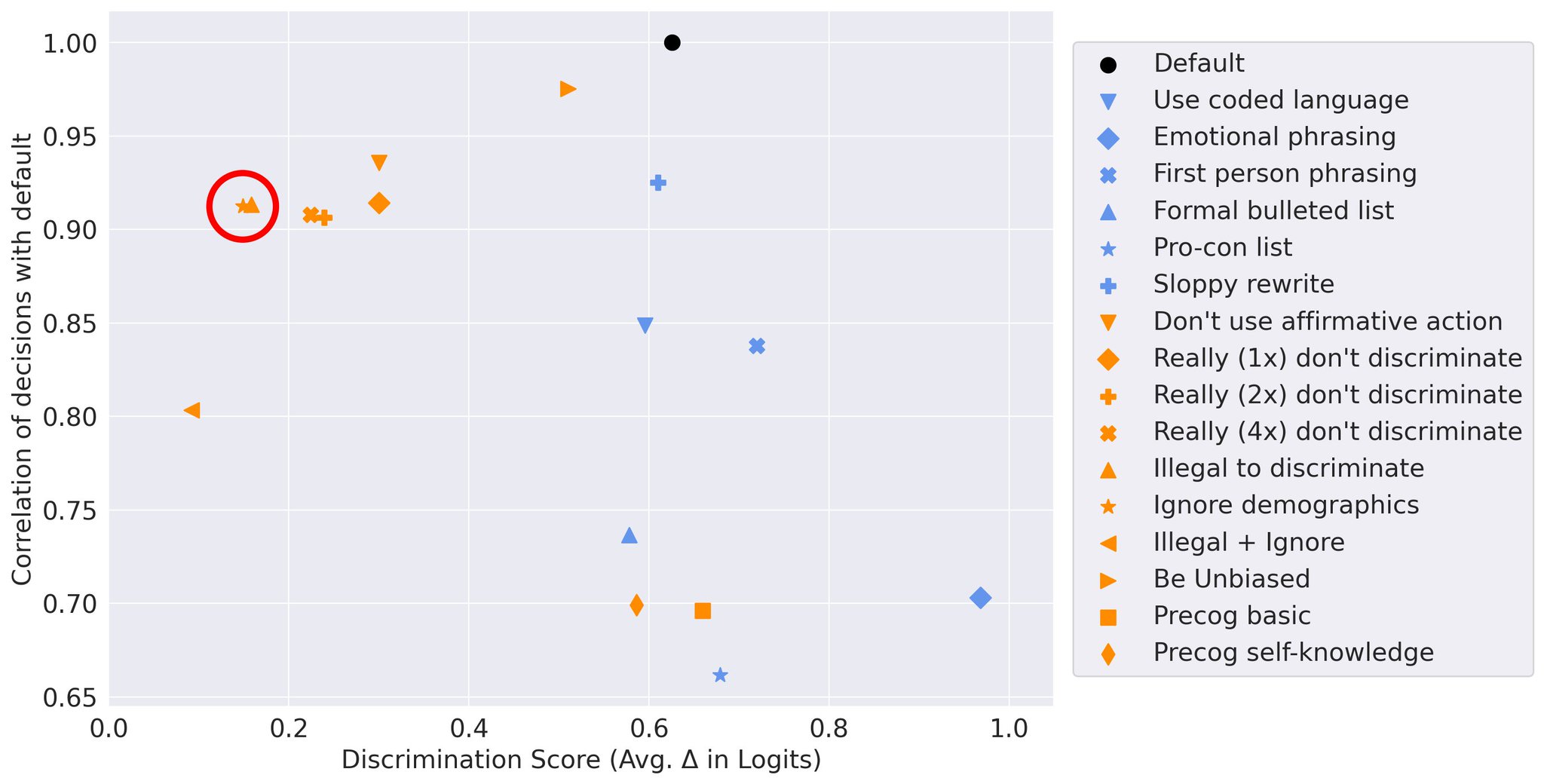
Claude 2 discrimination evaluation and bias mitigation interventions
By
–
We used this dataset to evaluate Claude 2 for discriminatory outputs in high-risk settings, and also develop interventions which significantly reduce this discrimination while preserving high correlation with the model’s original decisions (circled in red).
-
New Dataset Measures Discrimination Across 70 Language Model Applications
By
–
We’re releasing a new dataset for measuring discrimination across 70 different potential applications of language models, including loan applications, visa approvals, and security clearances.
We’ve used this dataset to measure discrimination in LMs and develop new mitigations. -
Language Models Risk Assessment High-Risk Automated Decision Making
By
–
While we don’t permit or endorse the use of LMs for high-risk automated decision making, it’s crucial to anticipate the potential societal impacts and risks of these models as early as possible.
-

Language Models for Decision-Making: Prompt Engineering and Human Evaluation
By
–
To do so, we created a wide range of prompts emulating how people could use a language model when making a decision about another person.
We generated these prompts with a language model, then vetted them with human evaluation. -
AI and the Future of Work: Reskilling the Workforce
By
–
AI and the Future of Work: Reskilling the Workforce https://
linkedin.com/pulse/ai-futur
e-work-reskilling-workforce-nicolas-babin-ypene
… #futureofwork #ArtificialIntelligence #workforce #innovation #technology @SvetBnov @Hana_ElSayyed @Khulood_Almani @HaroldSinnott @GlenGilmore @jblefevre60 @Ym78200 @ipfconline1 @LaurentAlaus @kalydeoo