Good news: Anthropic just revealed Mythos- the most powerful AI model ever made Bad news: you'll never be able to use it I get it. It's so powerful that it could exploit cybersecurity But I hate it. I don't love that a company gets to hand select who gets to use the best intelligence. The companies who get access to Mythos will have a distinct economic advantage against those that don't That feels unfair I'm more of a fan of democratization of intelligence. This feels like an opportunity for OpenAI to release something as powerful but put it in the hands of consumers. Trust the consumer by default. Sort of like with the OpenClaw situation Another reason to root for open source Anthropic (@AnthropicAI) Introducing Project Glasswing: an urgent initiative to help secure the world’s most critical software. It’s powered by our newest frontier model, Claude Mythos Preview, which can find software vulnerabilities better than all but the most skilled humans. anthropic.com/glasswing — https://nitter.net/AnthropicAI/status/2041578392852517128#m
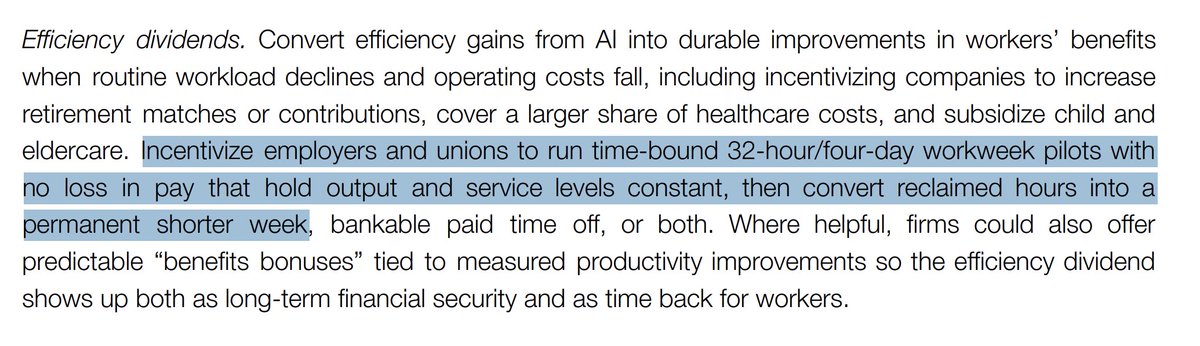
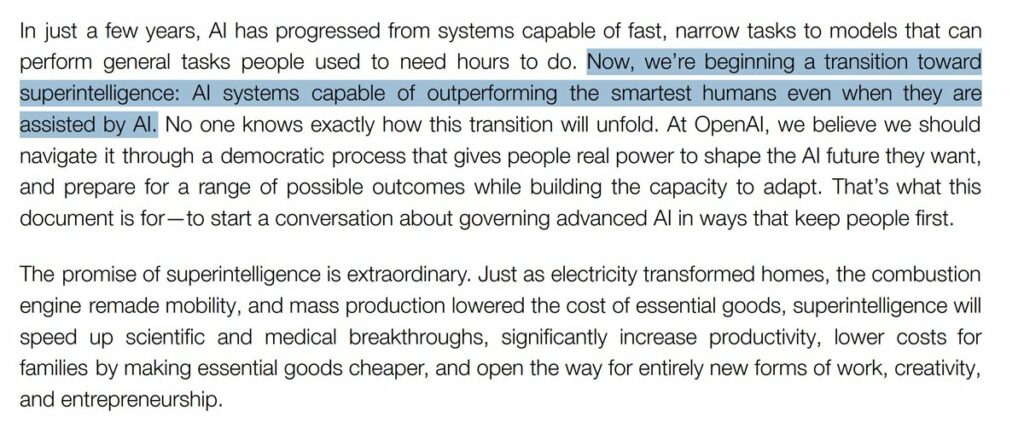
So maybe OpenAI *really* figured out superintelligence. In a way, Anthropic did, right? nitter.net/kimmonismus/status/204… Chubby♨️ (@kimmonismus) Looks like OpenAI reached Superintelligence. OpenAI: "Now, we’re beginning a transition toward superintelligence: AI systems capable of outperforming the smartest humans even when they are assisted by AI." OpenAI just published a 13-page policy blueprint for the "Intelligence Age"- proposing a Public Wealth Fund, 32-hour workweek pilots, portable benefits, a formal "Right to AI," and tax reforms to offset shrinking payroll revenue as automation scales. The document frames superintelligence not as a distant scenario *but an active transition requiring New Deal-level ambition*: new safety nets, containment playbooks for dangerous models, and international coordination modeled on aviation safety institutions. Here are OpenAI's suggestions (tl;dr): Open Economy: -Give workers a formal voice in AI deployment decisions -Microgrants and "startup-in-a-box" for AI-native entrepreneurs -Treat AI access as basic infrastructure (like electricity) -Shift tax base from payroll toward capital gains and corporate income -Public Wealth Fund — every citizen gets a stake in AI growth -Fast-track energy grid expansion via public-private partnerships -32-hour workweek pilots, better benefits from productivity gains -Auto-scaling safety nets triggered by displacement metrics -Portable benefits untied from employers -Invest in care economy as a transition path for displaced workers -Distributed AI-enabled labs to accelerate scientific discovery Resilient Society: -Safety tools for cyber, bio, and large-scale risks -AI trust stack — provenance, verification, audit logs -Competitive auditing market for frontier models -Containment playbooks for dangerous released models -Frontier AI companies adopt Public Benefit Corporation structures -Codified rules and auditing for government AI use -Democratic public input on AI alignment standards -Mandatory incident and near-miss reporting -International AI safety network for joint evaluations and crisis coordination Notably, OpenAI calls for stricter controls only on a narrow set of frontier models while keeping the broader ecosystem open, a clear attempt to position regulation as targeted, not industry-wide. They're backing it with up to $100K in fellowships and $1M in API credits for policy research, plus a new DC workshop opening in May. — https://nitter.net/kimmonismus/status/2041130939175284910#m
The #AIIndex2026 returns this year with comprehensive analysis from an expanded interdisciplinary team of experts – bringing fresh perspectives and deeper insights on how AI is shaping research, the economy, policy, and public opinion. Subscribe here: https://t.co/iMfE3xkyHGpic.twitter.com/e3miEDcBNB
The #AIIndex2026 returns this year with comprehensive analysis from an expanded interdisciplinary team of experts – bringing fresh perspectives and deeper insights on how AI is shaping research, the economy, policy, and public opinion. Subscribe here: hai.stanford.edu/ai-index
It’s not strange if you lived and worked there during these 2 decades of hyper growth. Have you heard of a “GDP company” because there were actual state owned companies in China that cooked the books for the specific purpose of pumping up China’s GDP numbers. Without
This will be essential; otherwise, only the 'rich' can afford to buy frontier intelligence in a market that is increasingly supply-constrained (giving them an asymmetric and compounding advantage)—and thereby fulfilling the anti-AI political platform. The only way AI 'wins' is
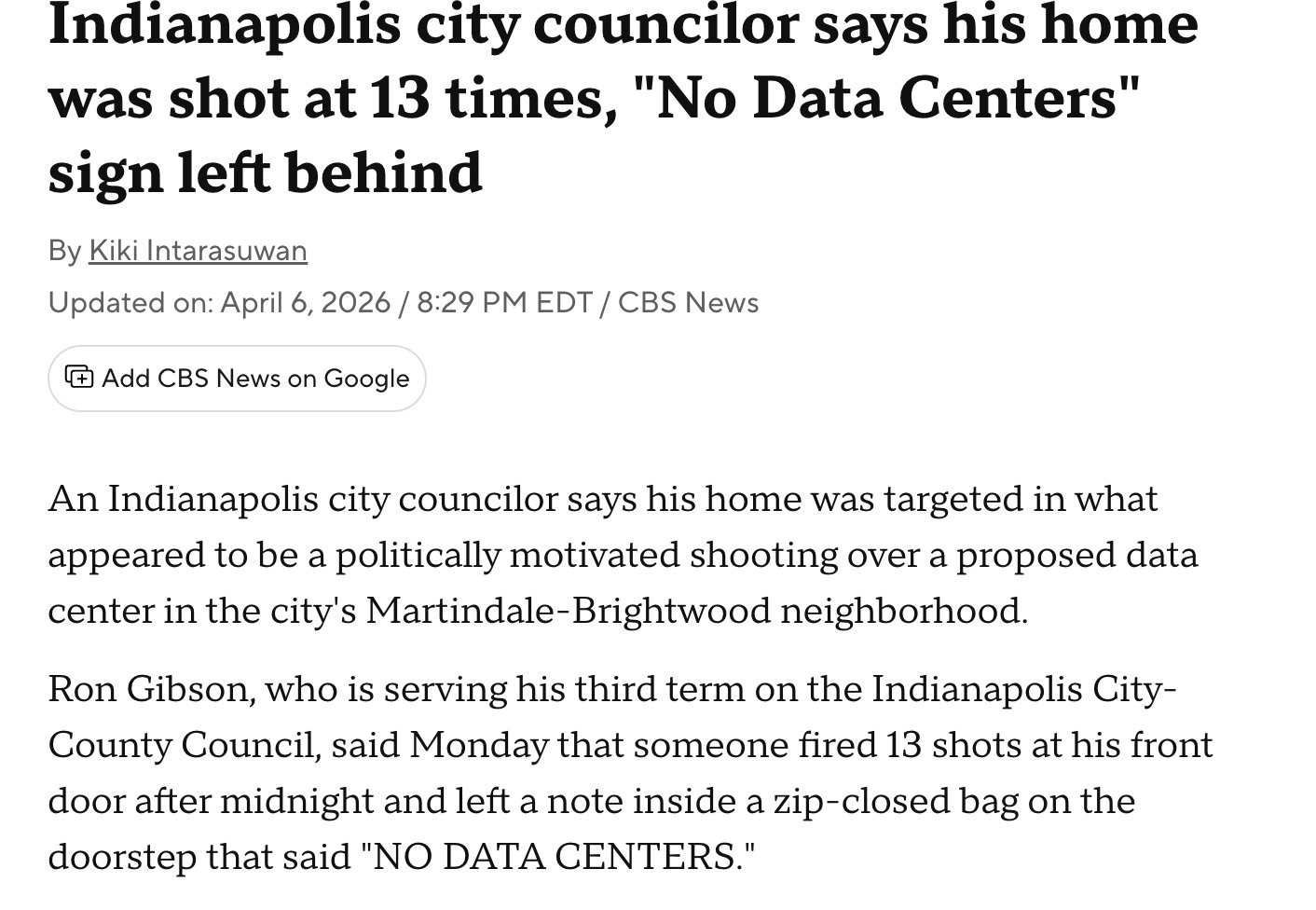
Absolutely wild. A councilor's home shot, with 'no data centres' sign left behind. AI is losing the public perception war, VERY BADLY, and it's already becoming violent. The numbers: 1/ AI is less popular than ICE (NBC Poll) 2/ $162 billion in AI projects blocked or
I am experiencing this now and it’s definitely the future Marc Andreessen 🇺🇸 (@pmarca) Magical OpenClaw experiences that use frontier models cost $300-1,000/day today, heading to $10,000/day and more. The future shape of the entire technology industry will be how to drive that to $20/month. — https://nitter.net/pmarca/status/2041397922940801170#m
AI capability is accelerating at the same time geopolitical competition is intensifying. That means bigger Intelligence factories. More capital. More competition to control the infrastructure that produces Intelligence. Because in the 21st century, whoever can build, scale and
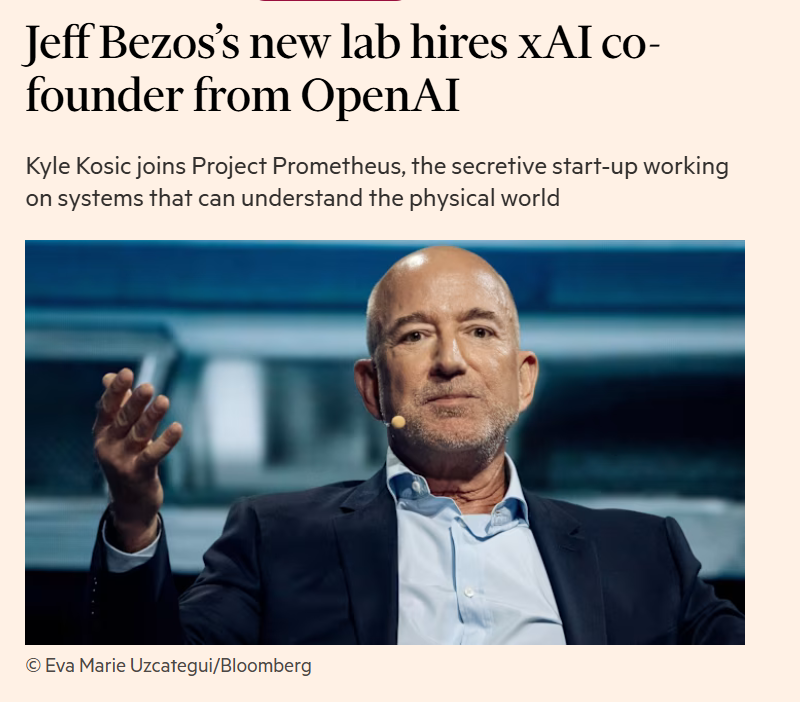
Amazon wants to be back in the game: Jeff Bezos is rapidly scaling his stealth AI venture “Project Prometheus,” hiring Kyle Kosic, a former OpenAI and xAI leader, to build next-gen infrastructure. The company is aggressively recruiting top talent and aiming to develop AI that understands the physical world, targeting industries like aviation and engineering with massive proprietary datasets. With plans to raise tens of billions and build a Berkshire-style AI investment powerhouse, Prometheus shows his shift from chatbots to real-world industrial transformation in finance. Via FT
Your AI setup should not depend on someone else’s pricing model.
That is the real lesson from the #Claudepocalypse. Claude is still excellent. That is not the point. The point is that if one subscription change can break your agent workflow overnight, then you do not really own