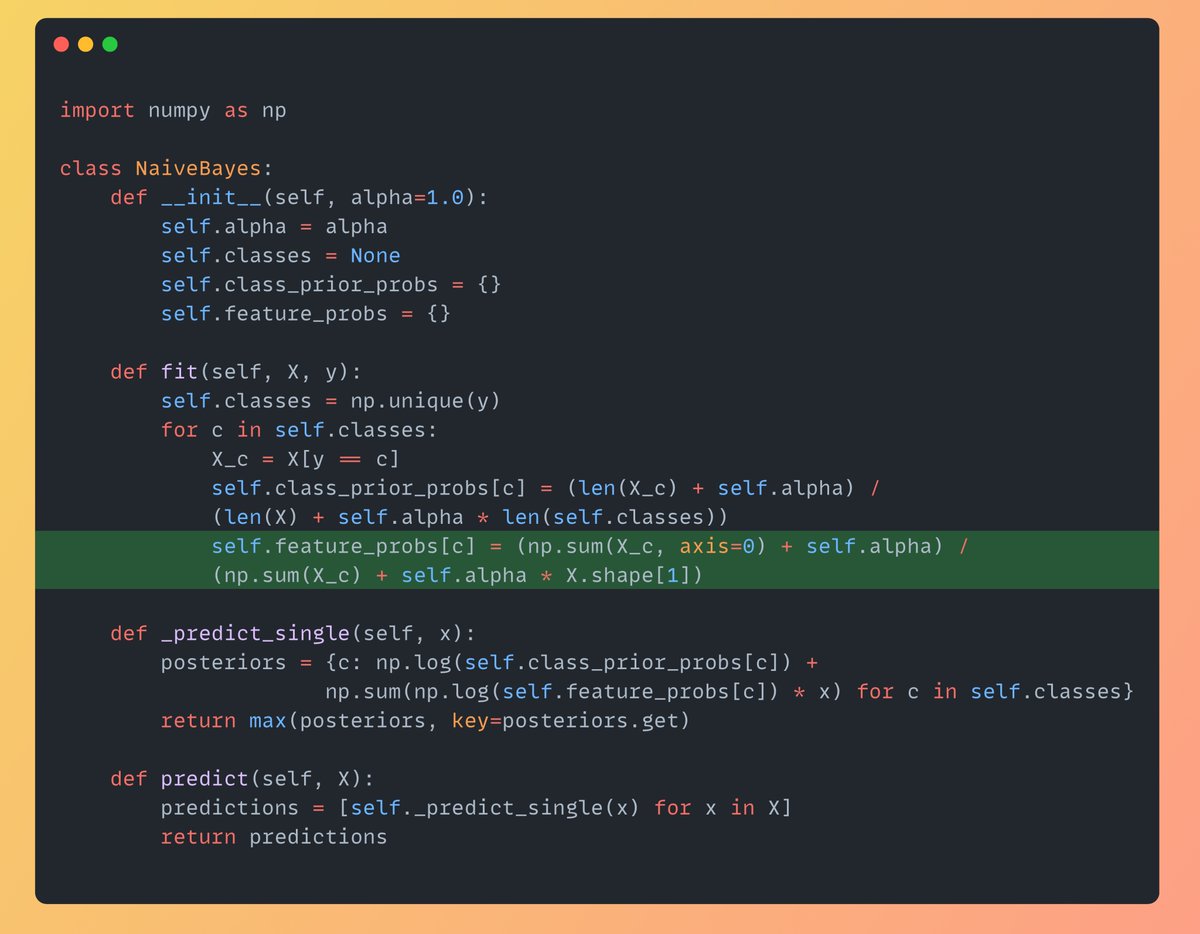
Similarly calculate the probabilities of individual features for the current class "c". To simplify this is the probability of occurrence of that feature given that the class is c.
AI
-
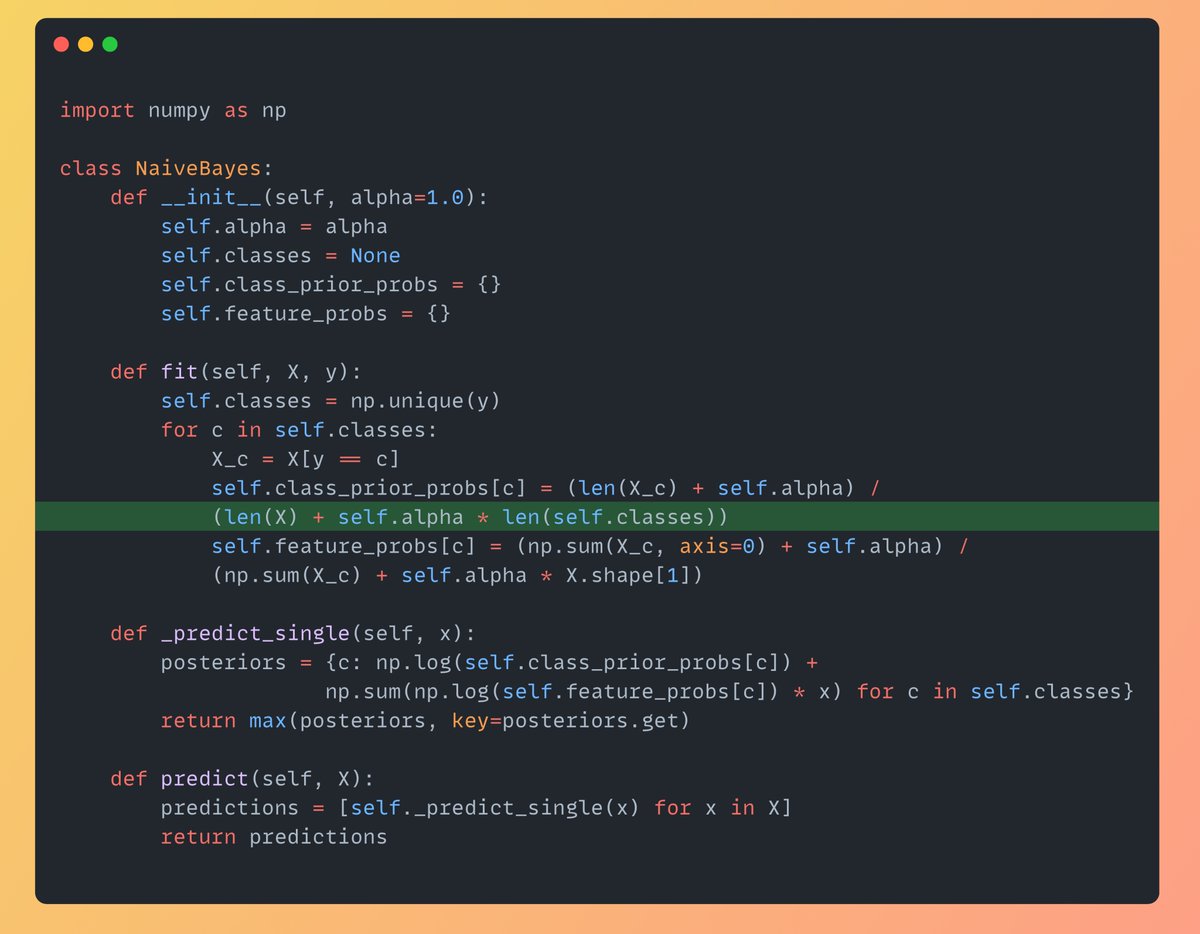
Alpha Parameter Prevents Zero Probability in Unseen Feature Data
By
–
Here you can see we have multiple by "alpha". For example if you have unseen feature data. Since it is unseen, the algorithm calculates it's probability as 0. By multiplying this with the probability the entire value is 0. To avoid this alpha is used whose default value is 1.
-

Calculating Class Probability in Training Data Loop
By
–
Now loop over each class. And from "X" subset the features corresponding to the current class "c". Using that calculate the probability of that class "c" occurring in the training data. This is calculated by: (Total No of times class "c" occurred)/Total No of classes
-

Defining the Naive Bayes Classifier Fit Method for Training
By
–
Define the fit method to train the Naive Bayes classifier. • Here "X" is the feature matrix that contains the data samples • "y" contains the class labels corresponding to each data sample. Also get the unique class labels and store them in "self.classes".
-
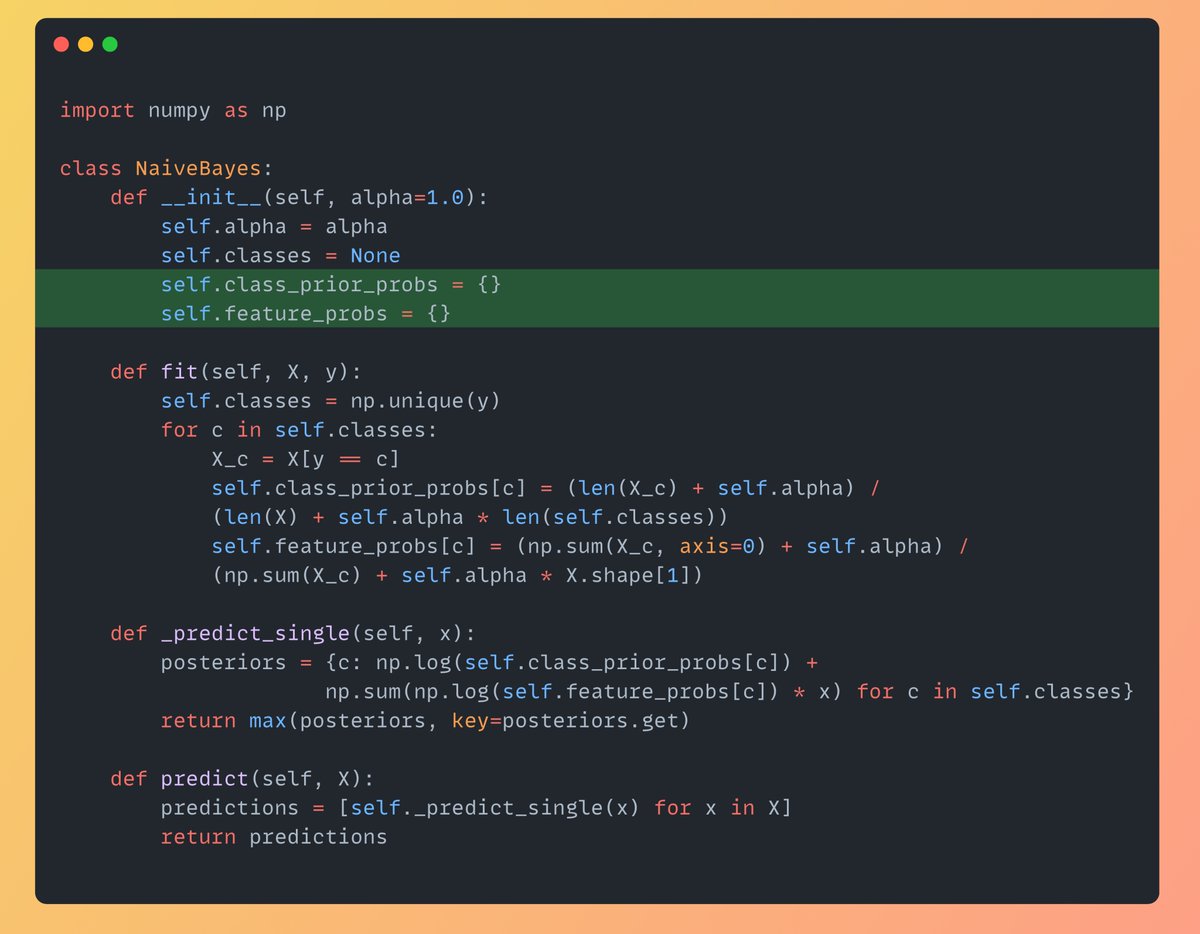
Initializing Class Prior Probabilities and Feature Probabilities Parameters
By
–
Similarly initialise: → class_prior_probs: This stores the probabilities of an individual classes → feature_probs: This stores the feature probabilities or conditional probability. More on these 2 parameters later:
-

Naive Bayes: Independence Assumption and Parameter Initialization
By
–
There reason why it called "naive" is it assumes the features are independent to each other. First, Let's initialise the parameters: → alpha: Just remember this as a smoothing parameter. Will explain it's importance later. → classes: To store the unique class labels.
-
CTEs: Simplifying Complex SQL Queries Through Modular Components
By
–
CTEs provide a way to define temporary result sets that you can reference within a SELECT, INSERT, UPDATE, or DELETE statement. CTEs enhance code readability and maintainability by breaking down complex queries into simpler, modular components.
-
Common Table Expressions Explained: SQL Fundamentals
By
–
Common Table Expressions (CTEs) are explained with an example:
-
Claude 3 outperforms GPT-4 in creative writing and summarization
By
–
Finding that Claude 3 is a better creative writer & summarizer than GPT-4. Nice to finally see some legit competition!
-

Comprehensive Machine Learning Algorithms Book Recommendation
By
–
Brilliant 798-page “Everything #ML from A to Z” book — I have a copy and I love it! >> "Mastering #MachineLearning #Algorithms" at http://
amzn.to/37cDZ7F by @GiuseppeB ——————
#Python #DeepLearning #AI #BigData #DataScience #DataMining #Mathematics #Coding #DataScientists