My short essay on LLMs & AGI: Have we reached the 'AGI of flight'? Not even close. Our planes can carry hundreds of passengers across the globe in just a few hours, yet nothing we build matches a godwit flying non-stop for eleven days without rest or the agility of a bat
AGI
-
AI as Industrial Revolution: Comparing Past Technological Paradigm Shifts
By
–
If you think the future is like the past, then it all comes down to your analogy: 1880s railroads? 2000 dot-com? 1910s factory electrification? 1980s software? It is also possible to argue that AI represents an industrialization-style break with all past trends. We don't know.
-
AI Future Scenarios: Bubble, Plateau, or Transformative Breakthrough?
By
–
I don't think we have a good grasp on what the future of AI will be, so it would be reasonable to start thinking in scenarios: what if there is a bubble or a plateau in AI development? (Not the same thing) Conversely, what if the insiders saying transformative AI soon are right?
-

Benchmark Progress Achieved Despite Remaining Visual Artifacts
By
–
Big progress on this important benchmark (but still weird artifacts). https://t.co/1mz8SCJisk pic.twitter.com/f9tpCi9fne
— Ethan Mollick (@emollick) 10 octobre 2025Big progress on this important benchmark (but still weird artifacts).
-
Claude AI Extracts Flight and Hotel Booking Data from 2024
By
–
I asked Claude to find every flight and hotel booking I made in 2024 and it seemed to get them all, plus how much they cost and if I paid cash or credit card points
-
Economic Sovereignty in AI: Major Powers vs. Dependent Nations
By
–
the idea i had is like:
– lots of major economies are investing for sovereignty (they can afford to try)
– many many other countries have no chance to be sovereign (don’t have the cash, capabilities, critical mass) so they’ll just give up or won’t try and be “neutral” and depend -
Where Will AI Asymptote? Exploring Future Limits
By
–
Ask not where AI is, but where it will asymptote.
-
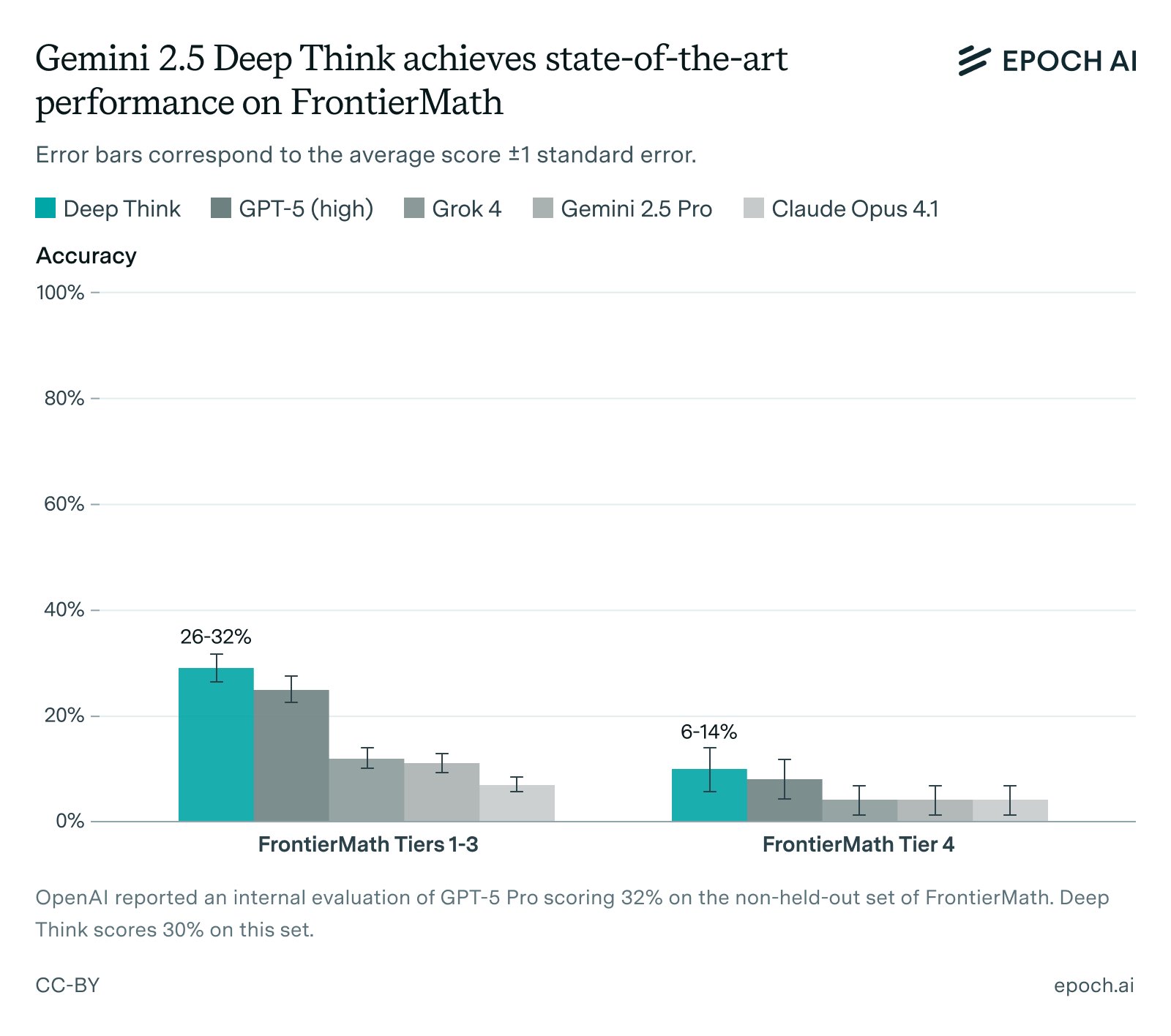
DeepThink IMO Gold Model Achieves State-of-the-Art FrontierMath Results
By
–
Very cool to see this new state-of-the-art result on FrontierMath achieved by the #DeepThink IMO Gold model that we built 3 months (a long time) ago 🙂 The fact that is evaluated externally using a publicly available API is a strong testament that what we built generalizes beyond