AI Dynamics

Global AI News Aggregator

About

AGENTS

  • AI Curation Era: X’s Shift Away from Human Curators

    A couple of days ago @nikitabier announced that they would be penalized from here on, at least in payments. I got the message. Which is one reason why I have my AI reading all of the AI community here on X and telling you what's important. It gives you a dramatically different view of the AI world here on X than you can get from X: alignednews.com/ai Having your own AI reading the communities you care about gives you a lot better view of what's actually being discussed that doesn't often make it to your feed. No longer are we seeing what's popular, but what AI has picked for us to see. In many ways that's an improvement but I miss the old world too. Curators who read thousands of posts every day and reshare the best are being "turned down." It is unclear whether AI generated custom feeds can ever get any distribution to make them profitable. Running custom AI's costs money. Mine costs $100 or more per day in tokens and $300 a day in API calls (the site is wholly generated via the X API since terms of service here forbids scraping the data). It's an end of an era where humans really have much to do with what other humans see. Now we are in a completely AI run world. I am seeing a few understanding this and building an @OpenClaw or a Hermes system to build new personalized news services for their owners. That will be a must for those of us who really want to see the news in an unbiased way (every AI is biased, including mine, since I taught it over two months of talking to it about what I wanted it to present to me and you). I need to turn this into a business that at least covers the costs that @blevlabs and I are running up, or else it will have to be shut down, which would be a shame, since I know it brings a few people value. Working on that the rest of the week.

    → View original post on X — @scobleizer, 2026-04-14 08:19 UTC
  • Retrieval vs Behavioral Learning: The Real Gap in AI Agents

    Really well articulated. The distinction between "finds the right fact when asked" vs "already changed behavior from experience" is the real gap. Retrieval is table stakes. Consolidation turning episodic traces into behavioral defaults is where agents actually start learning.

    → View original post on X — @akshay_pachaar

  • Agent Development Tools Bridge Semantic Web Infrastructure Gap

    Fair point on the Semantic Web angle. The loose coupling idea is solid. The practical challenge is that most teams building agents today aren't working in that paradigm yet, so tools like Cognee bridge the gap with familiar abstractions until the infrastructure catches up.

    → View original post on X — @akshay_pachaar

  • Session Management Performance Optimization in AI Chat Systems

    Solid point! That's a real thing people will hit when using Cognee in a live chat. Using session_id to defer the heavy graph updates to the background keeps responses fast while memory stays in sync behind the scenes.

    → View original post on X — @akshay_pachaar

  • Which Household Tasks Does Jesse Trust Agents With

    curious which household tasks jesse actually trusts agents with vs manually overrides

    → View original post on X — @whats_ai

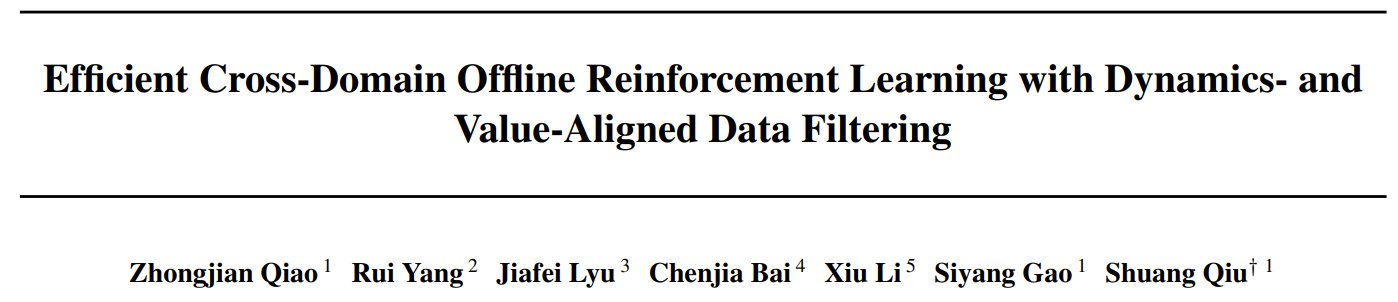
  • Efficient Cross-Domain Offline Reinforcement Learning with Data Filtering
    Efficient Cross-Domain Offline Reinforcement Learning with Data Filtering

    Efficient Cross-Domain Offline Reinforcement Learning with Dynamics- and Value-Aligned Data Filtering Paper: https://
    arxiv.org/pdf/2512.02435
    Code: https://
    github.com/zq2r/DVDF.git Our report: https://
    mp.weixin.qq.com/s/ztE8GofcssuI
    1PdkHx_kLg
    … #PapersAccepted by Jiqizhixin

    → View original post on X — @jiqizhixin

  • AI Agents Learning Across Different Environments

    How can AI agents learn effectively when their training data comes from environments vastly different from where they'll operate? Researchers from City University of Hong Kong, UIUC, Tencent, and Tsinghua University present DVDF, a new method for cross-domain offline

    → View original post on X — @jiqizhixin

  • DeepMind Hires Philosopher to Explore AI Consciousness

    Henry Shevlin – a philosopher of mind and AI ethics from Cambridge, just got hired as an in-house philosopher at Google DeepMind. He'll be focusing on machine consciousness, human-AI interaction, and the ethical governance of increasingly autonomous systems. What's significant here: DeepMind is treating philosophy as a discipline on par with computer science and neuroscience, embedding it directly into core research rather than just keeping ethicists as external advisors. The labs are starting to think about the consciousness, agency, and moral reasoning question. Whereas, I am working at the applied human level – what happens when a mid-level manager doesn't trust the AI their company just deployed, or when a team's workflows break because no one designed the adoption path. That's not the philosophy angle but rather organisational and psychological infrastructure. Both matter. [Translated from EN to English]

    → View original post on X — @scobleizer, 2026-04-14 07:04 UTC

  • AI Agent Deployers: The New Essential Enterprise Role

    this is a very very good write up not enough time being spent right now thinking clearly like this about AI outside of R&D I think this post nails it. start with the job-to-be-done, rethink the factory, and empower super operators Aaron Levie (@levie) The more enterprises I talk to about AI agent transformation, the more it’s clear that there is going to be a new type of role in most enterprises going forward. The job is to be the agent deployer and manager in teams. Here’s the rough JD: This person will need to figure out what are the highest leverage set of workflows on a team are (either existing or new ones) where agents can actually drive significantly more value for the team and company. In general, it’s going to be in areas where if you threw compute (in the form of agents) at a task you could either execute it 100X faster or do it 100X more times than before. Examples would be processing orders of magnitude more leads to hand them off to reps with extra customer signal, automating a contracting review and intake process, streamlining a client onboarding process to reduce as many straps as possible, setting up knowledge bases than the whole company taps into, and so on. This person’s job is to figure out what the future state workflow needs to look like to drive this new form of automation, and how to connect up the various existing or new systems in such a way that this can be fulfilled. The gnarly part of the work is mapping structured and unstructured data flows, figuring out the ideal workflow, getting the agent the context it needs to do the work properly, figuring out where the human interfaces with the agent and at what steps, manages evals and reviews after any major model or data change, and runs and manages the agents on an ongoing basis tracking KPIs, and so on. The person must be good at mapping the process and understanding where the value could be unlocked and be relatively technical, and has full autonomy to connect up business systems and drive automation. This means they’re comfortable with skills, MCP, CLIs, and so on, and the company believes it’s safe for them to do so. But also great operationally and at business. It may be an existing person repositioned, or a totally net new person in the company. There will likely need to be one or more of these people on every team, so it’s not a centralized role per se. It may rile up into IT or an AI team, or live in the function and just have checkpoints with a central function. This would also be a fantastic job for next gen hires who are leaning into AI, and are technical, to be able to go into. And for anyone concerned about engineers in the future, this will be an obvious area for these skills as well. — https://nitter.net/levie/status/2043883641366032638#m

    → View original post on X — @scobleizer, 2026-04-14 07:02 UTC

  • Multi-stage verification gates ensure AI output quality

    The staged approach works because each stage is a quality gate. You're not trusting the output, you're verifying it at multiple checkpoints before it goes anywhere.

    → View original post on X — @aihighlight