NYU's AI initiative is jam packed with more incredible folks than I can fit in a tweet. Beyond the obvious @ylecun
, others include @joanbruna @kchonyc @eunsolc @rob_fergus @sg1753 @yanjun_han @hhexiy @Qi_Lei_ @mengyer @mtelgars @EugeneVinitsky @andrewgwils @sainingxie &more! 4/n
@thegautamkamath
-

NYU’s AI Initiative Features Renowned Researchers and Experts
By
–
-
New Course on Hopfield Networks and Restricted Boltzmann Machines
By
–
New course: Introduction to Generalizations of Hopfield Networks and Restricted Boltzmann Machines
-
ML researchers rewriting statements for Physics departments
By
–
All ML researchers on the academic job market furiously rewriting their research statements for Physics departments
-
Four Academic Papers Referenced in Research Discussion
By
–
Tons. These are four off the top of my head: https://
arxiv.org/abs/1603.05953 https://
arxiv.org/abs/2203.01550 https://
arxiv.org/abs/1604.06443 https://
arxiv.org/abs/2304.09167. -
NeurIPS acceptance as weak quality signal versus selective conferences
By
–
As an addendum, to contrast this with NeurICMLR, which have become a "big tent": fixing acceptance rate at ~25% leads to more topics and papers being welcome, which has pros and cons. A consequence is that, in contrast, being accepted to NeurIPS is a very weak signal of quality.
-
Reasons to Skip STOC/FOCS Conferences
By
–
Some reasons you may avoid STOC/FOCS:
– you don't want to waste time with rejections
– you don't need more impressive CV lines
– you want to reach a specific different community with little overlap with theory CS/algorithms
– focused on appealing to industry -
STOC/FOCS papers matter more for ML candidates than theory papers
By
–
If you are applying for jobs as an ML candidate, a single STOC/FOCS paper will make the theory group take note. The reverse is not true for a theorist with a NeurIPS/COLT paper and the ML group.
-
The Difficulty of Publishing Papers at Top-Tier Conferences
By
–
Getting a paper into these conferences is hard. It requires the result to be "strong" and the techniques to be "interesting" (generally: lots of complicated math). Multiple "ideas" are needed per paper. It's brutally selective, and self-selective on top.
-
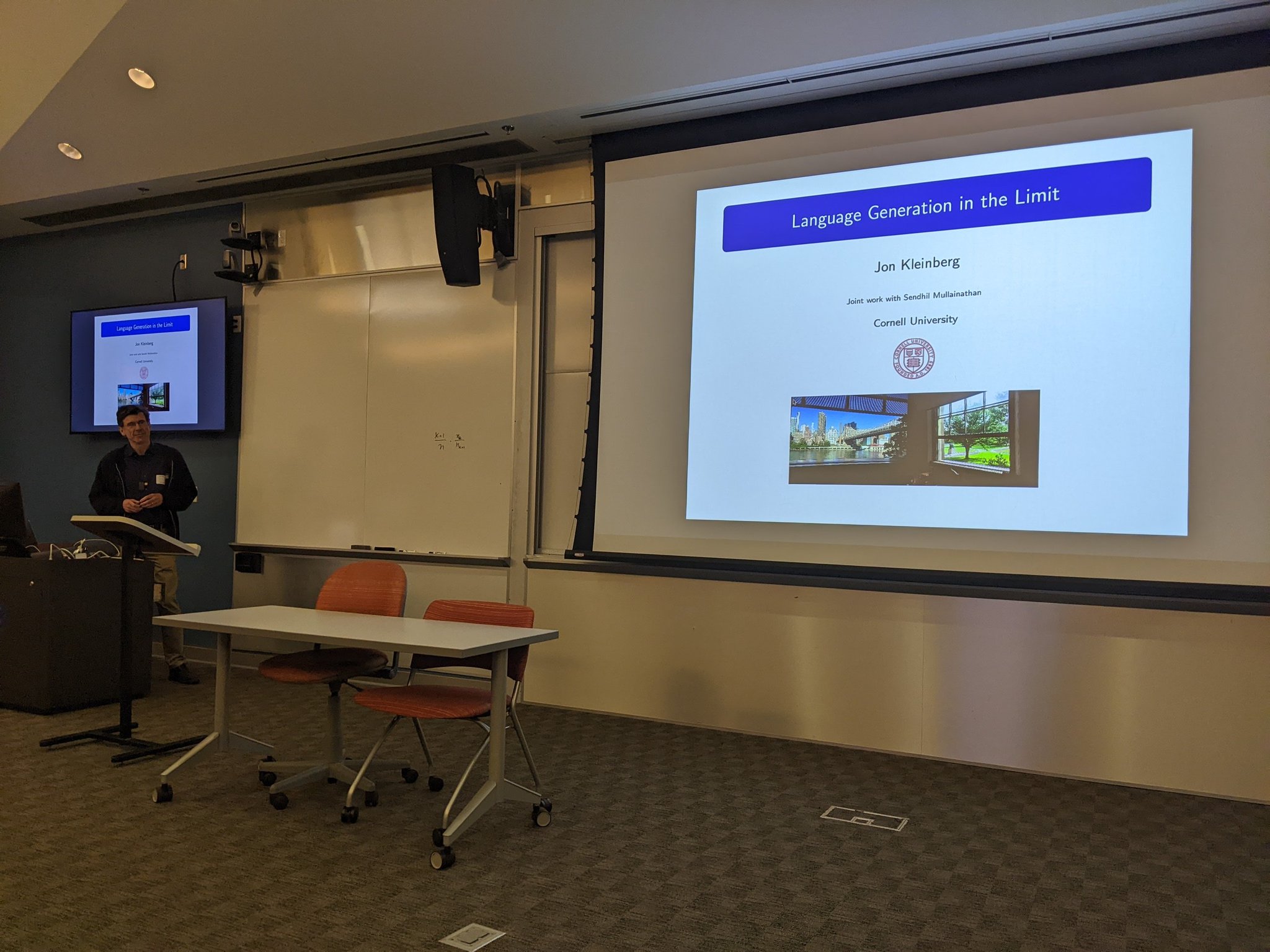
Language Identification vs Generation: Revisiting Gold’s Classic Result
By
–
Super cool talk and result. Classic work by Gold in 1967 (!) shows that language identification is impossible. But they revisit this setting with a focus on *generation* showing it's always possible.
-
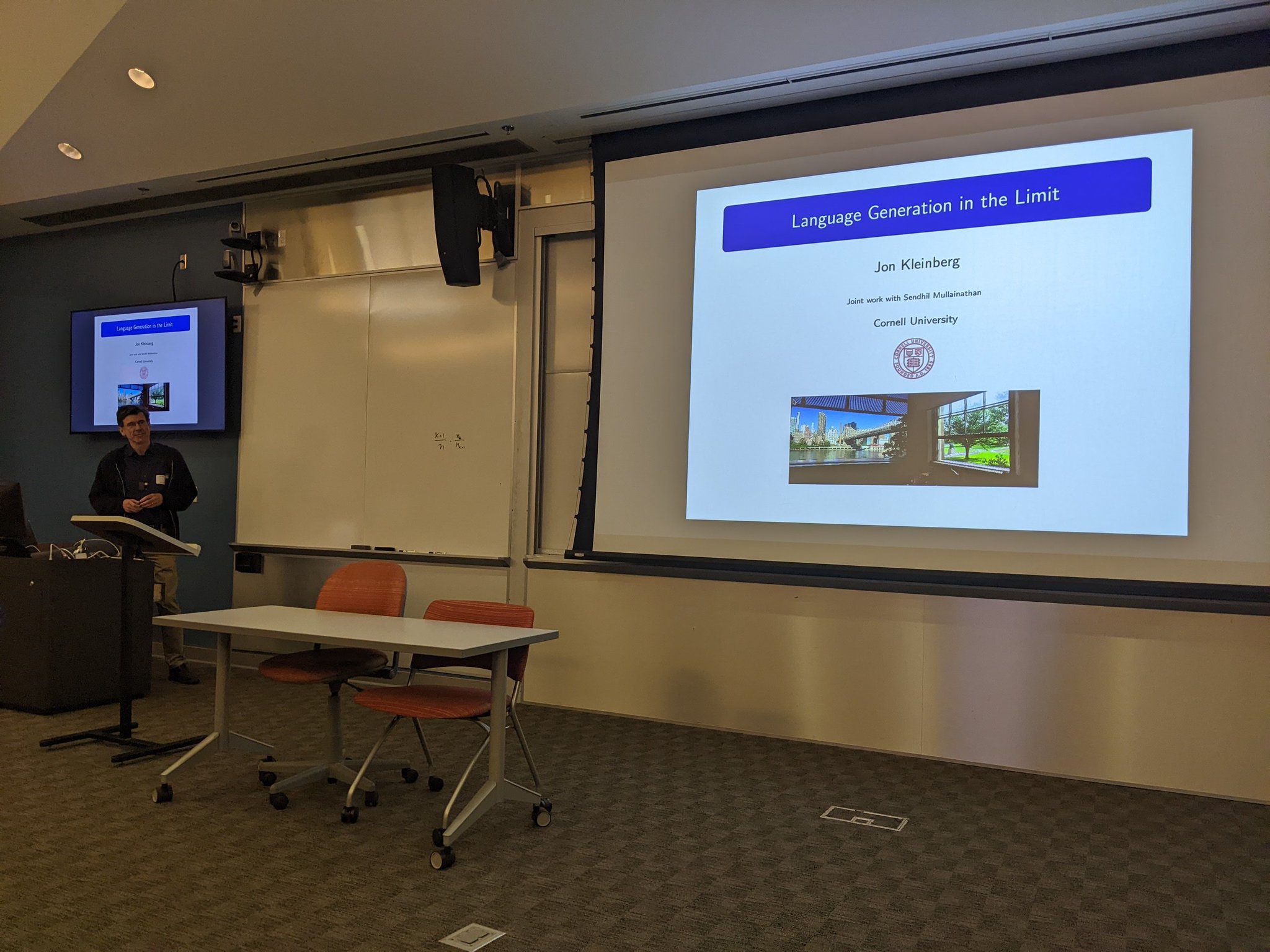
Jon Kleinberg presents Language Generation in the Limit
By
–
Second talk of the day is by Jon Kleinberg, on "Language Generation in the Limit"