Learn how to fine-tune #LLMs like #Llama2 with open-source @ludwig_ai
. Save your spot and get the free #notebook. We'll cover techniques like #deepspeed, full #finetuning, LoRA, and QLoRA, and optimizing training costs and compute. Register here: https://
pbase.ai/3qyseIy.
@predibase
-
Fine-tune LLMs with Ludwig: Free Workshop on Llama2 Techniques
By
–
-
Comparing LLMs: Llama2 vs OpenAI A/B Testing Workshop
By
–
There are a lot of options when it comes to choosing an #LLM. So how do you choose which option is right for you? Check out this virtual workshop "#Llama2 or OpenAI? How to compare LLMs using A/B testings" with @Predibase Data Scientist, @DalianaLiu
. -
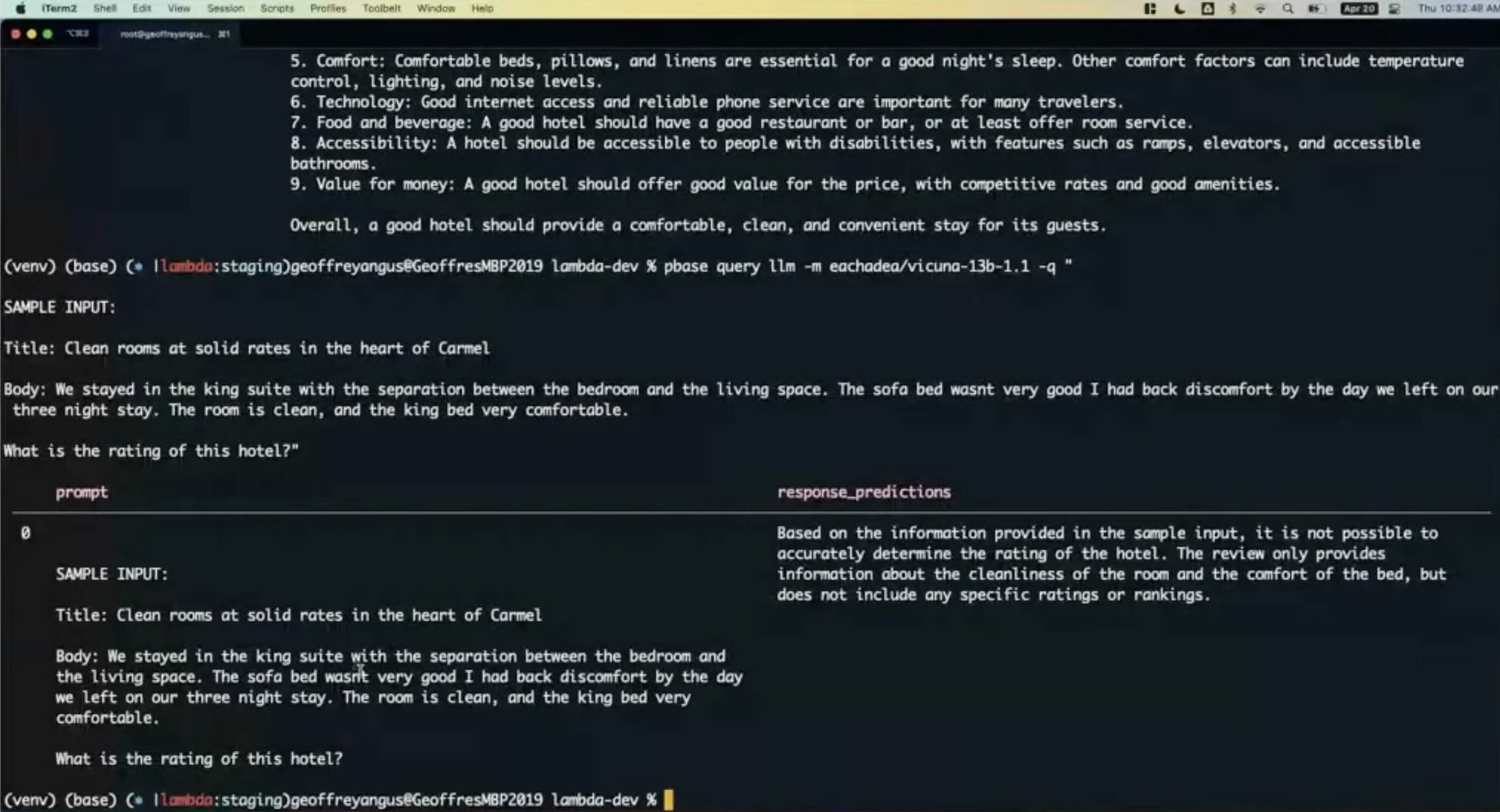
Learn LLMs with Hotel Rating Prediction Demo
By
–
Best way to learn about #LLMs is to see a real example! Here's a demo #predicting hotel ratings by analyzing reviews. Customer review demo: https://
youtu.be/wl0BrnSwCsg?t=
1573
… Want to get hands, check out our upcoming webinar: https://
pbase.ai/3qk0jfc. -
Ludwig v0.8: Open-Source Low-Code Framework for LLM Fine-Tuning
By
–
Announcing Ludwig v0.8—the first #opensource low-code framework optimized for building and #finetuning LLMs on your data. New features incl. fine-tuning, integrations w/ Deepspeed, parameter efficient fine-tuning (#LoRA), prompt templating and more!
-
Deploy and Fine-tune Open-Source LLMs with Ludwig AI
By
–
Want to learn how to deploy and #finetune open-source #LLMs on your own data the easy way? Join our hands-on webinar to learn about the latest release of open-source @ludwig_ai and how to build custom LLMs in just a few commands. Save your spot: https://
pbase.ai/3s1KiLy -
Operationalize LLMs with RAG and Open Source Models
By
–
Ready to operationalize LLMs? Get best-in-class #RAG with privately hosted #opensource LLMs on managed infra right in your #VPC thanks to @predibase and @llama_index
. • Check the docs: https://
gpt-index.readthedocs.io/en/latest/exam
ples/llm/predibase.html
… • Get the notebook: https://
colab.research.google.com/drive/1ESVuNhB
gAIgQ9RI56Coak5Jxhs9AyfG5?usp=sharing
… -
Loading Model Weights into GPU Memory with Ray Object Store
By
–
How did we do it? By loading the model weights into memory once before training begins and inserting them as numpy arrays into the #Ray object store, we can then zero-copy read the weights directly from shared memory into each GPU worker process.
-
Ludwig simplifies distributed computing with Ray backend integration
By
–
Doing this yourself would normally be a fair bit of cumbersome code, but in Ludwig you get it for free just by running with Ray as the backend runtime. Try it out for yourself: https://
pbase.ai/3qfet19 -
Optimized LLM Training Framework Reduces Host Memory Overhead
By
–
If you use an optimized #LLM training framework like https://
pbase.ai/3DHqnE5, you can get the host memory overhead back down to a more reasonable 7 * 4 = 28 GiB of host memory even when training on multiple GPUs. -
Loading Pretrained Checkpoints: Multi-GPU Memory Challenge
By
–
Before you even get to multi-GPU training with model parallel frameworks like #Deepspeed, you need to load the pretrained checkpoint into memory. To make matters worse for machines with multiple GPUs, you need to load the checkpoint into host memory once for each GPU in your job!