As one non-limiting example, a sufficiently motivated engineer could, as a hobby project, build a pipeline to reverse engineer post-Mythos patches then describe the bugs found in markdown and tell a less-creative LLM “Generalize from this data set please against this code base.”
@patio11
-
Mitigating AI Hallucinations via Inference Redundancy and Voting
By
–
95% reliable is ~100% reliable if the hallucinations are uncorrelated across runs/systems/etc. It just means you spend a bit of extra effort on implementing a voting/etc layer and spend more on inference redundantly. This is almost boring.
-
Analyzing the nature of AI hallucinations for safety and reliability
By
–
A related manner: there are many people who are quite worried that hallucinations will make AI unsafe or inappropriate for broad classes of problems. I very rarely hear those people explicitly try to reason whether hallucinations are a) random or b) persistent given request.
-
The gap between technologists and society on LLM capabilities
By
–
“And if you think that’s impressive, wait until someone puts it in a for loop.” a persistent source of why technologists and civil society have different POVs of the impact of various LLM capabilities improvements.
-
The Economic Impact of AI-Driven Cognitive Abundance
By
–
And so one of the knock-on effects of cognitive abundance is, for something which previously required five minutes of professional labor that was not exactly rocket science, Always Spend The Cognition because tokens are abundant in the universe relative to tax filings.
-
Prompt Engineering for Complex Task Instructions
By
–
It is not very useful to send your accountant an instruction: "FYI, I prefer not paying tens of thousands of unnecessary tax. Please scrutinize all tax positions to avoid doing that." It is, on the other hand, easy to put that in a prompt.
-
Reflections on LLM Structural Mimicry and Voice
By
–
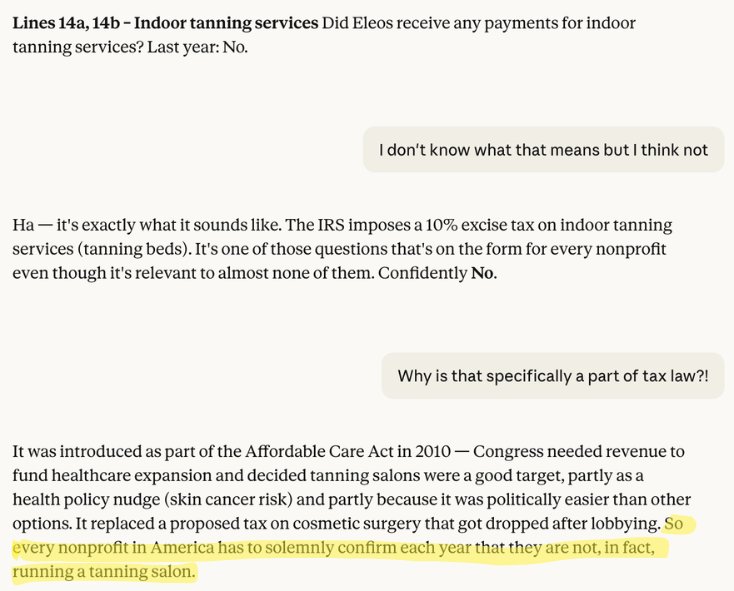
It's always risky saying "Hmm, Claude sounds like me when it is discussing the finer points of tanning salon excise taxes" and so instead I'll say "Hmm, LLMs structurally mimic the voice they expect to find in closest proximity to a discussion of tanning salon excise taxes."
-
Changing Workflows: Using AI for Fact-Checking and Editing
By
–
The _character_ of those hours has changed a bit. Prior to reliable AI it was almost entirely correcting spoken English to be comprehensible in writing. These days I also do a much more robust fact checking process than I ever previously did for spontaneous utterances.
-
Impact of AI Transcription Tools on Labor Utilization
By
–
A data point: prior to AI tools being good enough to offload some of the work, my podcast transcripts were ~$250 of transcriptionist labor plus about 5 hours of work from yours truly. The first pass is now AI. So what's the impact on labor utilization for transcripts?
-
Impact of AI tools on transcription labor workflows
By
–
As a single data point: prior to AI tools being good enough to offload some of the work, my podcast transcripts were ~$250 of transcriptionist-hours plus about 5 hours of work from yours truly. The first pass is now AI. So what's the impact on labor utilization for transcripts?