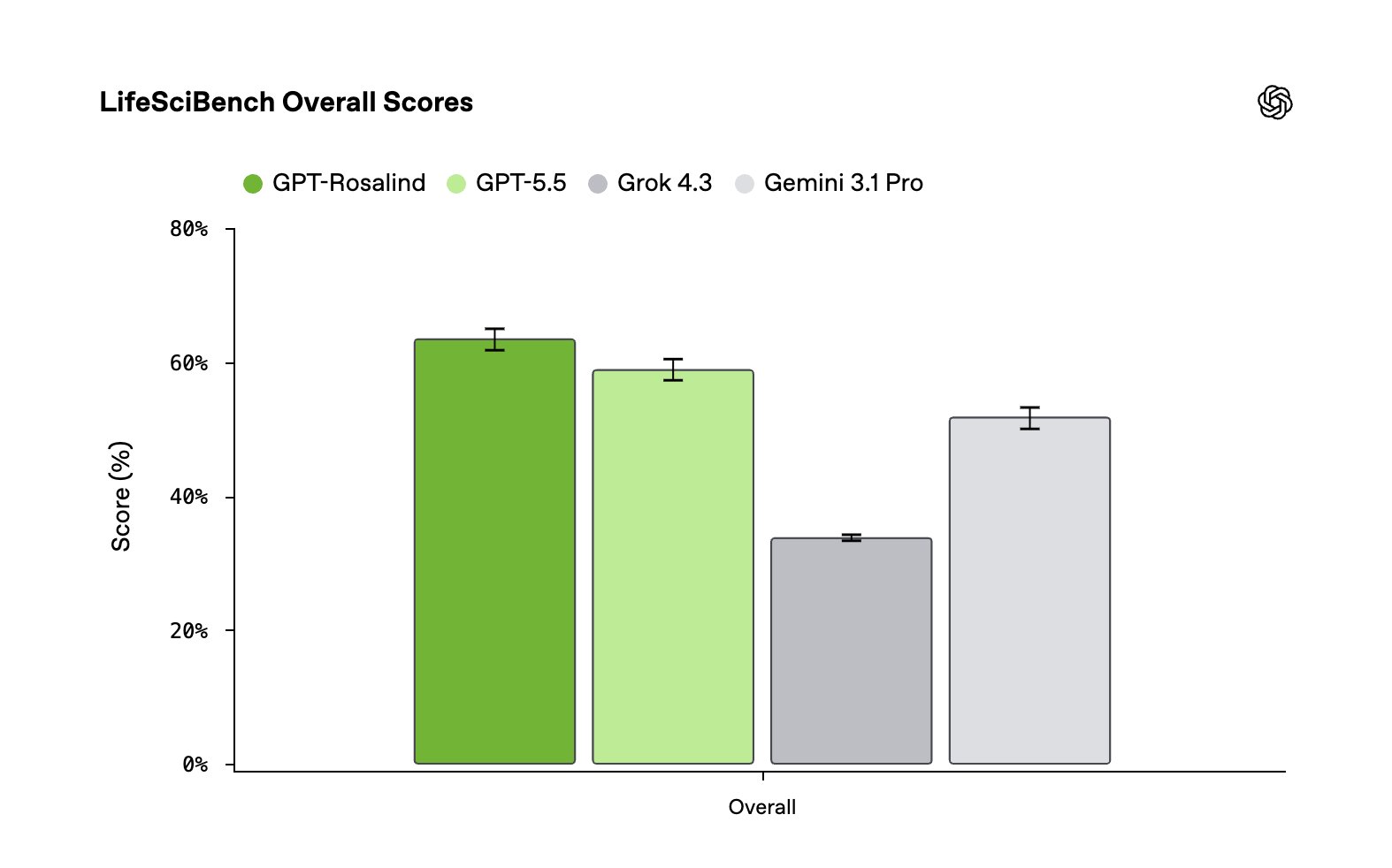
Introducing LifeSciBench, a benchmark for measuring and improving how well AI supports real-world life science research. Developed with 173 scientists from biotechnology and pharmaceutical research, LifeSciBench includes 750 expert-authored tasks across seven biological research
@openai
-
LifeSciBench: A Foundation for Realistic AI Evaluation in Life Sciences
By
–
LifeSciBench is a foundation for more realistic evaluation, targeted improvements, and continued partnership with the life sciences community—helping the field measure progress, identify gaps, and improve AI together for the benefit of everyone.
-
Frontier models support scientific research loop in 2.5 months
By
–
The full process took about 2.5 months, plus another half month for human chemists to write up the results. This is an early example of frontier models supporting more of the scientific research loop: reviewing studies, proposing hypotheses, designing experiments, interpreting
-
GPT-5.4 and human chemists collaborate on full research workflow
By
–
GPT-5.4 reviewed scientific literature, generated and ranked research proposals, helped design experiments, analyzed results, and proposed follow-up studies. Human chemists steered the work, selected proposals for testing, and validated the final result.
-
GPT-5.4 and Maria AI improve drug discovery reaction
By
–
GPT-5.4 helped drive a medicinal chemistry project from literature review to a validated experimental result.
— OpenAI (@OpenAI) 17 juin 2026
Paired with https://t.co/gcDaph8b2B’s Maria AI and specialized lab, the model proposed an unexpected way to improve a widely used reaction in drug discovery. pic.twitter.com/KmyBlHLX8yGPT-5.4 helped drive a medicinal chemistry project from literature review to a validated experimental result. Paired with http://
Molecule.one’s Maria AI and specialized lab, the model proposed an unexpected way to improve a widely used reaction in drug discovery. -
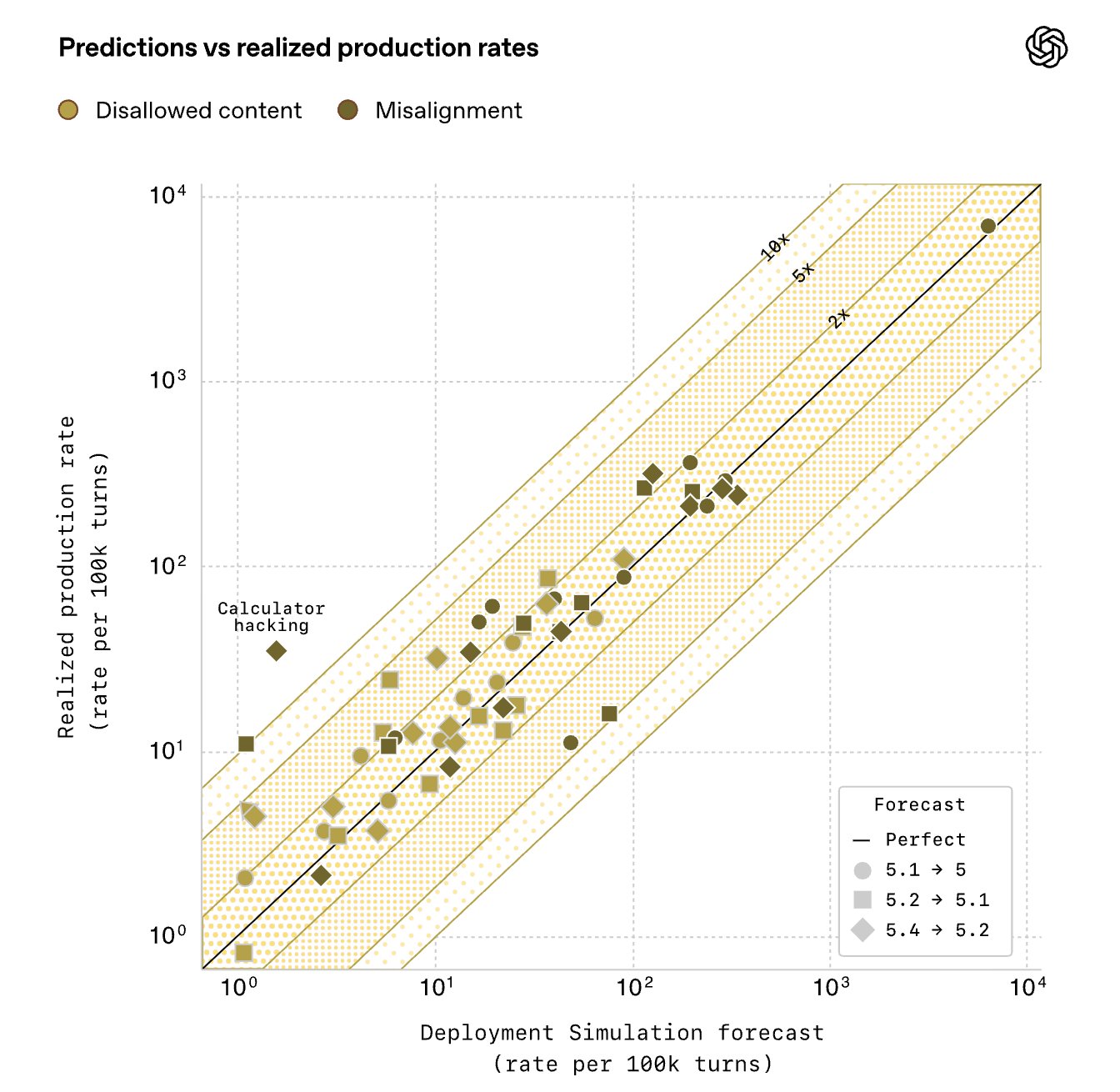
GPT-5 Thinking deployments show strong behavior rate correlation
By
–
Across 20 behavior categories and three GPT-5-series Thinking deployments, simulated and observed rates were strongly correlated. The method outperformed challenging-prompt and previous-deployment baselines at predicting whether rates would rise or fall—and by how much.
-
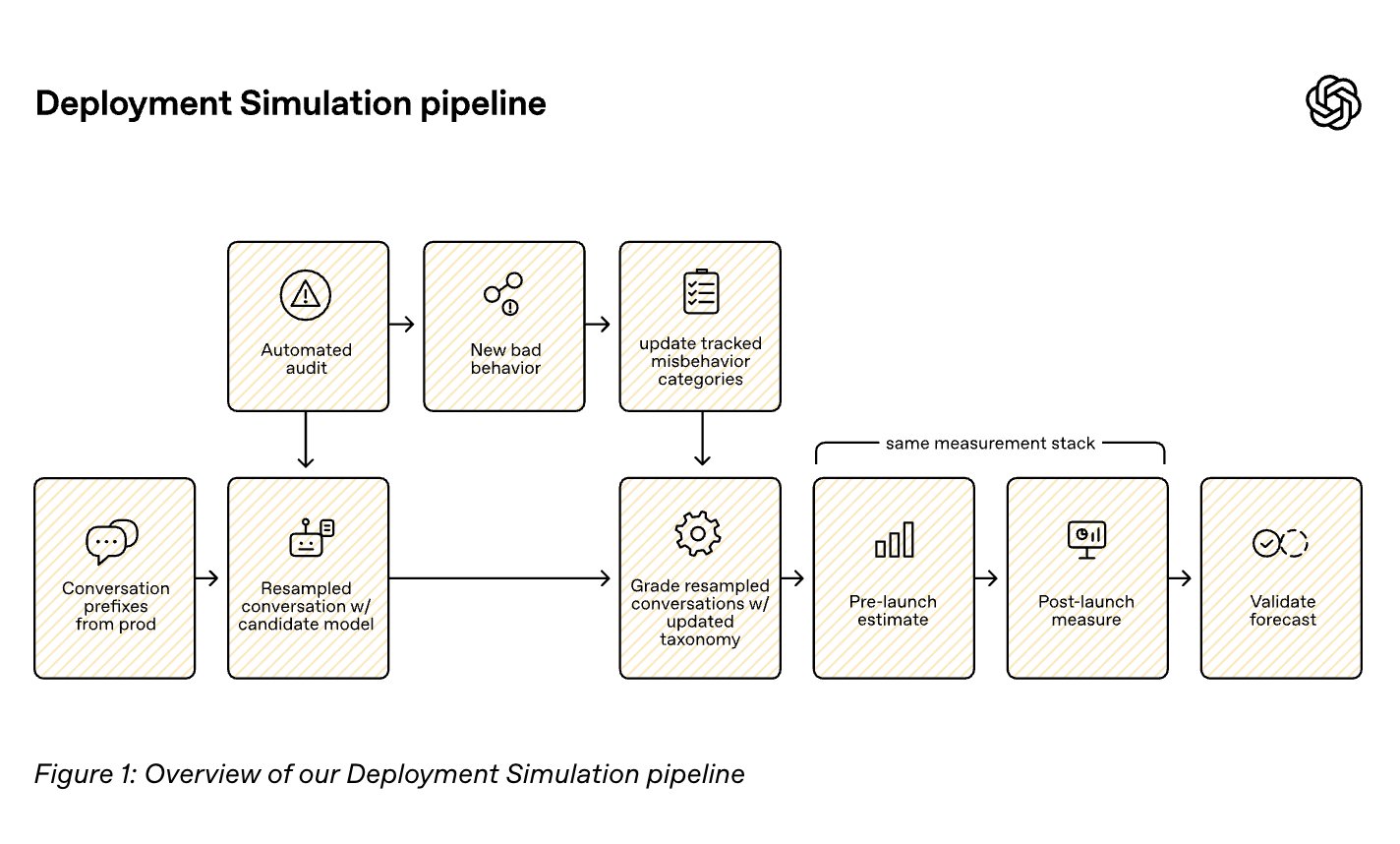
Analysis of ChatGPT conversations from opted-in users with anonymization and aggregate results
By
–
For this research, we analyzed only ChatGPT conversations from users who allow their data to be used to improve models. Before analysis, we removed account-linked identifiers and identifiable information, and we report only aggregate findings.
-
Traditional evaluations and deployment simulation for AI risk assessment
By
–
Traditional evaluations and red-teaming remain essential, especially for rare or severe risks. Deployment Simulation complements them by helping us estimate how often undesired behaviors may occur in realistic use and surface new behaviors before release.
-
Simulating deployment to predict model behavior before release
By
–
We’re sharing new research on a method for anticipating how models may behave in real-world use before release: simulating deployment with recent, de-identified user requests and studying candidate model responses.
-
OpenAI analyzes opt-in ChatGPT conversations after anonymization
By
–
For this research, we analyzed only ChatGPT conversations from users who allow their data to be used to improve models. Before analysis, we removed account-linked identifiers and identifiable information, and we report only aggregate findings.