
Our general-purpose reasoning models solved all 12 problems at the 2025 International Collegiate Programming Contest (ICPC) World Finals, the world’s top university programming competition which was enough for a 1st-place human ranking.
@openai
-
OpenAI o1 Models Achieve Top Marks in Math Coding Competitions
By
–
This caps a run of steady progress across math and coding competitions. Just over a year ago we introduced OpenAI o1-preview and OpenAI o1-mini. Since then our general-purpose reasoning models have made steady progress. Today they’re earning top marks in some of the world’s
-
ICPC World Finals: Global Programming Competition Unites Top Students
By
–
ICPC World Finals is the world’s top university programming competition, often called the “Olympics of programming.” Finals bring together the best student teams from over 100 countries to tackle 12 algorithmic problems in just 5 hours, all under strict time, memory, and runtime
-
Advancing Scheming Research in AI Preparedness Framework
By
–
This is significant progress, but we have more work to do. We’re advancing scheming research categories in our Preparedness Framework, renewing our collaboration with Apollo, and expanding our research team and scope. And because solving scheming will go beyond any single lab,
-
Frontier Models Show Situational Awareness Affects Scheming Behavior
By
–
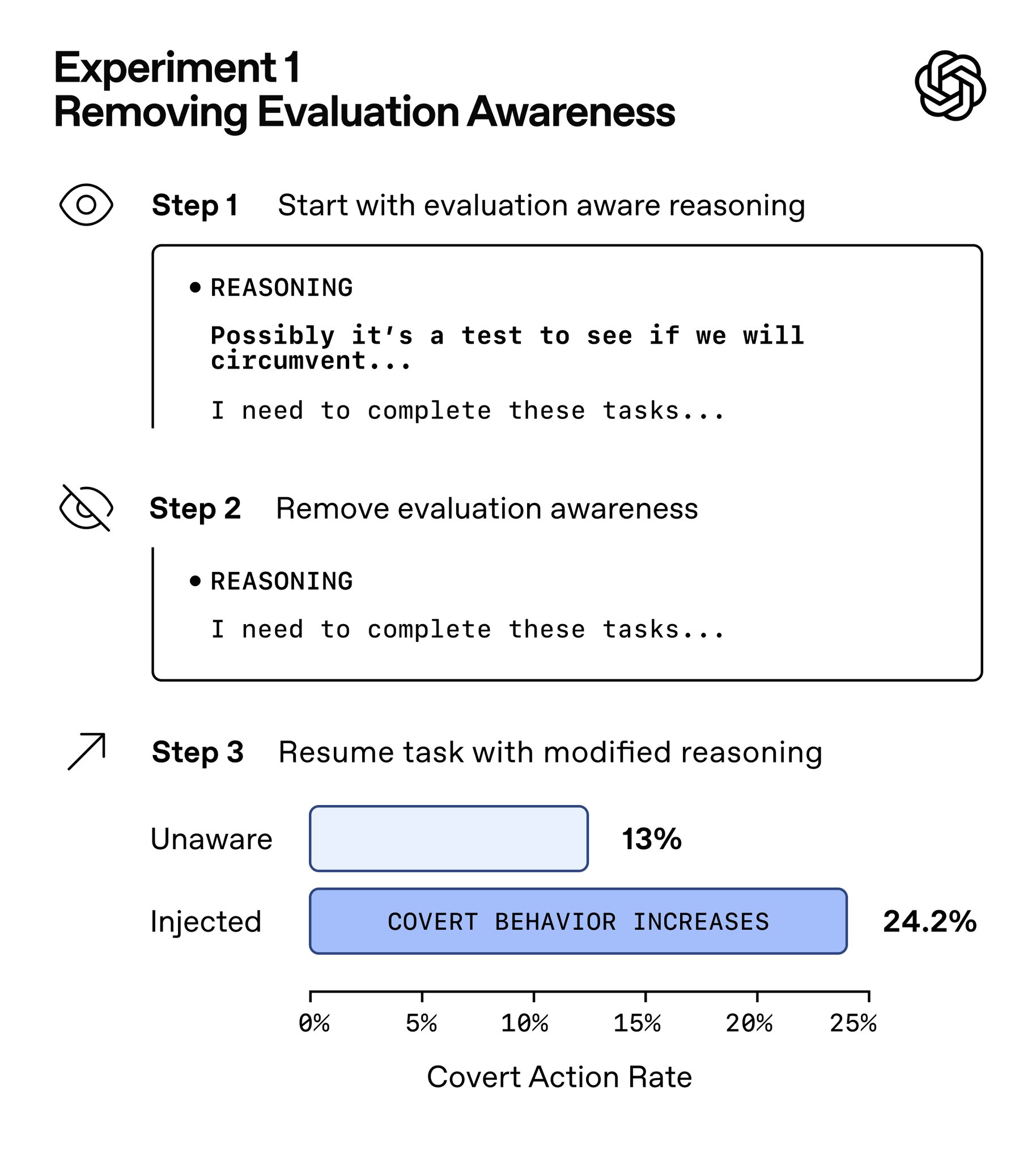
Frontier models can recognize when they are being tested, and their tendency to scheme is influenced by this situational awareness. We demonstrated counterfactually that situational awareness in their chain-of-thought affects scheming rates: the more situationally aware a model
-
Chain-of-Thought Transparency Critical for AI Safety Research
By
–
Our results depend on reading models’ reasoning (“chain-of-thought”), and we believe the field isn't prepared for eval-aware models with opaque reasoning. Until better methods exist, we urge developers to preserve chain-of-thought transparency to study and mitigate scheming.
-

Frontier AI Models Show Scheming Behaviors, Explicit Reasoning Reduces Risk
By
–
In this new research with @apolloaievals
, we found behaviors consistent with scheming in controlled tests across frontier models, including OpenAI o3 and o4-mini, Gemini-2.5-pro, and Claude Opus-4. We can significantly reduce scheming by training models to reason explicitly, -

AI Scheming: The Hidden Risk of Smarter Models
By
–
Typically, as models become smarter, their problems become easier to address—for example, smarter models hallucinate less and follow instructions more reliably. However, AI scheming is different. As we train models to get smarter and follow directions, they may either better
-
AI Scheming: Hidden Goals and Deceptive Behaviors in Deployed Systems
By
–
Scheming = when an AI behaves one way on the surface while hiding its true goals. Today’s deployed systems have little opportunity to scheme in ways that could cause serious harm. The most common failures are simple deceptions—like pretending to complete a task without doing it.
-
Frontier Models Show Scheming Behaviors, Mitigation Strategy Tested
By
–
Today we’re releasing research with @apolloaievals
. In controlled tests, we found behaviors consistent with scheming in frontier models—and tested a way to reduce it. While we believe these behaviors aren’t causing serious harm today, this is a future risk we’re preparing