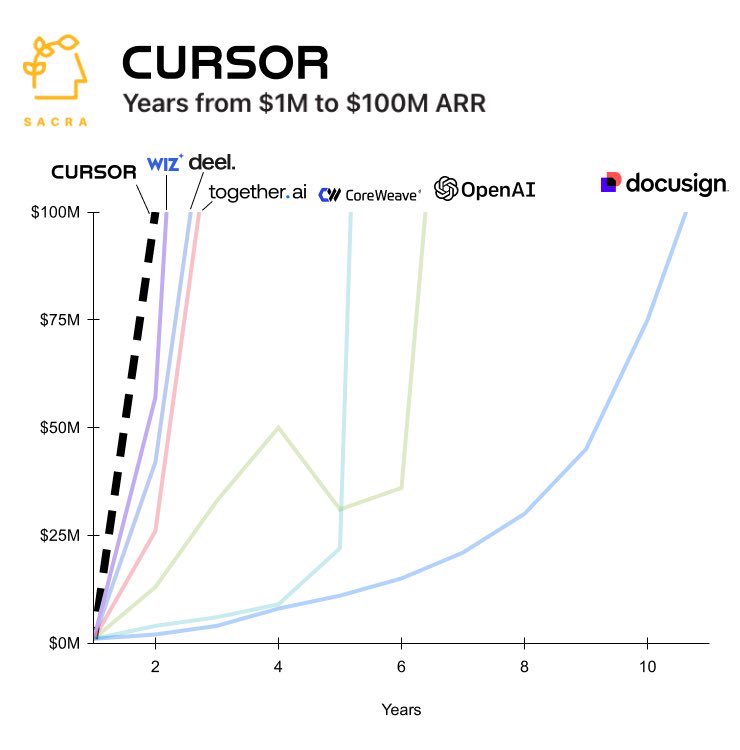
The fastest growing software product of all time: the AI Code Editor. Knowledge work automation Act I.
@ninadschick
-
AI Already Replacing Workers Despite Common Predictions
By
–
‘You won’t be replaced by AI, you’ll be replaced by someone using AI’ is already proving to be untrue. (and I said that too!)
-
AI Automation Threatens Mid-Level IT and Knowledge Work
By
–
“The Revolution eats itself.” AI adjacent industries – IT/programming – is where mid-level roles are being automated first. All knowledge industries next.
-
Chinese Hedge Fund Open Source OS Model Disrupts AI Market
By
–
That’s the irony, duh. The best OS model came from a Chinese hedge fund. The operative words here being ‘open source.’ That API already being built upon by hundreds of thousands of developers. (97% cheaper than Open AI’s.)
-
Reinforcement Learning AI Models Demand Infinite Computational Resources
By
–
And that’s before we flip into a version of training AI models through RL that has an infinite hunger for compute.
-
Chain of Thought merchandise and Google search disruption impact
By
–
100% love the COT too. Need to get that MERCH ASAP! Wonder what happens to Google revenue when the rest of the world twigs on to new search?
-
How AI Represents Knowledge Differently Than Humans
By
–
Epistemology—the study of knowledge—has always been a human endeavor. But AI represents knowledge in ways we barely understand. It doesn’t store facts like us. It doesn’t “reason” like us. Instead, it encodes vast statistical relationships in high-dimensional space. This
-
Mechanistic Interpretability: Understanding How LLMs Think
By
–
Fascinating insight from @tegmark on how LLMs ‘think.’ Because AI is a ‘black box,’ mechanistic interpretability—the emerging study of what goes on under the hood—is vital. One only wonders if our study of AI epistemology can keep up with AI itself. I don’t think it can.
-
AI Economics Shift: Inference and RL Drive Future Costs
By
–
And for those arguing this means less reliance on compute—it actually means more.
 The game is shifting. The biggest costs aren’t just in pre-training on human data anymore.
 It’s on inference and new training techniques like reinforcement learning to drive the next