Sandboxes must achieve 2 things at the same time… The speed of a serverless function. You cannot make an agent wait 2 minutes for a VM to start. It must offer the persistent state of a complete machine. Agents are not
@langchain
-

LangSmith LLM Gateway: Anonymizes Data and Controls Costs
By
–
LangSmith LLM Gateway sits between your agents and LLM providers. It applies spending limits and anonymizes personal data (PII) before requests reach the model, stopping problems at the source rather than simply
-
Steering Deep Agents via HITL Primitives
By
–
Deep Agents deep dive part 4 | Steering@sydneyrunkle on how the Deep Agents harness supports steering via first-class HITL primitives. pic.twitter.com/DYfLGkzDSP
— LangChain (@LangChain) 18 juin 2026Deep Agents: Deep Dive Part 4 | Steering @sydneyrunkle on how Deep Agents support enables steering via first-class HITL primitives.
-
Iteratively improve your agents for production with LangSmith
By
–
✅ Take your agent from first run to production-ready through iterative cycles of improvement.
— LangChain (@LangChain) 18 juin 2026
✅ Learn how to observe and evaluate agents with LangSmith
✅ Build reliable agents that last pic.twitter.com/pXS87Pk47xTake your agent from first run to production-ready with iterative improvement cycles. Learn to observe and evaluate agents with LangSmith. Build reliable agents that last.
-
Managed Deep Agents: Solution for Production Execution
By
–
Building a useful agent is becoming easier. Running them in production remains difficult. We built Managed Deep Agents so your team can focus on agent behavior rather than rebuilding the execution environment around it.
-

LangSmith sandboxes now first-class environment in Harbor
By
–
LangSmith sandboxes are now a first-class environment in @harborframework Installation:
pip install "harbor[langsmith]" Authentication:
export LANGSMITH_API_KEY="" That's it. Your evaluations are now ready to run -
Economic exploitation of unique signals: LangChain Labs study
By
–
We partnered with @FireworksAI_HQ to answer the following question… How can we economically exploit important signals from each unique trace while maintaining state-of-the-art performance? Read our LangChain Labs study
-
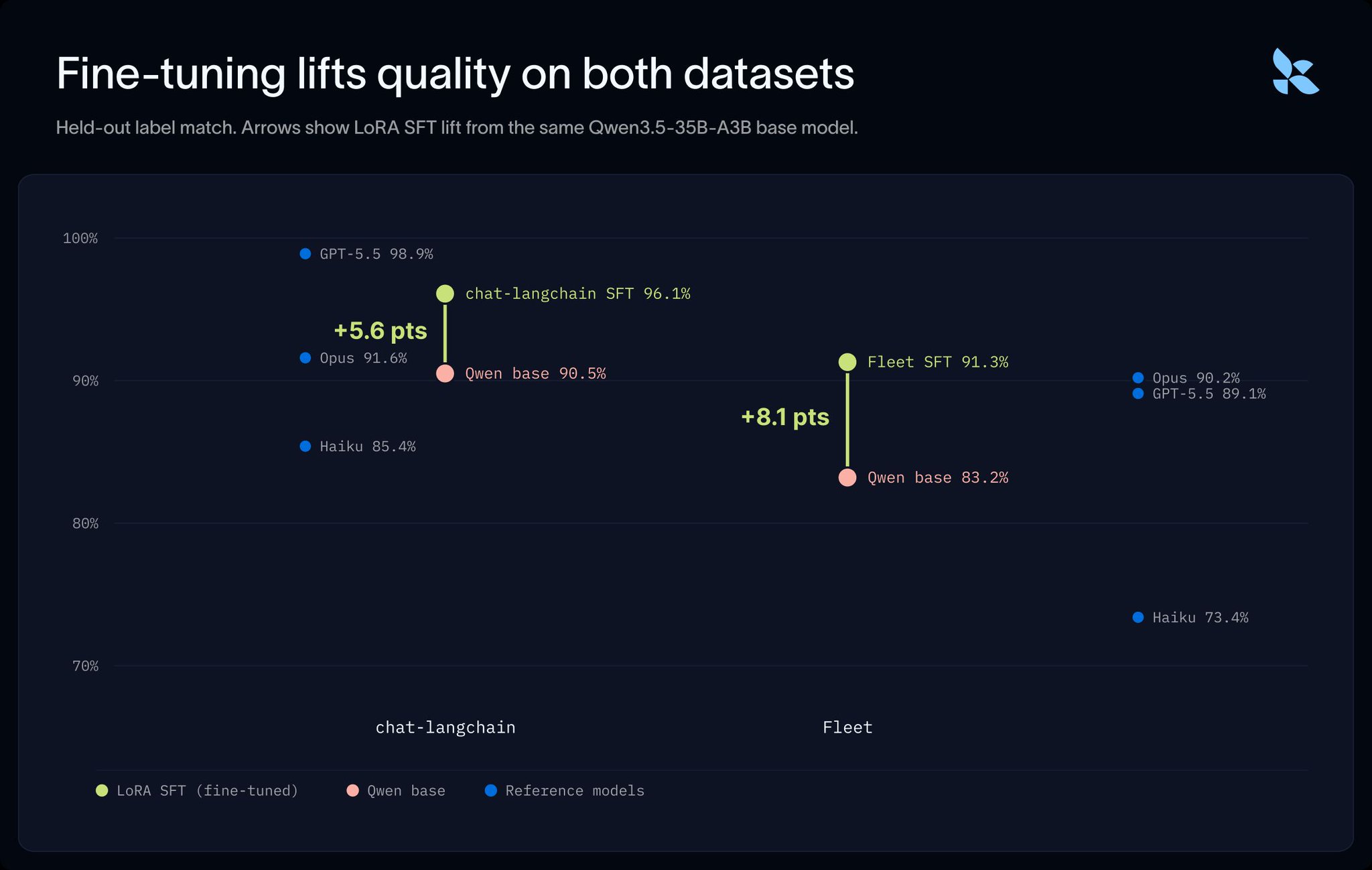
Fine-tuning open models can surpass state-of-the-art models
By
–
Fine-tuning open models can surpass or match state-of-the-art models. Base
@Alibaba_Qwen
out of the box with good prompting:
Solid for perceived error classification, below state-of-the-art model performance. With a LoRA SFT job:
Both -
Deep Agents Part 3: Delegation with Built-in Sub-Agents
By
–
Deep Agents deep dive part 3 | Delegation
— LangChain (@LangChain) 17 juin 2026
TLDR:
A planning tool that allows the model to organize work for challenging tasks.
Equipped with subagent support out of the box.
A 90 second explanation from @SydneyRunkle pic.twitter.com/6GTyaGjpegDeep Agents deep dive part 3 | Delegation TLDR:
A planning tool that allows the model to organize work for complex tasks. Equipped with built-in support for sub-agents from the start. A 90-second explanation by
@SydneyRunkle -
Introduction of On-Call Copilot, new agent model
By
–
Introducing On-Call Copilot – a new agent template in LangSmith Fleet
— LangChain (@LangChain) 17 juin 2026
→ Triages every alert and investigates root cause across your code and traces
→ Manages tickets and routes every incident to the right channels
→ Continuously learns from your runbooks, escalation rules,… pic.twitter.com/5SM2FmJE7LIntroduction of On-Call Copilot – a new agent model in LangSmith Fleet
→ Sorts each alert and investigates root cause across your code and traces
→ Manages tickets and redirects each incident to the right channels
→ Continuously learns from your