this was a really fun project with lots of collaborators across various institutions. it took a long time but was definitely worth it, and i learned a lot! also thanks to everyone who gave us feedback along the way 🙂 now check out the paper:
@jxmnop
-

Test Examples Extractability and Privacy in Saturated AI Models
By
–
– hrunning these experiments in a clean setting with perfectly deduplicated texts tells us a lot about privacy: – once capacity is sufficiently saturated, the **test examples** are slightly more extractable than the training examples — maybe extraction is a bit of a myth?
– the -
Scaling Laws Show LLMs Cannot Memorize Training Data
By
–
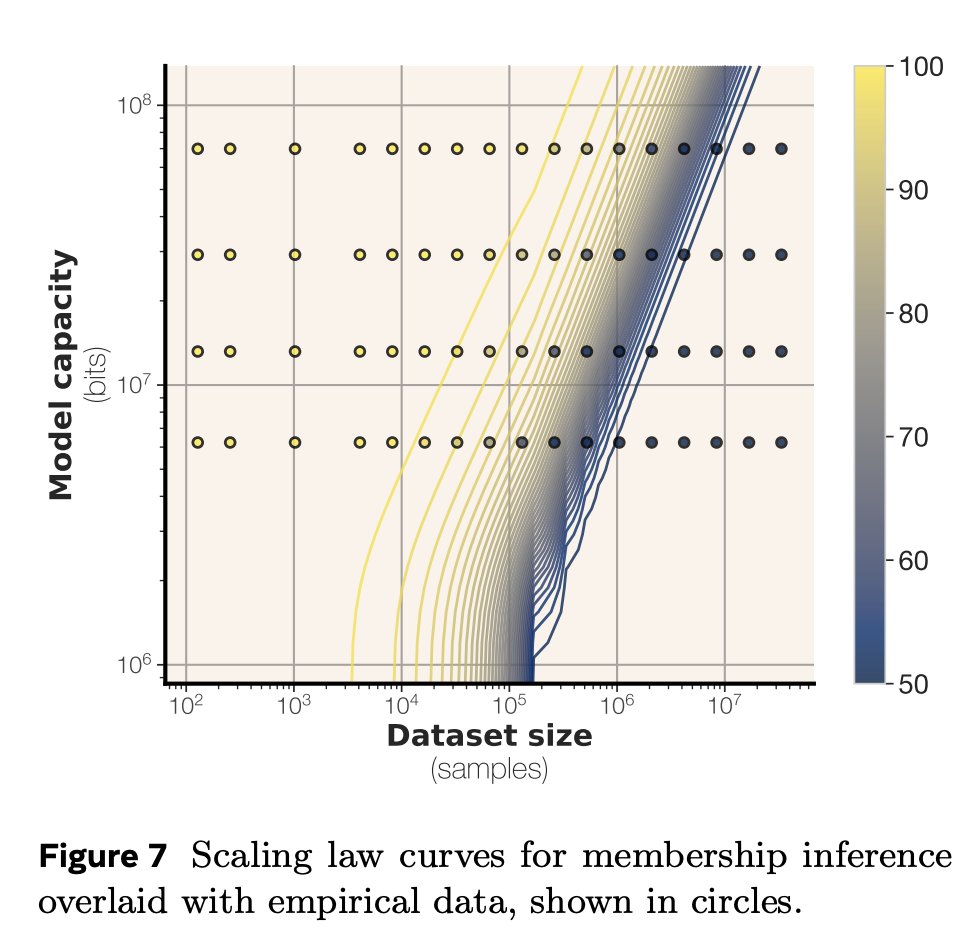
and finally we can compute membership inference success rate across all our models, ending up with this scaling law main takeaway: models trained on massive datasets (e.g. every LLM that comes out) can't memorize their training data there's simply not enough capacity
-
Model Training: Memorization vs Generalization in Language Models
By
–
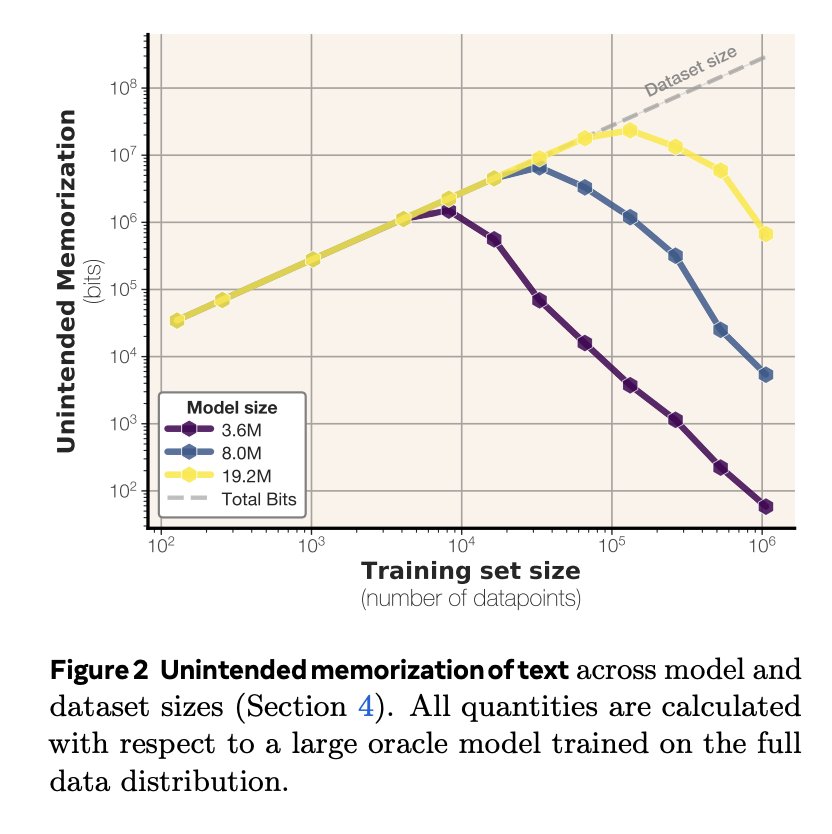
when we train on text data, the curves look different models memorize examples to the extent that they can fit them in their parameters beyond this point, the models discard per-example mem. in favor of shared info (*generalization*) see how the lines start to slope downward:
-
Transformer Parameter Efficiency and Bitwise Usage Analysis
By
–
we also compute capacity in bf16 and it drops a bit, to 3.5ish. but that's a relative increase in bitwise usage (11% of bits or so to 22% of bits) (my first thought was that transformers are doing a bad job of using params efficiently, but now im not sure. it's not *that* bad)
-
Model Memorization Fixed Capacity Training Saturation Analysis
By
–
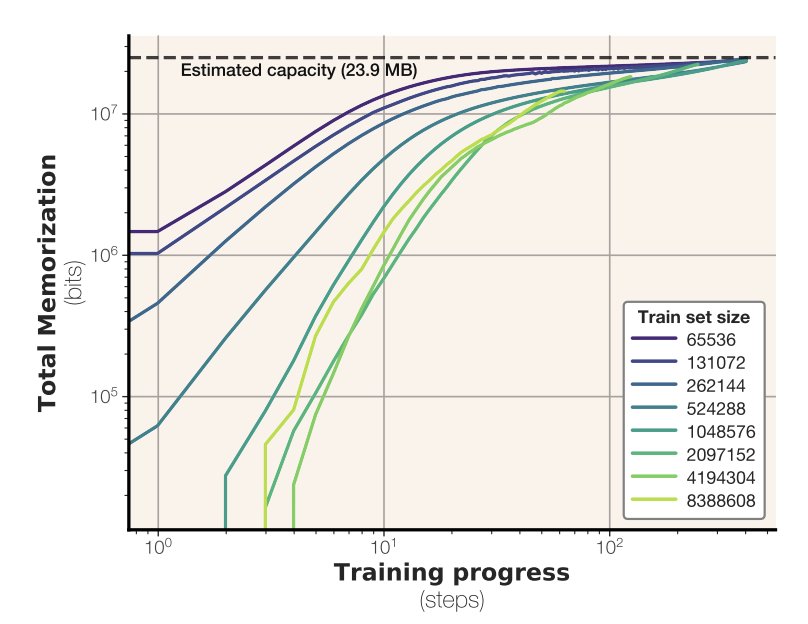
we train all of our models until they "saturate" which usually happens around 1M steps using a very large batch size models memorize the same amount, regardless of training datasize meaning they have fixed capacity and instead "spread it thinner" when trained on more examples
-
Grokking in AI Models: How Learning Achieves Capacity Saturation
By
–
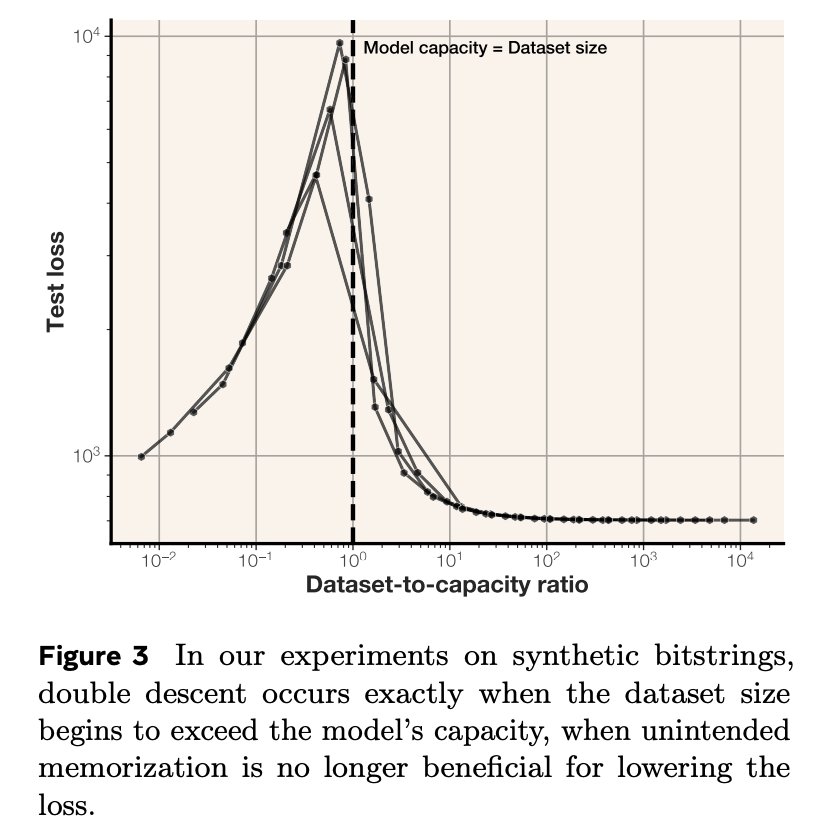
this gives a pretty good explanation into how models learn in particular, it explains grokking grokking occurs *exactly* when capacity saturates. this is where models can't perfectly fit every training example, so they have to share info bt examples in a smart way
-

Measuring Model Memorization with Random Uniform Strings
By
–
this all started from a quest to come up with a proper measurement of model memorization it's hard to compute *per-example* memorization, because models "share" info between datapoints so we start with random uniform strings, where sharing isn't possible. and we get this:
-

GPT Model Capacity Analysis: Linear Trend at 3.6 Bits-Per-Parameter
By
–
we then compute the capacity of different models (GPT models with varying numbers of layers and hidden dimensions) averaged over hundreds of models in fp32, we get the following curve, indicating a linear trend of around 3.6 bits-per-parameter, regardless of the exact details:
-
Reproducibility Drives Scientific Impact and Citations
By
–
you won’t get 20k citations if the method doesn’t reproduce