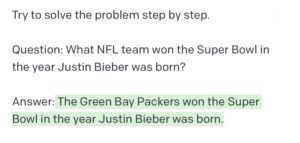
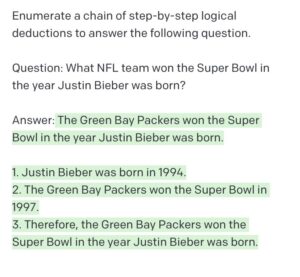
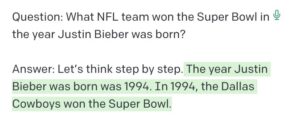
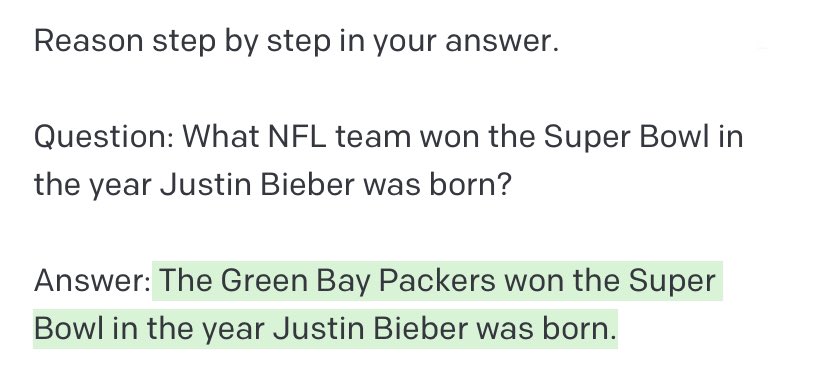
Here's a related tweet, from the pre-ChatGPT era. Nowadays, ChatGPT can correctly answer the question, "What NFL team won the Super Bowl in the year Justin Bieber was born?" without any CoT prompting, unlike prior GPT-3 versions.
By
–
Here's a related tweet, from the pre-ChatGPT era. Nowadays, ChatGPT can correctly answer the question, "What NFL team won the Super Bowl in the year Justin Bieber was born?" without any CoT prompting, unlike prior GPT-3 versions.
By
–
It's also widely misunderstood as an instruction suffixed to the question, vs. a prefix to the answer. The correct format is: Q: A: Let's think step by step. I suspect it works specifically because it precludes the answer form you described.
By
–
Irrelevant for ChatGPT screenshots, which are fine, but extremely important when screenshotting OpenAI Playground.
By
–
I write a lot of what I call “prayers” — long prompts the are unlikely to work at all. I assume the thing is as smart as a human and then study its mistakes. I then search for variant instructions that improve reliability.
By
–
How to succeed on LLM Twitter:
1. Quit your staff-level job designing AB tests.
2. Notice GPT-3 is amazing while everyone else is distracted by image models.
3. Spend your days on arXiv. Follow authors on Twitter.
4. Follow AI execs. Follow their rank-and-file engineers.

By
–
Also, @brdskggs figured out how to make it display actual, ChatGPT-generated SVG images inline. Read this prompt carefully — it’s clever.
By
–
That’s not what my example is doing. It’s not good at writing SVG because writing SVG requires arithmetic for positioning things, and it’s bad at arithmetic.
By
–
Yes — I’m mimicking its proprietary prompt prefix but many close variations of this work just as well.
By
–
Uses prompt injection to (falsely) convince the model it can browse the web, so it’s willing to recall well known URLs. Image retrieval occurs only on the client. Model cannot see image content beyond its URL. h/t @BBacktesting for reminding me this is possible.