OdysseyBench also includes detailed metadata: • Task → App count (1/2/3)
• Token count per session
• Turn-by-turn dialogue history
• Execution plan
• Expected output artifacts Which means… you can analyze why your agent failed, not just if it did.
@godofprompt
-
OdysseyBench: Advanced Metadata for AI Agent Debugging and Evaluation
By
–
-
Technical Configuration Tips for RAG System Optimization
By
–
RAG configuration tips from the paper: • Don’t over-retrieve; more context isn’t always better
• Chunk-level summaries are high ROI
• Tune top-k per task type
• Retrieval granularity (utterance vs session vs chunk) changes everything
• Align your memory format to how the -
GPT-4o Performance Analysis on OdysseyBench-Neo
By
–
Example: GPT-4o on OdysseyBench-Neo: • Long-context: 51.99%, 6.7K tokens
• RAG + chunk summary: 56.29%, 1.36K tokens Semantic compression ≫ brute-force memory More tokens ≠ more understanding. -
Memory design and retrieval strategies in AI models
By
–
Memory design matters more than model size OdysseyBench evaluated multiple retrieval strategies: • Long-context prompting (8K+ tokens)
• RAG with raw session or utterance context
• RAG with summarization: session or chunk Chunk-level summaries outperformed all, with ~75% -
Challenges with File Formats in AI Agent Workflows
By
–
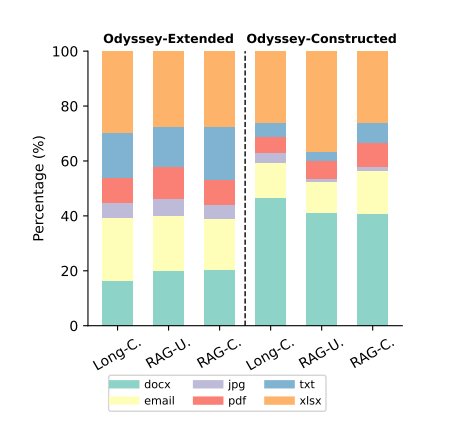
File formats that cause the most breakage? DOCX and XLSX Why? • Multi-step creation workflows
• Fragile API sequences
• Confusing dependencies across tools
• Easy to hallucinate filenames or paths -
Top 4 Failure Modes in AI Agent Execution
By
–
Top 4 Failure Modes: 1. Missing files – agent forgets to locate or read required inputs
2. Missing actions – agent skips subtasks (e.g., doesn’t write output)
3. Incorrect tool use – uses wrong app or API for the goal
4. Poor planning – jumps to execution before -
Evaluation Methodology for AI Agent Performance
By
–
Evaluation uses a mix of: • Exact/fuzzy matching on output files
• Execution-based checks (e.g., file created, event logged)
• Pass/fail based on fulfillment of all expected artifacts Every agent output is evaluated against the required plan, not just the final answer. -
Comparative Performance Analysis of LLMs Across Task Complexity
By
–
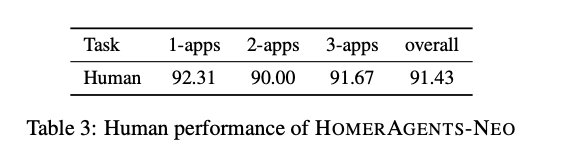
How do models perform? Human: 91%+
GPT-5: ~54%
GPT-4.1: ~36%
GPT-4o: ~52%
DeepSeek-R1: ~55% And here’s the kicker: 3-app tasks cause up to 3x degradation vs single-app tasks across all models. -
OdysseyBench Evaluates Core AI Agentic Competencies
By
–
OdysseyBench tests true agentic competence: • Contextual recall (across ~5K tokens)
• Multi-step reasoning
• Cross-app state tracking
• Intent inference through casual, noisy dialogue
• Tool execution (simulated, but grounded) It’s not toy data. It’s full workflow -

OdysseyBench and HOMERAGENTS: A Multi-Agent Generation Pipeline
By
–
OdysseyBench is built using HOMERAGENTS, a multi-agent generation pipeline: • HOMERAGENTS+: Converts atomic tasks into multi-turn workflows • HOMERAGENTS-NEO: Synthesizes entirely new tasks using simulated app exploration Each task is: • Goal-driven
• Dialogue-based
•