The meta-lesson from reverse-engineering Anthropic's library:
Prompt engineering isn't about clever tricks. It's about clear communication of: WHO should respond (role)
WHAT they should do (task)
HOW they should do it (process)
WHAT format to use (structure)
WHAT to avoid
@godofprompt
-
Mastering Prompt Engineering Fundamentals
By
–
-
Prefilled responses: underrated prompt technique
By
–
Tenth pattern: they use prefilled assistant responses. This is the most underrated technique in the entire library. Instead of just sending a prompt, Anthropic starts Claude's response.
API structure: { "messages": [ {"role": "user", "content": "Analyze this contract"}, -
Error Handling in AI Prompts
By
–
Ninth discovery: error handling is built into prompts. Anthropic anticipates edge cases and tells Claude how to handle them. If the input data is:
– Incomplete: State what's missing and make reasonable assumptions
– Contradictory: Identify the contradiction and -
Negative examples in prompt engineering
By
–
Sixth technique: constraint specification using negative examples.
Don't just say what you want. Say what you don't want. Standard approach: Write a professional email. Anthropic's method: Write a professional email that:
– Is concise (under 150 words)
– Has a -
Anthropic’s Thinking Tags for Complex Reasoning
By
–
Fifth discovery: they use thinking tags for complex reasoning. When the task requires multi-step logic, Anthropic explicitly asks Claude to show its work. Before answering, wrap your reasoning in tags.
Include:
– Assumptions you're making
– Alternative -
Complete Examples vs Fragments
By
–
Fourth pattern: examples are structured as complete documents, not fragments. Most people do this: Example: The cat sat on the mat. Anthropic does this: Translate "The cat sat on the mat" to French – "The cat" = "Le chat"
– "sat" = past tense of "sit" -

Anthropic’s granular role definition technique
By
–
Third technique: role definition goes way deeper than "you are an expert." Anthropic specifies expertise granularly. Weak role definition: You are a software engineer. Anthropic's method: Senior backend engineer with expertise in:
– Distributed systems architecture
– -

Separating Thought and Output in Prompts
By
–
Second pattern: they separate thinking from output. Most prompts blend everything together. Anthropic isolates the reasoning process. Standard prompt: Analyze this data and create a report. Anthropic's structure: First, analyze the data following these steps:
1. -
Claude’s XML tag obsession revealed
By
–
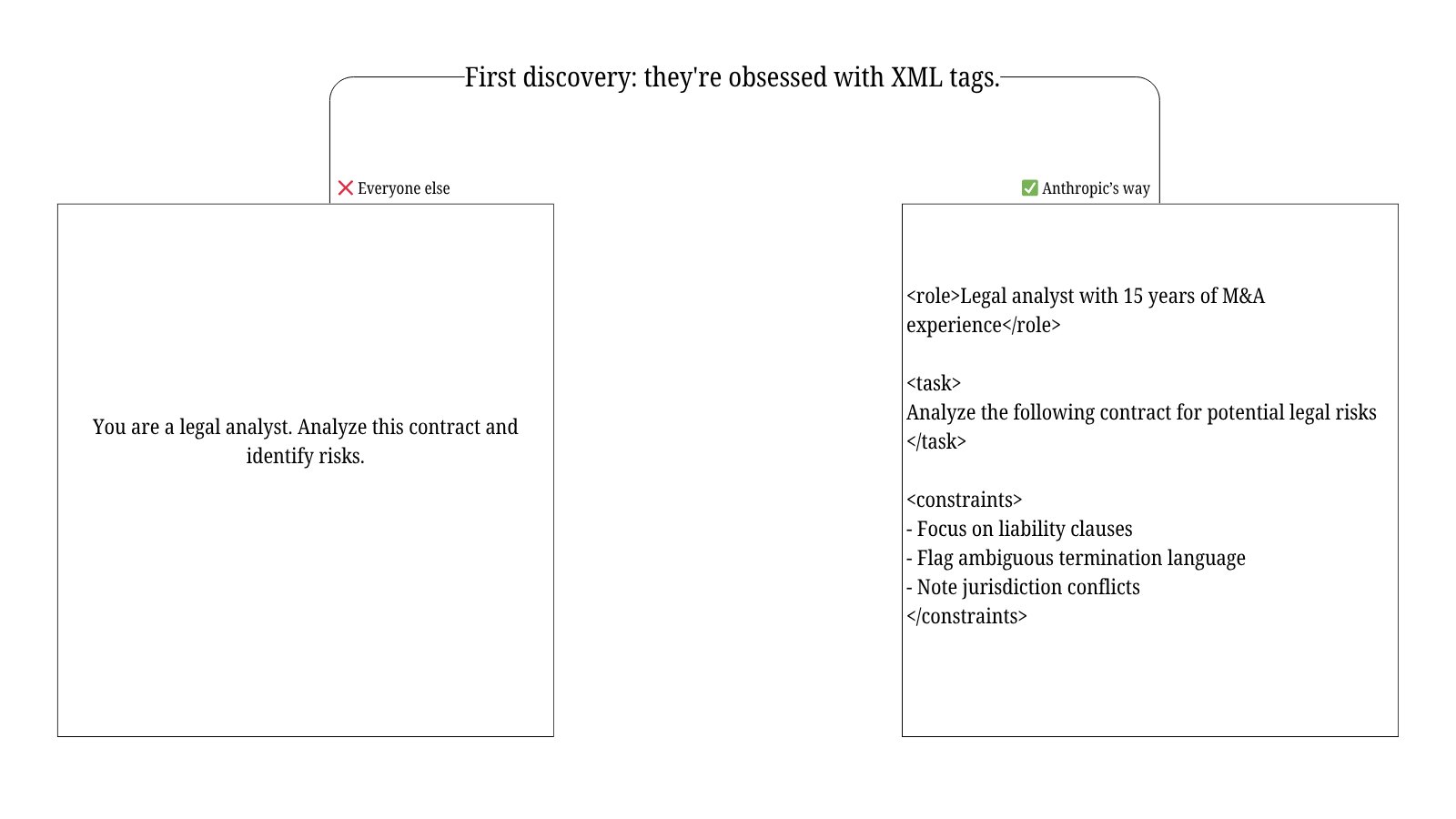
First discovery: they're obsessed with XML tags. Not markdown. Not JSON formatting. XML. Why? Because Claude was trained to recognize structure through tags, not just content. Look at how Anthropic writes prompts vs how everyone else does it: Everyone else: You are a legal
-
Anthropic’s Secret Prompting Techniques Revealed
By
–
Anthropic's internal prompting style is completely different from what most people teach. I spent 3 weeks analyzing their official prompt library, documentation, and API examples. Here's every secret I extracted