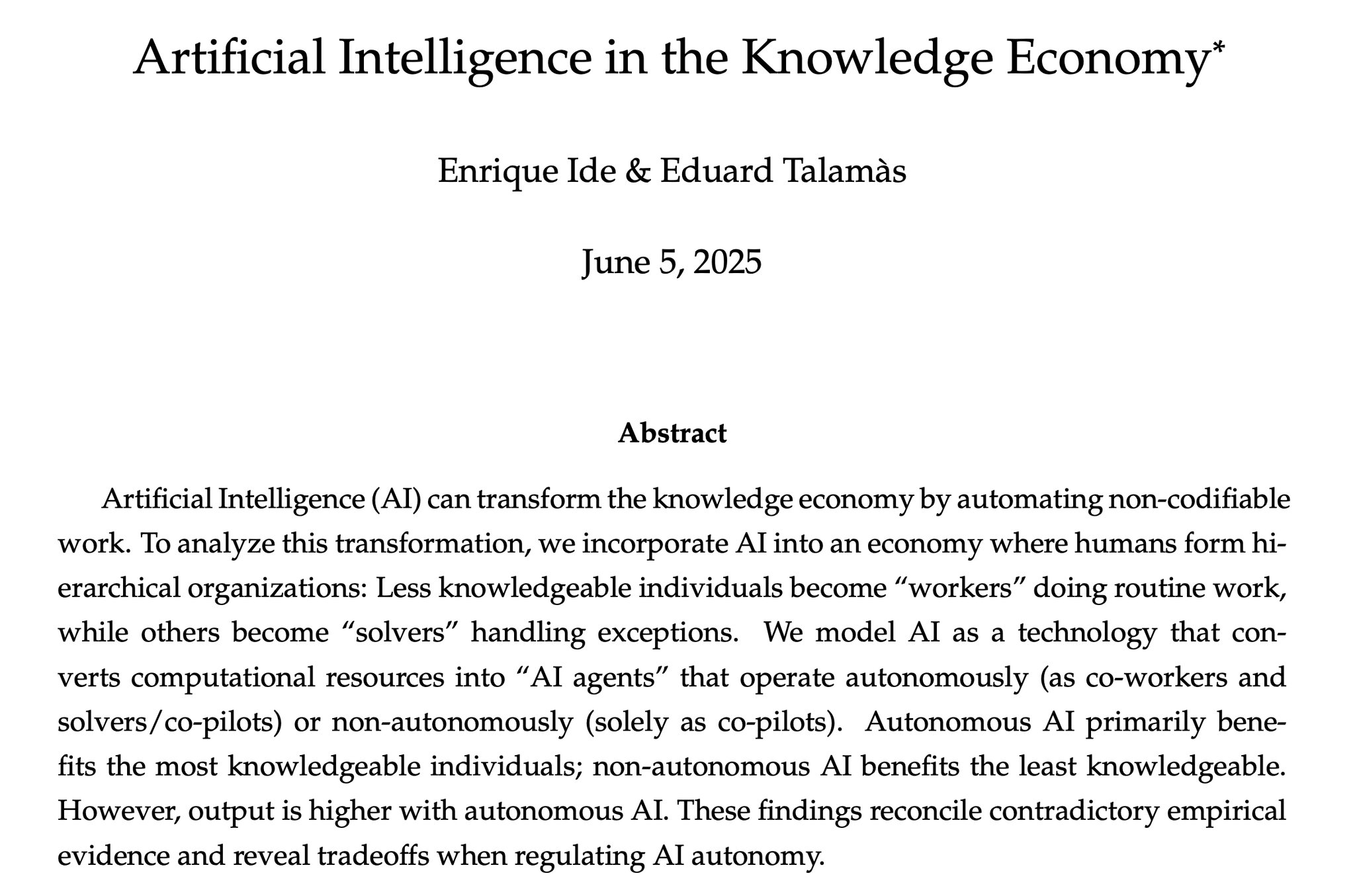
Now that we are getting some clearer signals from the labor market about how AI may be affecting employment of different groups, @ide_enrique provides a terrific thread tying together the key results with his new paper on AI in the Knowledge Economy with Eduard Talamas.
@erikbryn
-
Learning from AI experts in conversation
By
–
I always learn new things when I talk with @yshoham or @nxthompson.
— Erik Brynjolfsson (@erikbryn) 2 septembre 2025
I hope you enjoy this conversation as much as I did. https://t.co/V9wJb75lAOI always learn new things when I talk with @yshoham or @nxthompson
. I hope you enjoy this conversation as much as I did. -
The Gap Between Technical Innovation and Real Productivity
By
–
At the same time, it takes a long time — too long — to turn technical marvels into real productivity.
-
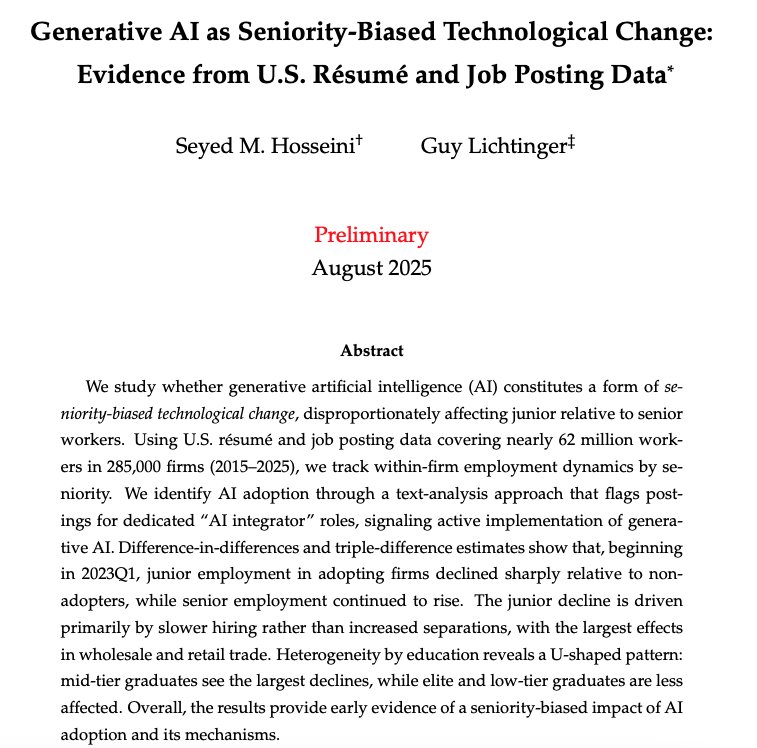
AI Impact on Young Worker Employment Levels Study
By
–
Here's a fascinating new paper by @SeyedMH98 and @LichtingerGuy about AI and the workforce. They use different methods and data sources than @econ_b, @RuyuChen
, and I do in our "canaries" paper, but they also find falling levels of employment for young workers in the -

AI Complements Experienced Workers Over Entry-Level Positions
By
–
.
@joshgans has a thoughtful interpretation of our "six facts" about AI and the labor market: AI may be complementing certain workers (the more experienced ones in highly exposed occupations), leading some firms to hire more them relative to those just starting their careers. -
Technology Hiring Trends Post-COVID Recovery Analysis
By
–
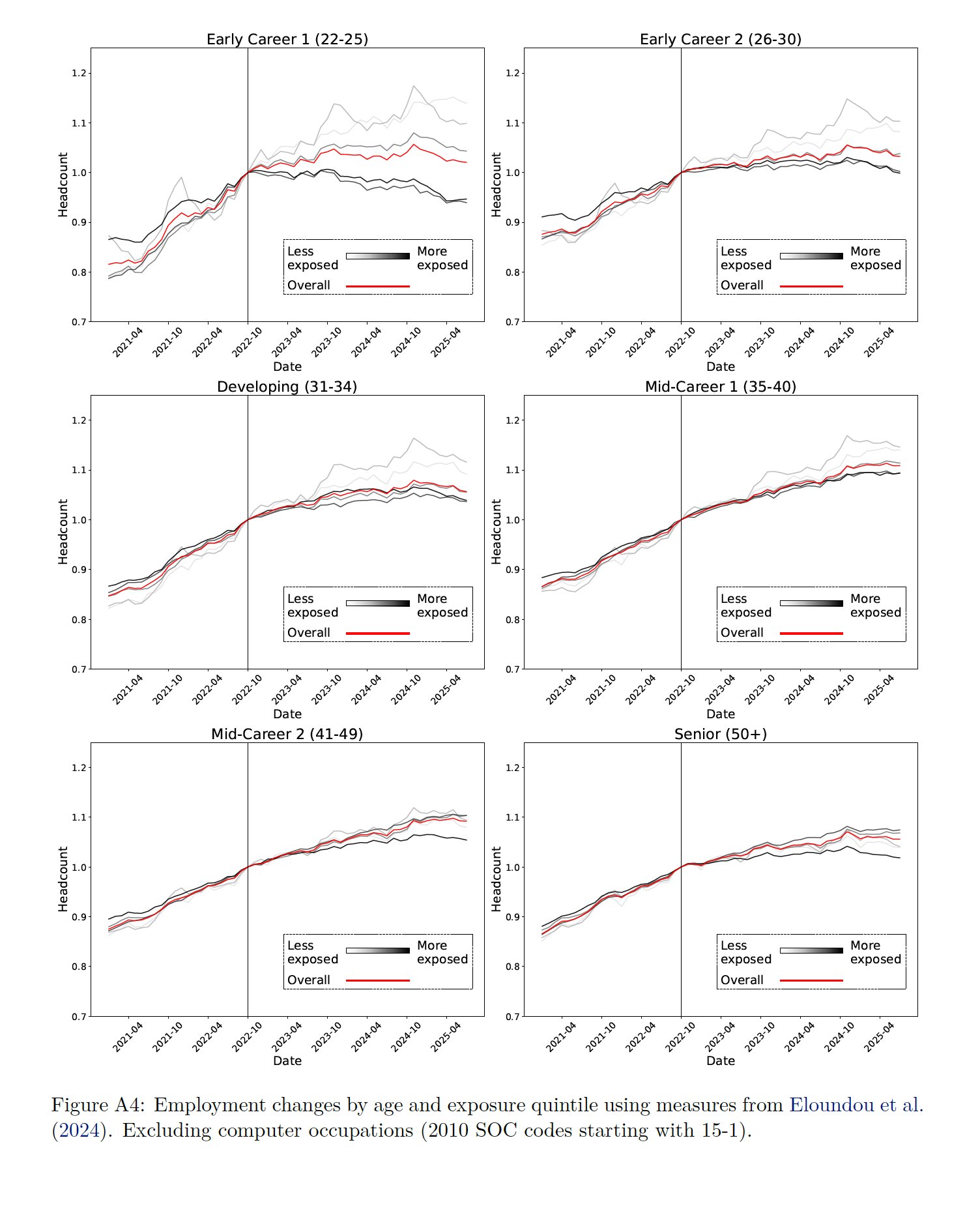
In section 4.6 we consider that "One possibility is that our results are explained by a general slowdown in technology hiring from 2022 to 2023 as firms recovered from the COVID-19
Pandemic." We do an analysis that excludes all computer occupations and get similar results. -
LLM Tools Impact on Worker Skills and Hiring Decisions
By
–
This is terrific. The story that AI complements certain skills and workers squares nicely with the facts we uncover. That said, it may be more complicated: I've spoken to many people involved in hiring, and they say that, at least in part, they also view LLM-based tools as
-
AI welfare gains exceed traditional consumer surplus sources
By
–
Yes, we should create a comprehensive estimate of all the sources of change in consumer surplus. We would likely find that much of the welfare increase created recently is not from water, AC, haircuts or cars, but from new goods that have low or zero price, like AI. Even if
-
Consumer Surplus Over GDP: Better Metric for AI Value
By
–
If you're interested in how much value increases when consumers get access to a good, a better metric is the change in consumer surplus not the change in spending or GDP. Sometimes changes in GDP are a good proxy for changes in consumer surplus, but not always. The ratio of
-
Measuring AI Value Creation in GDP Economics
By
–
Correct. Here's another way to get at the value created by AI (and other digital goods that are often missed or poorly measured in GDP: