Comic from today's newsletter: Monday's OpenAI announcement, Neuralink setbacks, Elevenlabs Music, 10 new AI Tools and the latest AI research papers:
@aibreakfast
-
Using AI to create comics for newsletter editions
By
–
Every edition of the newsletter, I use AI to create comics and feature them at the bottom of the email. Read it here:
-
DALL-E 3 produces image on first prompt, rare
By
–
DALLE-3, produced the image on the first prompt (rare)
-
Superintelligence crossing will be clear only in hindsight
By
–
There probably won’t be a “Look there it is, we did it!” Los Alamos moment, but the superintelligence line will be crossed at some point, however it is defined. It will be clear in hindsight.
-
Gap between most capable AI and second most capable will increase
By
–
Consider this: The gap between the “most capable” AI and the “second most capable” will actually increase with time.
-
Early AGI access limited to private company invitees
By
–
Assuming that AGI is eventually created by a [private] company, during the first few months between its creation and planned public release, it will live exclusively in the hands of a few hundred people. Those people will basically have invite-only access to an exponentially
-
Hierarchical 3D Gaussians: Research and Videos Available
By
–
Full research, more videos: https://
repo-sam.inria.fr/fungraph/hiera
rchical-3d-gaussians/
… -

Microsoft bans US police from facial recognition AI
By
–
Microsoft bans US police departments from using enterprise AI tool for facial recognition
-
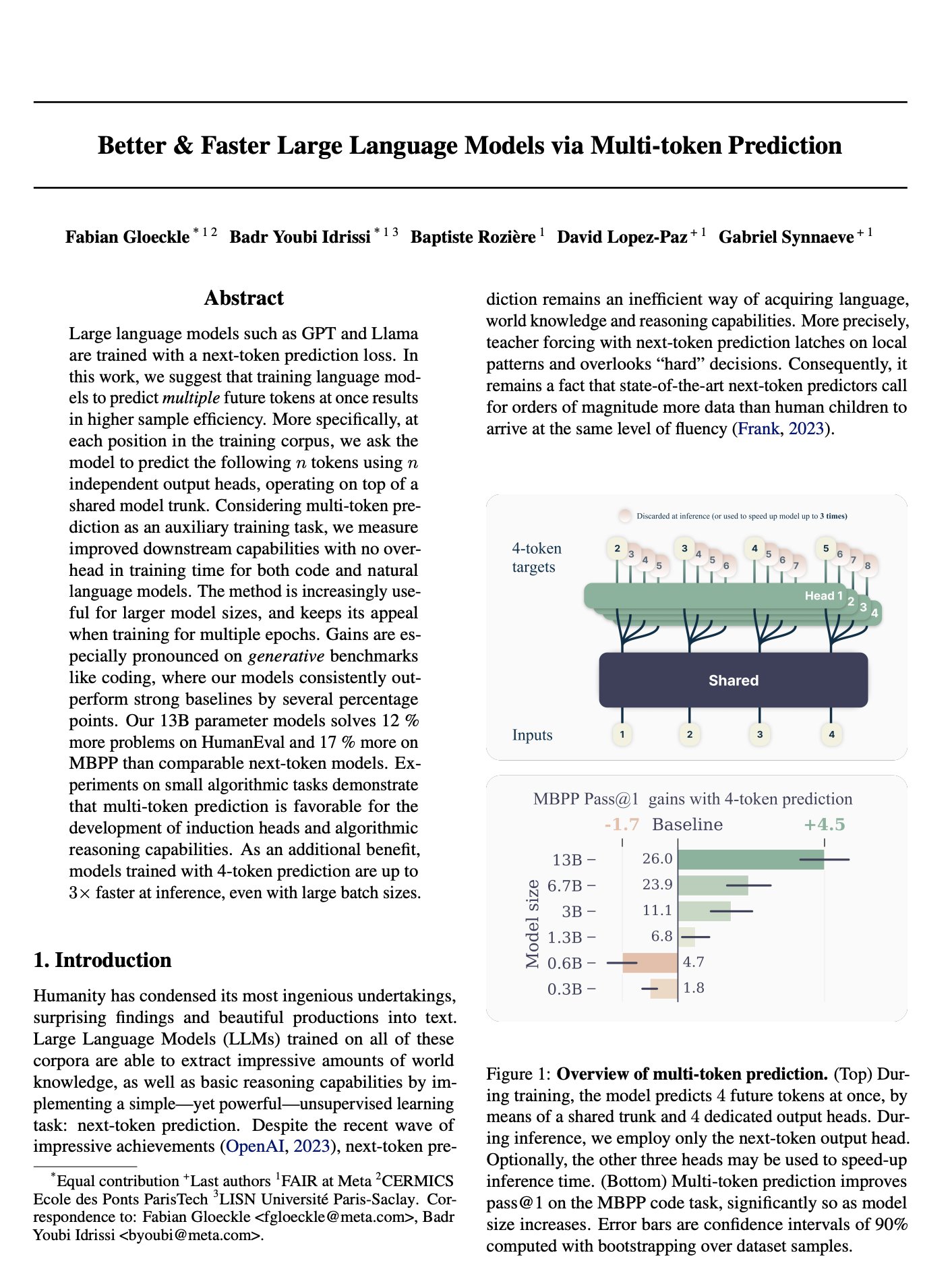
AI language models may predict multiple tokens at once
By
–
The future of AI language models may lie in predicting beyond the next word: Multi-Token Prediction Studies suggest that the human brain predicts multiple words at once when understanding language, utilizing both semantic and syntactic information for broader predictions – now
-
Efficient fine-tuning enables GPT-2 to approach GPT-4 performance
By
–
Most likely explanation for gpt2-chatbot: OpenAI has been working on a more efficient method for fine-tuning language models, and they managed to get GPT-2, a 1.5B parameter model, to perform pretty damn close to GPT-4, which is an order of magnitude larger and more costly to