The SSL cookbook features insights from more than a dozen authors from @NYUTandon
, @umiacs
, @UCDavis
, @UMontreal + Meta AI researchers, such as @ylecun We’re excited to share this with the community as part of our effort to lower barriers + democratize access to SSL research.
@aiatmeta
-
SSL Cookbook: Collaborative Research for Democratizing Self-Supervised Learning
By
–
-
SSL Cookbook: Practical Guide to Self-Supervised Learning
By
–
Self-supervised learning underpins today’s cutting-edge work across natural language, computer vision & more — but it’s an intricate art with high barriers to entry. Today we're releasing the SSL Cookbook, a practical guide for navigating SSL + contributing to this space
-
DINOv2: Meta’s Self-Supervised Vision Model Breakthrough
By
–
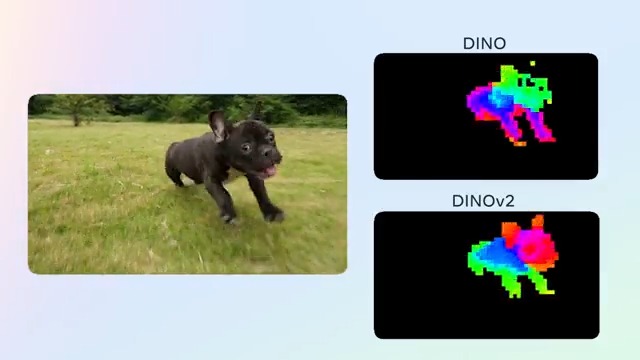
DINOv2 by Meta AI is the first method for training computer vision models that uses self-supervised learning to achieve results matching or exceeding industry standards. More details and a demo
-
Meta Open-Sources Animated Drawings Code and Dataset
By
–
ICYMI, we open-sourced the code for our animated drawings work + released a first-of-its-kind dataset of annotated amateur drawings to help researchers keep innovating in this space. Access the code & dataset
-
DINOv2 Open-Source Release with Interactive Demo Available
By
–
Want to explore DINOv2 for yourself? Today we're releasing both the open-source code and an interactive demo. GitHub https://
bit.ly/40eMPxk
Demo https://
bit.ly/3KHBnVa -
DINOv2 Complements Computer Vision Work Beyond Segmentation
By
–
DINOv2 complements our other computer vision work, such as Segment Anything. While SAM is a promptable system focused on zero-shot generalization to diverse segmentation tasks, DINOv2 uses simple linear classifiers to achieve strong results across tasks beyond segmentation.
-
AI Models Map Forests Tree-by-Tree Across Continents
By
–
Models like this will be useful in a wide variety of applications. For example, we recently collaborated with @RestoreForward to use AI to map forests, tree-by-tree, across areas the size of continents. pic.twitter.com/T2we4cqTa4
— AI at Meta (@AIatMeta) 17 avril 2023Models like this will be useful in a wide variety of applications. For example, we recently collaborated with @RestoreForward to use AI to map forests, tree-by-tree, across areas the size of continents.
-
Meta Releases DINOv2: Self-Supervised Computer Vision Model
By
–
Announced by Mark Zuckerberg this morning — today we're releasing DINOv2, the first method for training computer vision models that uses self-supervised learning to achieve results matching or exceeding industry standards.
— AI at Meta (@AIatMeta) 17 avril 2023
More on this new work ➡️ https://t.co/h5exzLJsFt pic.twitter.com/2pdxdTyxC4Announced by Mark Zuckerberg this morning — today we're releasing DINOv2, the first method for training computer vision models that uses self-supervised learning to achieve results matching or exceeding industry standards. More on this new work https://
bit.ly/3GQnIKf -
Tactile Diffusion: Bridging Sim2Real Gap in Tactile Sensing
By
–
Tactile Diffusion generates synthetic tactile images from sim data, capturing the complex illumination of the gel deformation. This research from UW & Meta AI is the first method using diffusion to close the sim2real gap for vision-based tactile sensing.
— AI at Meta (@AIatMeta) 14 avril 2023
Read the paper ⬇️Tactile Diffusion generates synthetic tactile images from sim data, capturing the complex illumination of the gel deformation. This research from UW & Meta AI is the first method using diffusion to close the sim2real gap for vision-based tactile sensing. Read the paper
-
Open-sourcing Animation Demo and 180K Drawing Dataset for Researchers
By
–
In 2021, we created a research demo that brought amateur drawings to life through animation — today, we're open-sourcing the code + releasing a first-of-its-kind dataset of nearly 180K annotated amateur drawings to help researchers keep innovating in this space.
— AI at Meta (@AIatMeta) 13 avril 2023
More details ⬇️In 2021, we created a research demo that brought amateur drawings to life through animation — today, we're open-sourcing the code + releasing a first-of-its-kind dataset of nearly 180K annotated amateur drawings to help researchers keep innovating in this space. More details