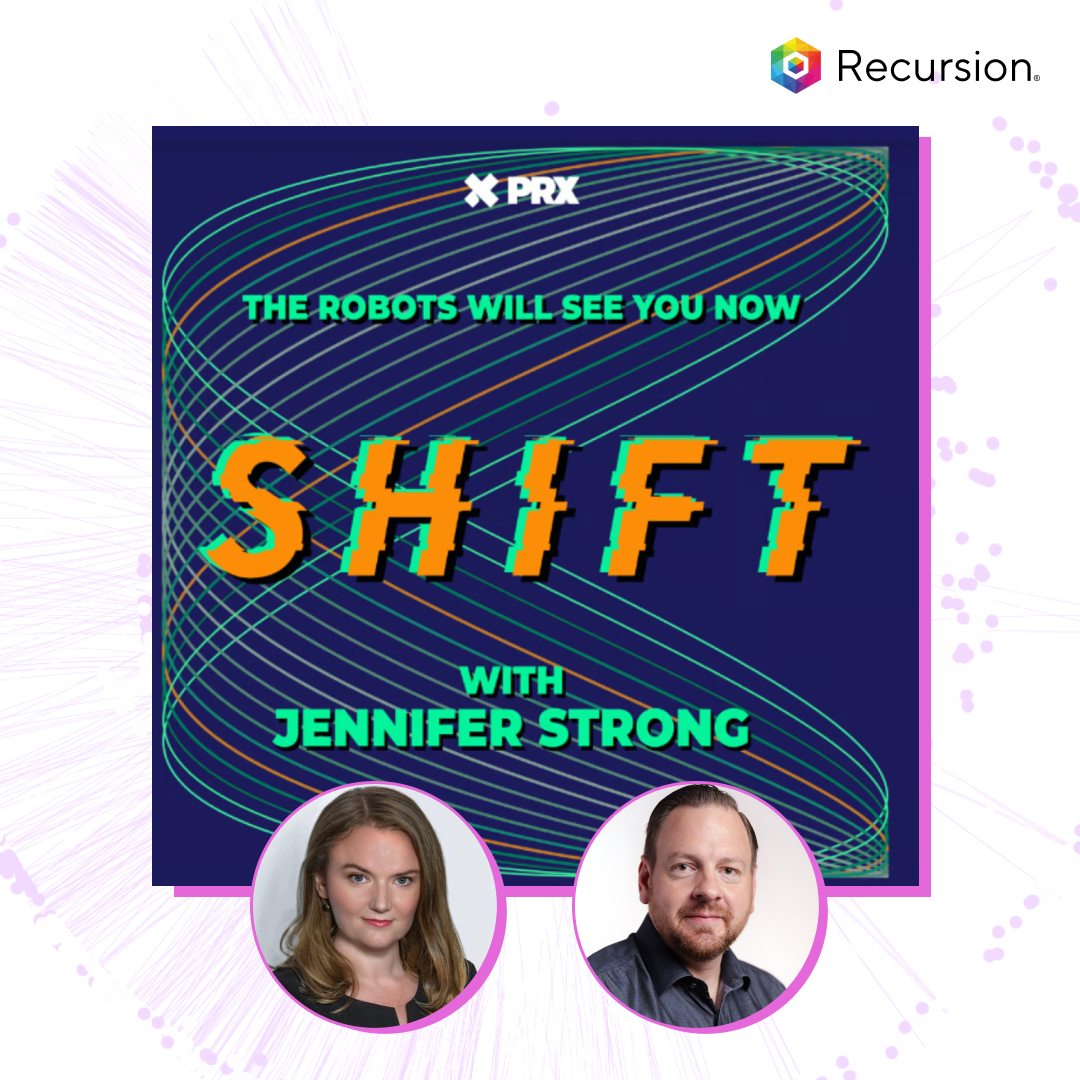
Recently, @StrongReporter, host of the SHIFT podcast, visited Recursion’s Salt Lake City headquarters to get a “peek behind the curtain” at our automated labs in action. She talked with cofounder and CEO @RecursionChris about the recent explosion of TechBio companies, biology’s incredible complexity, the benefits of robots, and what’s required to run an industrialized end-to-end drug discovery company at scale. 🔹 Some highlights: ▪️ On pharma’s TechBio transition “This is a multi-trillion dollar industry. About a decade ago there was a set of 6-10 upstarts that wanted to use things like ML or AI to try and discover medicines better. Today there are probably 400-500 of these companies, most of them still very early stage. Recursion is one of the very few of that original wave of companies.” ▪️ On biology’s complexity “Inside of each of us we have trillions of cells, and inside every one of those cells, we've got about 20,000 genes that are expressing about 400,000 different proteins, and there are trillions of interactions of all of those 400,000 proteins. So it is wildly complex, and that's the problem…Today, 90% of drugs that go into clinical trials fail, and it's not because there aren't really smart scientists working on the problem, it's because they're working against this incredible complexity.” ▪️ On enlisting robots “We envisioned a company where we could use robots to generate massive quantities of data, and we could use machine learning and AI to take all of that data and distill it down to find the patterns that actually tell us how biology works so that we could go from failing 90% of the time in clinical trials to maybe failing 80% of the time. I tell the team ‘If we could go to 80% failure rate, we would be twice as efficient as the industry, and you could theoretically cut the price of medicines in half.’” ▪️ On the lab in action “This facility full of robots and a handful of people is doing the equivalent of my entire PhD's worth of data generation about every 15 minutes… You see all of these different workstations, all of these different lights, little arms moving plates around, and this system is running about 20 hours a day, 7 days a week, 50 weeks a year. It's really more like an advanced manufacturing facility than it is like a traditional research lab.” 👉 Listen to the full conversation here: play.prx.org/listen?ge=prx_3…
→ View original post on X — @strongreporter, 2025-05-27 13:23 UTC