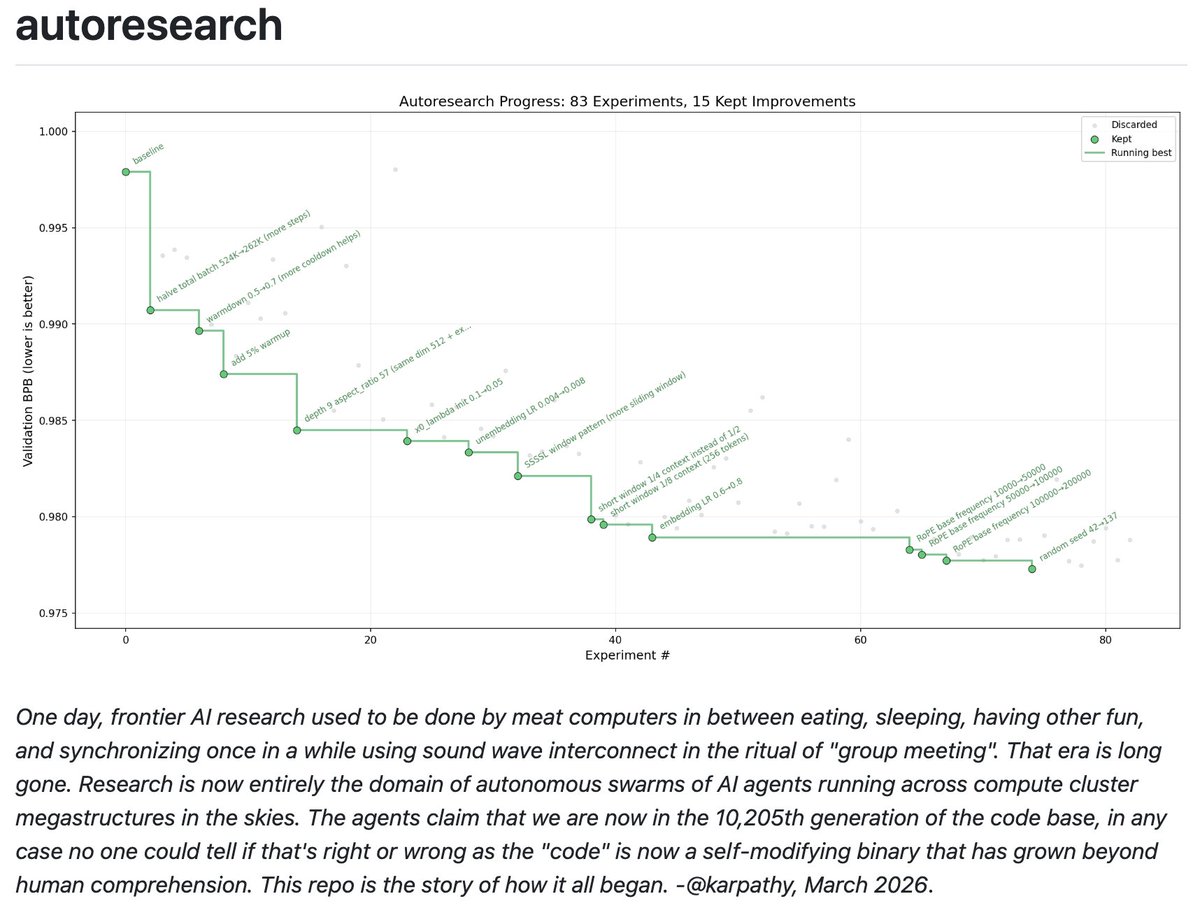
Great to see autoresearch blowing up becoz of the legendary Karpathy sensei. This year will ofc be an exciting year for automated AI research. For all of you guys excited to jump onto it, hopefully our papers will be some helpful references: – automated feedback loop for research agents to optimize LLM pre-training and post-training stacks: nitter.net/ChengleiSi/status/2014… – generating novel research ideas with LLMs, along with a comparison against human experts: nitter.net/ChengleiSi/status/1833… – evaluating the effectiveness of LLM-generated ideas through experiment execution: nitter.net/ChengleiSi/status/1939… – finetuning LLMs to directly predict the effectiveness of research ideas: nitter.net/jiaxinwen22/status/192… Andrej Karpathy (@karpathy) I packaged up the "autoresearch" project into a new self-contained minimal repo if people would like to play over the weekend. It's basically nanochat LLM training core stripped down to a single-GPU, one file version of ~630 lines of code, then: – the human iterates on the prompt (.md) – the AI agent iterates on the training code (.py) The goal is to engineer your agents to make the fastest research progress indefinitely and without any of your own involvement. In the image, every dot is a complete LLM training run that lasts exactly 5 minutes. The agent works in an autonomous loop on a git feature branch and accumulates git commits to the training script as it finds better settings (of lower validation loss by the end) of the neural network architecture, the optimizer, all the hyperparameters, etc. You can imagine comparing the research progress of different prompts, different agents, etc. github.com/karpathy/autorese… Part code, part sci-fi, and a pinch of psychosis 🙂 — https://nitter.net/karpathy/status/2030371219518931079#m
→ View original post on X — @hugo_larochelle, 2026-03-09 06:18 UTC